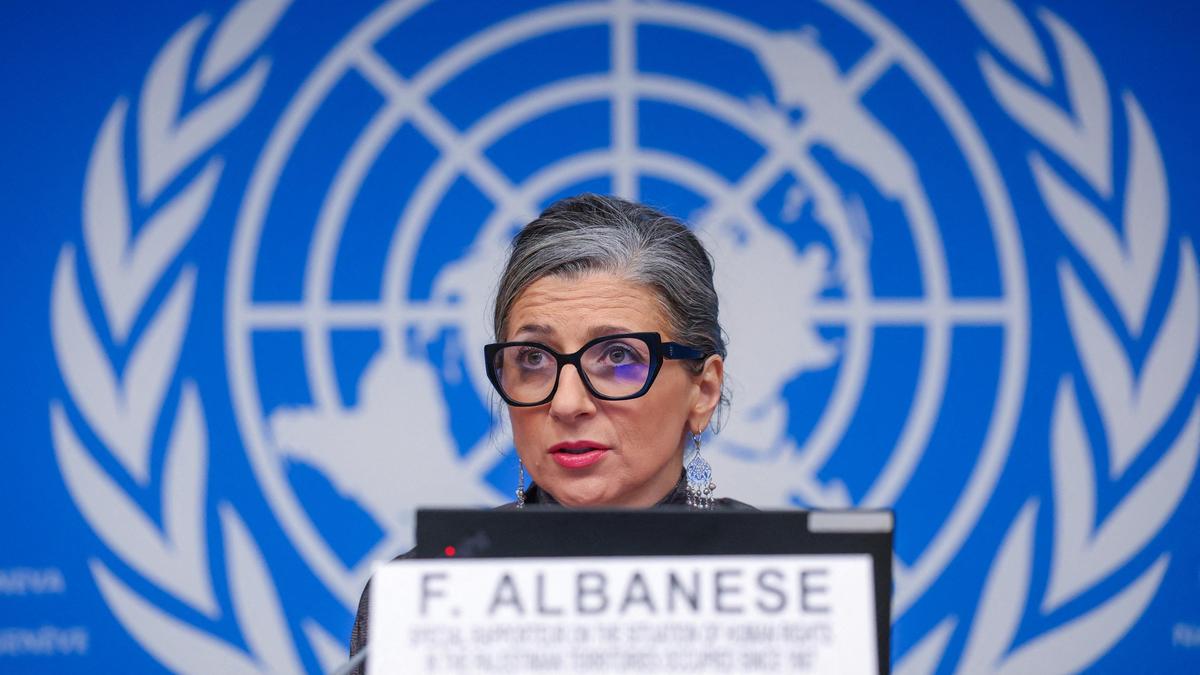
India’s foreign policy is at a crossroads that many in New Delhi don’t want to talk about. For decades, the country managed a delicate balancing act between its historical support for Palestinian statehood and its growing strategic partnership with Israel. But that middle ground is shrinking fast. UN Special Rapporteur Francesca Albanese recently sent a shockwave through the diplomatic circuit by suggesting that India is violating its obligations under international law. It’s a heavy accusation. It’s also one that carries massive implications for India’s global standing as a leader of the Global South.
When a UN expert of Albanese’s stature points a finger at India’s arms exports and its silence on certain humanitarian issues, it isn't just noise. It’s a formal challenge to the "Vishwa Mitra" (friend of the world) narrative the current administration promotes. If you’ve been following the news, you know the rhetoric is usually about "de-hyphenating" the relationship between Israel and Palestine. Basically, India tries to deal with both separately. Albanese argues that you can't just ignore the legal reality of an occupation while shipping weapons used to maintain it. Meanwhile, you can read related events here: The Dragon and the Tiger Dance Across the Sea.
The legal trap of arms exports
The core of the argument centers on the Arms Trade Treaty and the Genocide Convention. International law isn't a suggestion. It’s a set of rules that states agree to follow. When there’s a "plausible risk" of genocide—a term used by the International Court of Justice (ICJ) regarding the situation in Gaza—every signatory has a duty to prevent it. Albanese’s point is straightforward. If India is exporting weapons, components, or drones to Israel during an active conflict where international humanitarian law is being breached, India becomes legally vulnerable.
You don’t have to be a lawyer to see the tension here. India has become a significant hub for manufacturing Israeli-designed defense equipment. Joint ventures between Indian firms and Israeli defense giants are common now. We aren't just talking about buying missiles anymore. We're talking about making them. Albanese is flagging that by continuing these exports, India risks being complicit in the very acts the ICJ warned against. It's a massive shift from India’s traditional stance. To see the bigger picture, check out the recent article by NPR.
Why the Global South is watching
India wants a permanent seat on the UN Security Council. To get there, you need the trust of the developing world. For a long time, India was the voice of the oppressed. It was the first non-Arab country to recognize the Palestine Liberation Organization (PLO) as the sole legitimate representative of the Palestinian people. That legacy still matters in Africa, Southeast Asia, and Latin America.
When Albanese speaks about India’s violations, she’s speaking to that legacy. She’s essentially asking if India has traded its moral leadership for tactical military gains. If the rest of the Global South sees India drifting away from international legal standards to protect a bilateral partnership, India's claim to lead the "Global South" starts to look pretty thin. You can't lead the neighborhood if you're ignoring the rules of the road that protect everyone.
The hypocrisy of selective internationalism
There’s a clear frustration in Albanese’s critique regarding how India applies international law. New Delhi is often quick to cite international norms when it comes to border disputes or maritime security in the Indo-Pacific. It’s right to do so. Rules keep the peace. But you can't pick and choose which parts of the UN Charter you like.
Albanese isn't just picking on India. She’s been vocal about many Western nations too. However, the stakes for India are different. Western nations don't usually claim to be the moral alternative to the old world order. India does. By staying quiet or continuing military cooperation during a crisis that the UN has described as "catastrophic," India is signaling that its commitment to the "rules-based order" stops where its defense contracts begin.
What the ICJ ruling changed for New Delhi
Before January 2024, India could arguably hide behind the complexity of the conflict. After the ICJ issued provisional measures against Israel, the legal floor moved. The court didn't say genocide was happening, but it said there was a plausible risk. That tiny word "plausible" changes everything for third-party states like India.
It triggers the duty to prevent. It means "business as usual" is no longer a valid legal defense. If India ignored these warnings, it would find itself on the wrong side of a future legal reckoning. Albanese highlighted that India’s domestic laws and its international commitments are now in direct conflict. You can't claim to support a two-state solution while providing the hardware that makes such a solution geographically impossible through the expansion of settlements and military control.
Breaking the silence on human rights
Francesca Albanese has been a polarizing figure, sure. Critics often accuse her of bias. But look at the facts she presents. She points to the use of Indian-made drones and parts in conflict zones. She points to the diplomatic cover provided by abstentions at the UN. These aren't opinions. These are documented actions.
India’s Ministry of External Affairs usually responds to these critiques by saying they support "peace and stability." Honestly, it’s a canned response. It doesn't address the specific legal challenges raised by the UN rapporteur. When you're a major power, "no comment" is a comment. It’s a choice.
The cost of ignoring the UN rapporteur
Ignoring a UN Special Rapporteur might work in the short term. But these reports build a paper trail. They influence the voting blocks in the General Assembly. They shape the opinions of the next generation of global leaders. If India wants to be seen as a responsible global power, it has to engage with these criticisms rather than dismissing them as "external interference."
The reality is that India's dependency on Israeli tech is real. It’s a vulnerability. But is it worth the long-term damage to India's reputation? Albanese doesn't think so. She’s pushing for a return to a foreign policy that prioritizes the human rights of the occupied as much as the security of the occupier. It's a tough sell in today's cynical geopolitical climate, but it’s the only path that keeps international law from becoming a dead letter.
The shift in Indian public opinion
It’s also worth noting that the Indian public isn't a monolith on this. While the government moves closer to Israel, large sections of the Indian population still feel a deep connection to the Palestinian cause. This isn't just about religion. It’s about the shared history of anti-colonialism.
When Albanese talks about international law violations, she’s tapping into a sentiment that still exists in Indian civil society. There’s a growing movement of activists and legal scholars within India asking the same questions. They want to know why their taxes are going into joint ventures that might be used for purposes they find morally reprehensible. The government’s pivot is out of sync with a significant portion of its own history.
Immediate steps for a legal course correction
India needs to audit its defense exports immediately. That’s the first step. You can't claim to be a neutral player if you’re a primary supplier. Transparency is the only way to kill the accusations of complicity.
Second, New Delhi should stop abstaining on critical human rights votes. If the goal is a two-state solution, then you have to vote for the measures that make that solution possible. Silence isn't a strategy. It's an abdication.
Finally, India needs to invite UN experts like Albanese for an open dialogue. Shutting the door only makes the accusations look more credible. If there’s nothing to hide, then there’s no reason to fear a report. A confident India would face these questions head-on. A defensive India just proves the critics right.