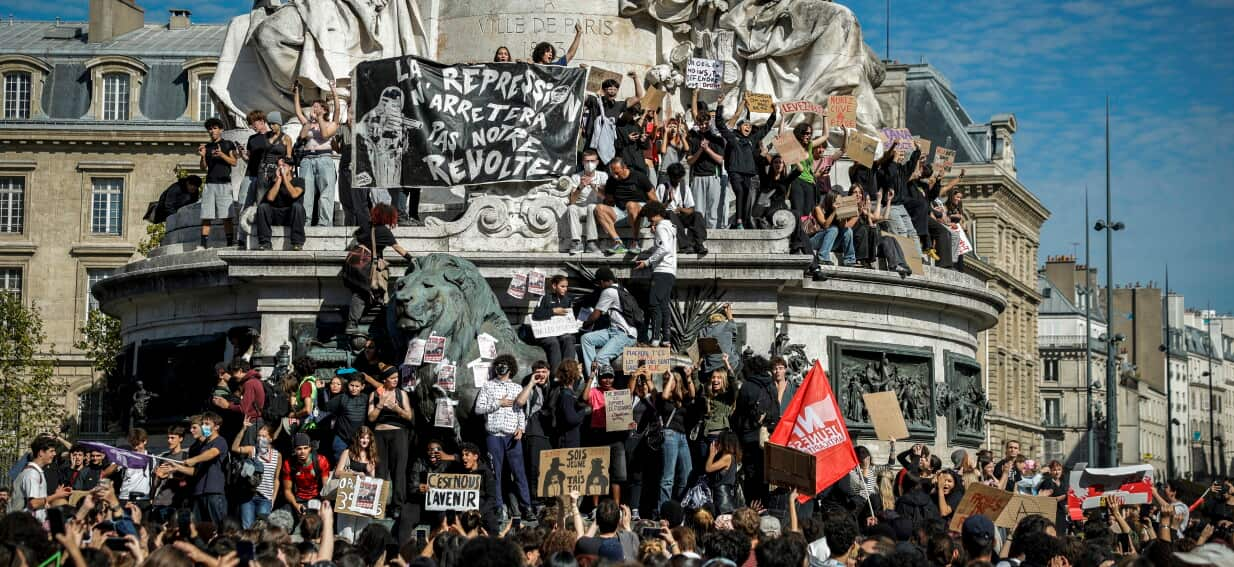
Every time tear gas fills the air around a Parisian lycée and teenagers start flipping bins, the global press rolls out the same tired script. Headlines scream about crumbling public infrastructure, underfunded classrooms, and the generational clash between rebellious youth and out-of-touch bureaucrats. Commentators shake their heads over decaying chalkboards and teacher shortages, mourning the supposed death of the egalitarian French republic.
It is a comfortable narrative. It requires zero cognitive effort. And it is entirely wrong.
The hundreds of arrests and burning barricades outside French high schools have almost nothing to do with education. If you think students are lighting fires because they care about class sizes or curriculum reforms, you have fallen for the grand illusion that adults project onto children.
I have watched from the inside as political factions treat teenagers as proxy infantry. Let us dismantle the lazy consensus.
The Proxy War Inside The Gates
To understand why French adolescents are occupying school gates, you have to look at who is actually organizing the logistics. Real organic rage does not print professionally laminated banners overnight, nor does it distribute matching megaphones with synchronized chants.
The structural mechanics of French student protests rely on unionized youth wings and political operatives who treat high schools as free staging grounds. When reforms hit the national assembly—whether pension adjustments, administrative digitization, or evaluation standards—adult political machines lack the street muscle to cause immediate economic disruption. Adults have mortgages, employment records, and tax bills. Teenagers do not.
Using minors as a human shield is a masterclass in political outsourcing.
When police lines form, the optical cost of a baton strike against a forty-year-old union worker is high. The optical cost of a skirmish involving a sixteen-year-old in a puffer jacket is catastrophic for any sitting administration. The students occupying the courtyards are not fighting for pedagogical autonomy; they are serving as the shock troops for labor disputes that began in corporate boardrooms and government ministries miles away.
We pretend this is an educational crisis because society prefers to view youth unrest through a romanticized lens of adolescent angst. We want to believe that young people are naturally revolutionary, rebelling against the constraints of knowledge itself.
The truth is far more cynical.
The Myth Of The Equal Classroom
The underlying grievance is rarely what is being taught inside the building. It is about what happens after the bell rings.
France clings to a foundational myth that every school delivers the exact same republican equality. The rhetoric claims that a child in a grim northern banlieue receives the exact same intellectual foundation as a child in the sixth arrondissement of Paris.
That is an administrative fiction.
Anyone who has spent time auditing institutions across different départements knows the stark reality. Teacher allocation is broken. The most experienced instructors systematically game the system to avoid high-friction zones, leaving novice teachers to handle chaotic environments with zero administrative backing.
Yet, when student unions mobilize, they studiously avoid demanding merit-based pay for teachers who take on difficult assignments, or radical administrative decentralization that would break the bureaucratic stranglehold of the Ministry of National Education. Why? Because touching the sacred cow of centralized state control goes against the dogma of the unions pulling the strings.
Instead, the demands focus on symbolic concessions. More funding into a black hole of administrative waste. Delayed exams. Lowered standards disguised as progressive compassion.
Lowering the bar does not bridge the achievement gap; it simply ensures that everyone trips over it together.
The Economics Of Burnout
Let us look at the financial mechanics underpinning these recurring riots. The French state spends an enormous percentage of its GDP on public education and social welfare. On paper, it looks robust. In execution, it is an administrative monolith optimized for employment generation for bureaucrats rather than cognitive output for students.
When budgets expand, money flows upward into supervisory committees, inspector general layers, and regional coordination offices. It rarely reaches the classroom floor. Teachers are chronically underpaid relative to their private sector equivalents with master's degrees, while the central apparatus grows ever heavier.
The teenagers burning trash cans outside the gates sense this dysfunction, even if they articulate it through the fog of teenage slogans. They know the credential they are chasing—the venerable baccalauréat—has been inflated into near-worthlessness. When everyone passes, the paper loses its signal value in the job market.
Instead of addressing the structural devaluation of credentials, the state responds with cosmetic adjustments. They tinker with grading curves. They ban mobile phones, as if a piece of plastic were the root cause of systemic apathy. Then, when students snap out of sheer boredom or economic anxiety about their future job prospects, the match is struck.
The Cost Of False Solutions
What happens when the smoke clears and the streets are hosed down? The government offers a familiar ritual. Concessions are whispered behind closed doors. A minor committee is formed. A minor minister goes on television to talk about "listening to the youth."
Nothing fundamental changes. The institutional rot remains untouched because fixing it requires political courage that no short-term administration possesses. Reforming French education means dismantling entrenched civil service protections, decentralizing hiring, and introducing accountability metrics that trade unions would strike over for months.
So, everyone settles back into the rhythm. The politicians buy temporary social peace. The unions keep their leverage for the next budget cycle. The students go back to classrooms that fail to prepare them for a hyper-competitive global economy.
Stop pretending these riots are a civic awakening. They are a recurring political tax paid in broken glass and tear gas, designed to protect a system that benefits everyone except the students trapped inside it. Until we have the stomach to dismantle the bureaucratic machine using these kids as leverage, expect the same fires next semester.


