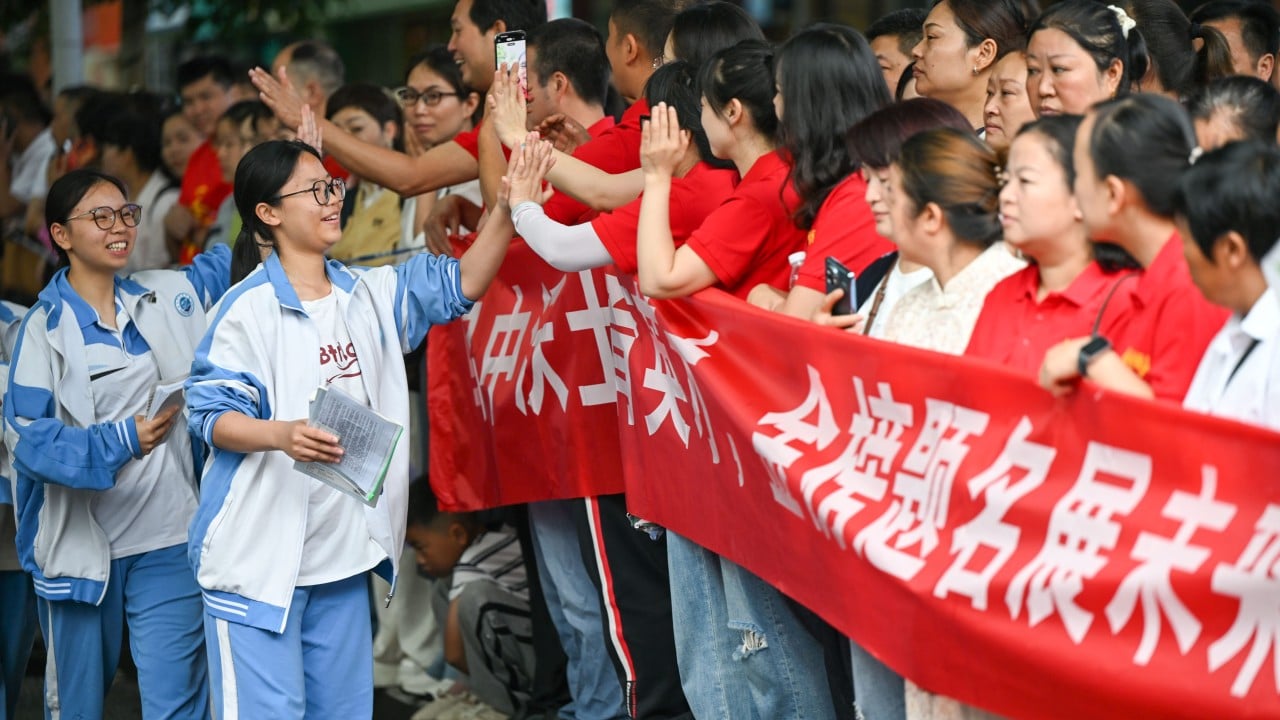
Western observers look at China’s national college entrance examination, the gaokao, and see a dystopian nightmare. They see ten million teenagers memorizing equations for twelve hours a day. They see police escorts for test papers and ambulances waiting outside exam halls. The standard narrative, repeated ad nauseam by mainstream education commentators, is that the gaokao is an antiquated, soul-crushing relic that stifles Chinese innovation and paralyzes its youth.
They are entirely wrong.
The lazy consensus views the gaokao as a broken educational tool. It is not. The gaokao is not actually an educational test; it is a hyper-efficient, cold-blooded sorting mechanism designed to maintain social stability and allocate human capital across a nation of 1.4 billion people. To judge the gaokao by how well it fosters "creativity" is like judging a particle accelerator by how well it bakes bread.
If China succumbed to Western pressure to abandon this brutal exam in favor of "holistic admissions," the Chinese economic engine would stall, and its meritocracy would collapse into rampant nepotism.
The Holistic Admissions Trap
Global education pundits love to push the idea of a holistic review. They argue that China should look at the whole student—extracurricular activities, leadership essays, letters of recommendation, and well-rounded profiles.
Let us look at what happens when you introduce holistic admissions into a society with massive regional wealth disparities.
I have spent years analyzing educational infrastructure and tracking how capital manipulates access. In a holistic system, the wealthy win every single time. A teenager in Shanghai’s wealthy Jing'an district can easily build a resume filled with cello lessons, international volunteer trips, and robotics clubs. Meanwhile, a brilliant kid in a rural village in Gansu province has access to nothing but a blackboard and a stack of textbooks.
The gaokao is the only thing standing between that rural student and total socioeconomic exclusion.
[Traditional System: Gaokao Score Only] -> Equal footing regardless of family wealth.
[Holistic System: Resumes, Sports, Essays] -> Heavy bias toward urban, wealthy elites.
The exam strips away privilege. The computer grading your multiple-choice sheet does not know if your father is a billionaire or a peasant farmer. It does not care if you have charisma or if you play the violin. It only cares if you can solve the advanced calculus problem in front of you.
By keeping the metric purely academic and strictly standardized, China prevents the kind of legacy-admission corruption that plagues Ivy League institutions in the United States. In the West, wealth buys access through donations and elite prep schools. In China, wealth can buy tutors, but it cannot buy the score. Dismantling the gaokao would instantly disenfranchise the rural poor, locking them out of the middle class forever.
The Innovation Paradox
A common critique from Western business schools is that rote memorization destroys the creative thinking required for a modern tech economy. The argument goes: because Chinese students spend their lives memorizing answers, China can only copy, not invent.
This argument is decades out of date.
Look at the global tech landscape. China leads the world in commercializing electric vehicles, drone technology, high-speed rail, and mobile payment infrastructure. Companies like BYD, DJI, and Tencent are not copycats; they are market dominant leaders.
How does a country supposedly crippled by a rote-memorization exam out-innovate its competitors in these sectors?
The answer lies in the mastery of fundamentals. The gaokao forces an entire generation to achieve a level of mathematical and scientific literacy that is virtually unmatched globally. To pass the quantitative sections of the gaokao, a student must possess a deep, intuitive grasp of hard sciences.
Creativity without competence is useless. A company does not build a solid-state battery or a generative AI model using vague notions of "out-of-the-box thinking." It builds them using rigorous engineering, endless iteration, and flawless execution. The gaokao builds the psychological resilience and cognitive stamina required for high-intensity engineering work. The grueling preparation teaches students how to handle extreme stress and manage cognitive loads that would break the average Western undergraduate.
The Brutal Truth of Human Capital Allocation
Let us address the "People Also Ask" obsession: Is the gaokao fair?
No, it is not perfectly fair. Beijing residents have lower score thresholds for entering elite institutions like Tsinghua and Peking University than students from Henan province. This regional quota system is a legitimate flaw, driven by internal political dynamics.
But asking if the gaokao is fair misses the broader economic reality. The real question is: What is the alternative for a country with 1.4 billion people?
Imagine a scenario where China switches to a subjective selection process. With hundreds of millions of citizens competing for a limited number of elite university spots, the room for bureaucratic corruption would be catastrophic. Every university admissions office would become a marketplace for bribes, favors, and political leverage.
The gaokao prevents this chaos by acting as a transparent, unyielding firewall.
The Real Cost of the Exam
To be absolutely clear, this system has dark consequences. The psychological toll on Chinese youth is massive. The pressure creates a hyper-competitive environment that contributes to youth burnout and the social phenomenon known as involution (neijuan), where individuals exert immense effort for diminishing returns.
| Metric | Gaokao System | Western Holistic System |
|---|---|---|
| Primary Selection Criteria | Raw academic performance | Mixed (Grades, Wealth, Legacy, Extracurriculars) |
| Vulnerability to Corruption | Extremely low | High (Legacy admissions, donations) |
| Socioeconomic Mobility | High for rural high-achievers | Low for low-income students |
| Psychological Cost | Extremely High | Moderate to High |
This is the trade-off. China has chosen collective economic efficiency and structural stability over individual psychological comfort. The state requires an orderly way to filter its population into tiers of labor, and the population accepts the exam because it remains the most transparent game in town.
Stop Exporting Western Educational Ideology
For years, Western consultants have tried to sell China on the idea of educational liberalization. They urge schools to reduce homework, cut down on testing, and focus on happiness.
Every time a Chinese school district flirts with these ideas—often called "素质教育" or quality education—parents revolt. Why? Because middle-class and working-class parents know that if the school stops drilling their children, they will fail the exam, while wealthy parents will simply hire private squads of tutors to do the drilling at home.
Educational liberalization is a luxury good. It works well for societies that have already accumulated massive generational wealth and can afford to let their elites pursue humanities degrees while importing technical talent from abroad. China does not have that luxury. It cannot rely on immigration to fill its engineering gaps; it must manufacture its own technical elite at scale.
The gaokao is China’s talent refinery. It takes millions of raw minds, subjects them to immense pressure, and extracts the purest technical talent to run the world's second-largest economy.
Stop looking at the exam through a lens of Western individualism. The gaokao is not going anywhere, because without it, the entire Chinese meritocratic system falls apart.


