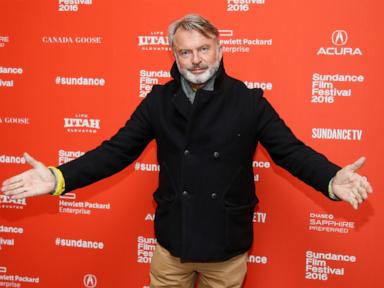
He did not look like a movie star. If you met him walking the dirt tracks of Central Otago in New Zealand, wearing a battered woolen jersey and holding a bucket of feed, you would have taken him for a quiet, slightly distracted sheep farmer. He was happier there anyway, among the vines of his vineyard, Two Paddocks, talking to his farm animals. He named them after his famous friends. There was a cow named Laura Dern, a ram named Jeff Goldblum, and a chicken named Meryl Streep.
That was Nigel John Dermot Neill. The world, of course, knew him as Sam.
On July 13, 2026, the quiet came for him. He was 78.
The headlines flashed the clinical details: a sudden and unexpected death in Sydney, years after a public, hard-fought battle with a rare non-Hodgkin lymphoma. The dry post-mortems of the internet listed his filmography like an inventory in a warehouse. They noted his box office receipts, his Emmy nominations, his three Golden Globe nods. They ticked off Jurassic Park, The Piano, The Hunt for Red October, and Peaky Blinders.
But to look at Sam Neill through the lens of a resume is to miss the entire point of the man.
To understand who we actually lost, you have to look at the people who are left standing in the quiet he left behind. You have to look at the collective intake of breath from the people who shared his spaces, who drank his Pinot Noir, and who watched him turn a chaotic, ego-driven industry into something that felt, for a moment, like a family.
Consider Steven Spielberg. In 1993, Spielberg was trying to bring dinosaurs back to life. He needed an anchor. He needed someone who could stand in front of a green screen—long before green screens were sophisticated—and make us believe, through sheer, unvarnished awe, that a Brachiosaurus was chewing leaves thirty feet in the air.
He chose Sam.
Spielberg remembered the sheer irony of that casting. In the film, Dr. Alan Grant is a gruff, reluctant hero who openly detests children, muttering about how they are messy and smelly.
"It was a stretch for him," Spielberg recalled.
The real Sam Neill was a father of four. He was a man who practically vibrated with warmth, whose real-life gentleness made the grumpy paleontologist a work of pure, counter-intuitive acting. Spielberg did not just lose a leading man; he lost a piece of the "Jurassic family" that has kept those films alive in the cultural memory for over three decades.
Then there is Nicole Kidman.
Before the Oscars, the Chanel No. 5 campaigns, and the global superstardom, she was an eighteen-year-old girl terrified on the set of a psychological thriller called Dead Calm. The ocean was vast, the shoot was intense, and she was young. Neill, already established, did not ignore her or retreat to his trailer. He took her under his wing.
"We stayed friends for life," Kidman said. Her grief is not for a co-star who helped launch her career, but for the man who made a scary, predatory industry feel safe when she was barely an adult.
And then there are those who met him much later, when his hair had turned silver and his presence carried the weight of an elder statesman. Cillian Murphy, who squared off against Neill’s corrupt, sadistic Chief Inspector Chester Campbell in Peaky Blinders, spoke of him with a reverence that actors rarely afford one another. On screen, they were bitter, violent enemies. Off screen, Murphy found "one of the kindest, funniest, and gentlest people" he had ever encountered in the trade.
How does a man maintain that kind of soul in Hollywood?
Perhaps because he never quite belonged to it. Neill was born in Northern Ireland and raised in New Zealand. He failed his first year of law school because he was too busy acting in university plays. He started his career when there was barely a domestic film industry in New Zealand to speak of. He helped build it, block by block, project by project, carrying local stories to the global stage without ever losing the dirt-under-the-fingernails sensibility of his home island.
When the COVID-19 pandemic shut down the world and trapped everyone in their homes, most celebrities retreated behind high gates and security details.
Not Sam.
He sat on his porch with a ukulele. He posted videos of himself singing to his pigs, chatting with his sheep, and showing off his latest bottle of wine. He became a digital hearth for millions of terrified people. He was the grandfatherly figure telling us that the world was still beautiful, that the soil was still there, and that the vines would still grow.
Even when he was diagnosed with stage-three blood cancer in 2022, he refused to let the darkness dominate his story. He wrote a memoir. He kept working. He went into remission, announced he was cancer-free, and got back to his vineyard. His family took pains to note that when he passed, he was still free of the disease. The cancer didn't beat him. He went out on his own terms, suddenly, unexpectedly, but with "the dignity that has characterized his whole life".
The industry will continue. There will be more dinosaur movies, more crime dramas, more red carpets.
But tonight, in the quiet valleys of Central Otago, the wind is blowing through the vines of Two Paddocks. The sheep are in their pens. And around the world, some of the most famous people on earth are raising a glass of red wine, looking at the stars, and remembering a man who was far too decent to ever be just a movie star.