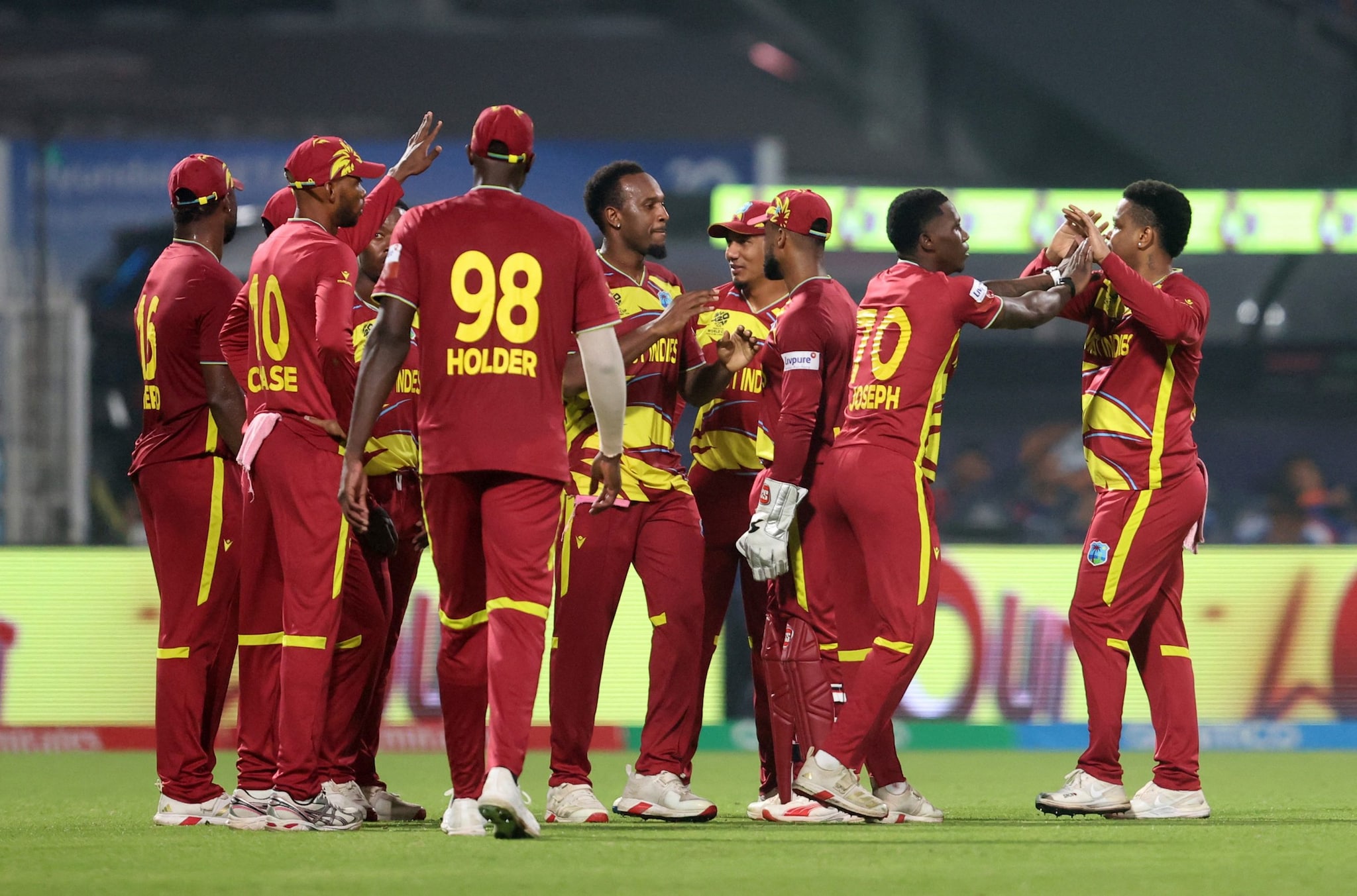
The stranding of the West Indies cricket team in Kolkata following their T20 World Cup exit serves as a high-profile case study in the fragility of global logistics when intersected by regional kinetic conflict. While surface-level reporting focuses on the inconvenience to athletes, a structural analysis reveals a deeper failure in "buffer-state" logistics and the inability of commercial aviation protocols to adapt to rapid-onset airspace closures. The situation highlights a critical bottleneck: the dependency of international sporting calendars on narrow, high-efficiency transit corridors that lack redundancy in the face of military escalation in the Middle East.
The Mechanism of Airspace Contraction
The primary driver of the West Indies’ delay was not a lack of available aircraft, but the sudden contraction of viable flight paths. When Israeli-Iranian tensions escalate into direct kinetic strikes, the immediate result is the issuance of NOTAMs (Notices to Air Missions) that effectively "delete" thousands of square miles of usable sky.
For a team traveling from India to the Caribbean or North America, the standard Great Circle routes typically utilize Persian Gulf hubs (Dubai, Doha, Abu Dhabi) or Western European corridors. When the airspace over Iran and Iraq is compromised, the "funnel effect" forces all east-west traffic into narrow lanes over Saudi Arabia or Turkey. This creates a secondary logistics failure: fuel-to-payload ratios. Flights must carry significantly more fuel to circumvent conflict zones, often necessitating unplanned technical stops or the offloading of cargo—including team equipment—to maintain safe takeoff weights.
The Three Pillars of Contingency Failure
The West Indies’ situation can be deconstructed into three specific failure points within the team’s operational strategy.
- Hub Dependency Risk: By routing through regions with high geopolitical volatility, the athletic federation accepted a "Single Point of Failure" (SPOF). Most T20 World Cup logistics are optimized for cost and transit time rather than route elasticity.
- Carrier Reciprocity Limits: During periods of mass disruption, airline alliances (e.g., Star Alliance, One World) prioritize high-yield commercial passengers over group bookings. Professional sports teams, despite their visibility, often travel on group contracts that lack the "guaranteed rerouting" clauses found in premium corporate travel tiers.
- Visa and Transit Sovereignty: A team stranded in a third-country hub (like Kolkata or a Middle Eastern transit point) faces the "Diplomatic Wall." Players holding various Caribbean passports may have visa-free access to their destination but lack the immediate transit visas required if they are forced to stay in an unplanned city for more than 24 hours due to flight cancellations.
The Cost Function of Elite Athlete Stranding
Beyond the immediate financial burden of rebooking, there is a quantifiable "Performance Decay" associated with extended transit delays. For elite cricketers, the recovery period from long-haul travel is calculated using a standard ratio of one day per time zone crossed. When a 20-hour transit turns into a 72-hour delay in a hotel, the physiological cost includes:
- Circadian Misalignment: The disruption of cortisol rhythms, which directly impacts reaction time—a critical metric in T20 cricket.
- Hyper-sedentary Stress: Extended periods in transit lounges or hotel rooms lead to muscle stiffness and reduced joint mobility, increasing the risk of soft-tissue injury upon the resumption of training.
- Psychological Attrition: The transition from the high-arousal environment of a World Cup to the "limbo" of a stranded state creates a rapid drop in dopamine, often resulting in mental fatigue that carries over into the next domestic or international series.
Geopolitical Realism in Sports Scheduling
The intersection of the T20 World Cup exit and the Israel-Iran escalation is not a coincidence of bad luck, but a predictable risk in a multipolar world. Logistics managers for major sporting bodies (the ICC, in this instance) must now account for "Kinetic Probability" when booking travel.
The standard model of "Shortest Path" logistics is no longer viable for high-value human assets. Instead, a "Resilient Path" model must be adopted. This involves:
- Bypassing Volatile Corridors: Opting for longer, southern routes (e.g., via Johannesburg) or trans-Pacific routes, even if they increase the initial travel time by 15-20%.
- Charter Sovereignty: Moving away from commercial airline dependence for "Final Mile" or "Exit" legs of a tournament. A chartered aircraft provides the flexibility to change flight plans in real-time without being subject to the cascading delays of a commercial hub's passenger backlog.
Tactical Rebalancing for Athletic Federations
The West Indies’ experience in Kolkata demonstrates that the "Exit Strategy" is as vital as the "Competition Strategy." When a team is eliminated, the priority shifts from performance to extraction. The failure to have a pre-cleared secondary route out of the subcontinent reflects a lack of "Just-in-Case" (JIC) planning, which has been overshadowed by "Just-in-Time" (JIT) logistics.
The bottleneck in Kolkata was exacerbated by the specific timing of the Iranian strikes. As airspace closed, the demand for remaining seats on unaffected routes spiked 400% within a six-hour window. In this market environment, a sports team of 20-30 individuals (including support staff and heavy gear) becomes an unattractive "bulk" for airlines trying to maximize revenue by selling individual seats to desperate travelers.
The Geopolitical Risk Matrix for International Tours
To prevent a recurrence, organizations must categorize host nations and transit hubs based on a Risk Matrix that accounts for more than just weather or local strikes.
| Risk Factor | Impact on Team Movement | Mitigation Requirement |
|---|---|---|
| Airspace Sovereignty | Sudden closure of transit lanes. | Pre-negotiated "Overflight" rights for non-standard routes. |
| Hub Volatility | 24-48 hour groundings in transit cities. | Multi-entry transit visas secured 30 days prior. |
| Escalation Velocity | Rapid shift from "Clear" to "No-Fly" zones. | Real-time geopolitical intelligence monitoring. |
The reliance on Kolkata as a fallback point was a logical choice given the infrastructure, but it lacked the "Aviation Elasticity" required when the western exit routes were effectively severed. The team was caught in a "Logistics Pincer"—unable to go West due to missiles, and unable to go East due to the lack of pre-arranged trans-Pacific carrier agreements.
Strategic Recommendations for Future Extractions
The optimization of team travel in the current geopolitical climate requires a shift from administrative booking to strategic supply chain management.
Federations should immediately implement a "Shadow Itinerary" policy. This involves holding refundable, secondary bookings on geographically distinct routes (e.g., one route via Europe, one route via the Pacific). While this increases the upfront "Dead Capital" in the form of deposits, it eliminates the catastrophic cost of a stranded team, which includes hotel overheads, player per-diems, and the loss of training cycles.
Furthermore, contractual language with tournament organizers must be updated to include "Geopolitical Force Majeure" clauses that mandate the organizer to provide military-grade logistics support if commercial lanes fail. The responsibility for player safety and extraction cannot rest solely on the individual federation when the tournament is held in or near zones of potential kinetic escalation.
The final strategic play is the decoupling of "Team" and "Gear." By utilizing forward-deployed equipment sets or separate cargo-only transit lines, the human element (the players) becomes more agile. A team that only needs 15 seats on a diverted flight is 300% more mobile than a team that requires 15 seats plus three tons of specialized cricket gear. Mobility is the only effective hedge against the narrowing of global airspace.
Federations must treat the "Logistics of Exit" with the same analytical rigor as they treat "Performance Analytics" on the field. The map is no longer static; travel strategy must become as dynamic as the game itself.