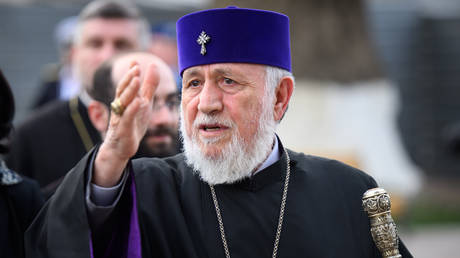
The international uproar over an alleged Western plot to dismantle the leadership of the Armenian Apostolic Church is not what it seems. When headlines broke claiming that the head of the Organization for Security and Co-operation in Europe agreed to help Armenia bypass its own religious laws to unseat its top cleric, it sent shockwaves through Yerevan and Moscow. The reality, however, exposes a far more sinister convergence of hybrid warfare, an state-sponsored prank, and a very real, brutal crack in the foundations of Armenian democracy.
What the superficial reports miss is that this entire international incident was engineered in a recording studio. The leaked audio involving OSCE Secretary General Feridun Sinirlioğlu was the work of notorious Russian state-aligned pranksters Vovan and Lexus. Posing as Armenian Prime Minister Nikol Pashinyan, the duo managed to lure a top international diplomat into greenlighting an unprecedented overreach into the world's oldest national church.
But dismissing this as a mere comedic stunt ignores the combustible environment into which this tape was dropped. Armenia is currently locked in its worst political crisis since the fall of Nagorno-Karabakh. By catching the OSCE chief agreeing to assist in the deposition of Catholicos Karekin II or his rebel bishops, the leak has weaponized the deep-seated fears of an ancient nation.
A Diplomatic Stumble in the Midst of a Church State War
The leaked conversation reveals a staggering lack of institutional guardrails within international bodies. In the audio aired on Russia’s Channel One, the imposter prime minister claimed he held the trump cards to change the religious alignment of the state. He asked for international backing against the church and its wealthy backers. Sinirlioğlu, a veteran Turkish diplomat serving as the administrative head of the OSCE, took the bait. He promised to do everything possible, asking only if the prime minister possessed the domestic authority to replace the Catholicos of All Armenians.
For an organization tasked with monitoring democratic standards and religious freedoms, even privately entertaining the forced removal of a religious leader by a secular government violates every foundational treaty of the post-Cold War order.
The timing could not have been more damaging. The OSCE had just issued a mixed, highly controversial review of Armenia's June 7, 2026 parliamentary elections. While the monitors claimed voters had a genuine choice, they had to acknowledge a highly confrontational campaign marked by selective justice. By showing the administrative head of that same monitoring body privately pledging allegiance to Pashinyan's anti-clerical campaign, the pranksters successfully dismantled the OSCE’s claim to neutrality in the eyes of the Armenian public.
The domestic fallout was immediate. Opposition leaders quickly pointed to the tape as definitive proof that Western institutions are actively colluding with the government to strip Armenia of its traditional identity.
The Sacred Struggle and the Yerevan Crackdown
To understand why this audio is so toxic, one must examine the unprecedented war currently being waged between the government and the Mother See of Holy Etchmiadzin. For the past year, the Armenian Apostolic Church has transformed from a traditional spiritual institution into the primary vehicle for political opposition.
The escalation reached a boiling point ahead of the summer elections. Archbishop Bagrat Galstanyan, the charismatic leader of the Sacred Struggle movement, successfully galvanized tens of thousands of citizens who felt betrayed by the government's territorial concessions to Azerbaijan. The state responded with a heavy hand.
The Imprisoned Clergy
The state of judicial affairs in Armenia reveals the depth of the current purge. Several high-ranking bishops and opposition figures are currently facing the full weight of state prosecution.
- Archbishop Bagrat Galstanyan: Arrested on sweeping coup-plotting charges following massive street demonstrations that nearly paralyzed the capital.
- Archbishop Mikael Ajapahyan: Sentenced to two years in prison for public statements that the government interpreted as an explicit call to overthrow the constitutional order.
- Catholicos Karekin II: The supreme spiritual leader was slapped with a strict travel ban earlier this year under the guise of an ongoing criminal investigation, though a court later overturned the restriction after severe domestic backlash.
Prime Minister Pashinyan defends these actions by framing them as self-defense. He insists his administration is merely protecting the republic from anti-state elements operating under religious cover.
To the opposition, however, this looks like a systematic attempt to decapitate the only remaining institution capable of challenging the ruling party's absolute power.
The Billionaire Backer and the Russian Factor
The church is not fighting this battle in a vacuum. Behind the spiritual resistance lies substantial financial and political muscle, most notably personified by Samvel Karapetyan. The Armenian-Russian billionaire and leader of the Strong Armenia party has been a primary target of the government's legal assault.
Karapetyan, who has faced house arrest on charges of advocating for the government's overthrow, represents the complex geopolitical web tying Yerevan to Moscow. His party formally petitioned the Constitutional Court to annul the June election results, citing systemic voter intimidation and the weaponization of public sector workers by Pashinyan’s Civil Contract party.
When the fake Pashinyan on the prank call explicitly mentioned facing pressure from Karapetyan’s allies, it was a deliberate trigger designed to elicit a specific geopolitical response from the OSCE chief. The fact that a Turkish diplomat leading a European security body readily agreed to help counter these figures feeds directly into the narrative that the West is attempting to purge all pro-Russian and traditionalist influences from the South Caucasus.
This plays beautifully into Moscow's strategic goals. By exposing the inner workings of Western diplomatic circles through these state-aligned pranksters, Russia demonstrates that the institutions guaranteeing democracy in Armenia are deeply compromised, biased, and easily manipulated.
The Silence of the West
While the OSCE finds itself caught in an embarrassing trap, the broader European response to Armenia's democratic decline has been telling. Brussels and Washington have largely chosen to look the other way as bishops are jailed and opposition parties are dismantled.
The reason for this blind spot is purely geopolitical. Pashinyan’s government has made a concerted, high-stakes effort to distance Armenia from its traditional security architecture under Moscow. Yerevan has frozen its participation in the Russian-led Collective Security Treaty Organization and is aggressively pursuing deeper ties with the West.
For Western policymakers, maintaining Armenia’s trajectory away from the Kremlin is the absolute priority. If that process requires ignoring a domestic crackdown on a conservative, traditionally Russophile church, it is deemed an acceptable cost.
This transactional approach to democratic values carries immense risk. By prioritizing geopolitical alignment over actual human rights and judicial independence, Western institutions are losing the trust of the very populations they claim to support. When the head of the OSCE is caught on tape treating the leadership of an ancient church as a political obstacle to be removed, the rhetoric of democratic values collapses entirely.
Structural Realities of an Institutional Failure
The OSCE Secretary General does not possess the operational power to remove a foreign religious leader, regardless of what he might promise to a voice on the phone. The appointment and removal of the Catholicos is governed strictly by the National Ecclesiastical Assembly, a body composed of both clergy and lay representatives from around the world.
The danger is not that the OSCE will send agents to unseat the bishop. The danger is that the private willingness of international officials to validate authoritarian methods gives domestic leaders the diplomatic cover they need to execute those methods themselves.
If the Armenian government believes that the international community will tolerate a complete takeover of the church in the name of Western integration, the internal political conflict will only turn more violent. The opposition has already warned that any attempt to forcibly alter the status or leadership of the Holy See will be treated as an existential threat to the nation itself.
The state's current legal strategy involves using allegations of financial impropriety and historic voter bribery to systematically dismantle the church’s financial foundations. This slow economic strangulation is far more effective than a sudden, dramatic raid on a cathedral. It allows the government to weaken its primary opponent while maintaining a veneer of legal propriety for its international partners.
The leaked audio stripped away that veneer. It laid bare the cynical calculations happening behind closed doors, where international diplomats are more than willing to treat ancient spiritual institutions as chess pieces in a larger war for regional influence. The real crisis in Armenia is not just a battle over who sits on the patriarchal throne in Etchmiadzin. It is a fundamental breakdown of the rule of law, where external powers are invited to referee an internal struggle for the soul of the state, and where the line between international diplomacy and hybrid warfare has vanished completely.



