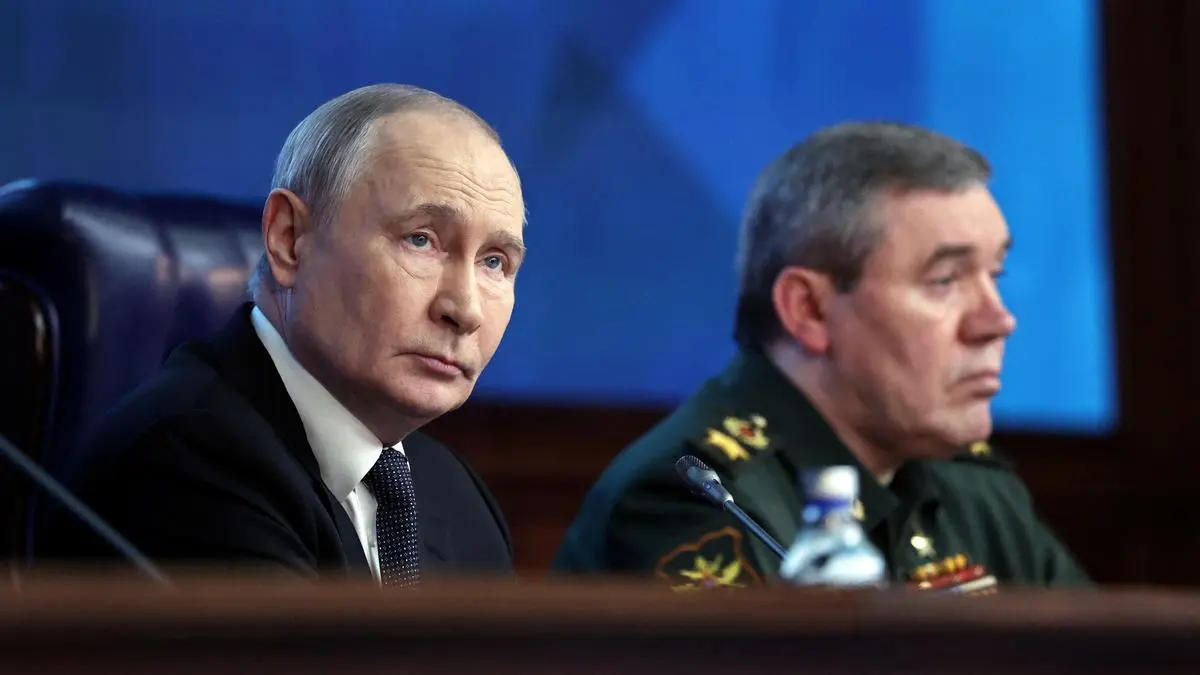
Valery Gerasimov, the Chief of the Russian General Staff, just dropped a massive number that should make everyone pause. He says Russian forces seized 1,700 square kilometers of Ukrainian territory since the start of 2024. That’s a lot of ground. It’s roughly equivalent to the size of London or about twice the area of New York City. If you look at a map, it seems like a sweeping victory. But maps can be liars. They show shaded areas, not the piles of burnt-out tanks and rows of fresh graves required to shade them.
The math of this war is getting darker. Gerasimov didn't mention the price paid for every meter. He didn't talk about the meat-grinder tactics in Vovchansk or the literal mountains of scrap metal left behind near Avdiivka. When we talk about 1,700 square kilometers, we’re talking about an area won through attrition so brutal it defies modern military logic. Russia has the bodies to throw at the problem. Ukraine doesn't. That’s the cold, hard reality of this phase of the conflict.
Why the 1700 square kilometers figure matters right now
You have to wonder why Gerasimov chose to go public with this specific number today. It isn't just about record-keeping. It's a signal to the West. He’s trying to tell Washington and Brussels that the momentum has shifted permanently. By highlighting these gains, the Kremlin wants to convince Ukraine’s supporters that further aid is a waste of money. They want you to believe the outcome is already decided.
The timing is intentional. Russia is currently pushing hard in the Donbas. They're eyeing strategic hubs like Pokrovsk. Every kilometer they take puts Ukrainian logistics under more strain. If they can disrupt the rail lines and supply roads that keep the Ukrainian front line fed, the territorial gains will accelerate. It’s a snowball effect.
However, "captured" doesn't always mean "controlled." In many of these areas, Russian troops are sitting in ruins. There’s no infrastructure left. There are no civilians to govern. They’ve captured a graveyard. While the 1,700 square kilometers sounds impressive on a spreadsheet, the strategic value of some of this land is debatable compared to the equipment losses Russia sustained to get it.
The grueling reality of the Russian summer offensive
We’ve seen a shift in how Russia fights. They’ve moved away from the massive, sweeping armored columns that failed so miserably in 2022. Now, it's about small-unit infantry surges backed by an insane amount of glide bombs. These glide bombs are the real nightmare for Ukrainian defenders. They’re cheap, they’re heavy, and they’re incredibly hard to shoot down.
Russia is essentially leveling a town with air power and then sending in infantry to occupy the rubble. It’s slow. It’s ugly. But it's working in terms of moving the line. Gerasimov’s claim of 1,700 square kilometers is a direct result of this "scorched earth" approach. They aren't outmaneuvering the Ukrainians; they're out-bombing them.
The pressure on the Kharkiv border also forced Ukraine to pull its best units away from the south and east. This "distraction" tactic allowed Russian forces to make those incremental gains Gerasimov is so proud of. It’s a classic shell game. Poke one area, force the enemy to move their pieces, then strike where they used to be.
Logistics and the exhaustion factor
War is a contest of endurance. Right now, Russia has the upper hand in the "stuff" department. They’ve shifted their entire economy to a war footing. Factories are running 24/7. They're getting shells from North Korea and drones from Iran. Ukraine is stuck waiting for Congressional votes or European bureaucratic shifts.
This creates a window of opportunity. Gerasimov knows this window might close if F-16s start patrolling the skies in significant numbers or if long-range missile restrictions are fully lifted. So, the 1,700 square kilometers represents a "sprint" before the environment changes again.
The human cost behind the stats
We can't ignore the casualty rates. Independent monitors and Western intelligence suggest Russian casualties have peaked at over 1,000 men per day during some of these pushes. Think about that. A thousand men a day to move a line on a map a few hundred meters.
- Russia is using "Storm-Z" units composed of convicts.
- They rely on heavy financial incentives to keep volunteers coming.
- The equipment they're pulling out of storage is getting older. We’re seeing T-62 tanks from the 1960s appearing on the front.
If Russia continues to lose men at this rate, the 1,700 square kilometers will look like a very expensive mistake in the long run. You can win a lot of land and still lose a war if you run out of the people needed to hold it.
What these gains mean for the end of 2024
If Gerasimov’s figures are accurate, it shows Russia is gaining territory at a faster rate than they were in 2023. Last year was mostly a stalemate. This year is different. The momentum has tilted. Ukraine is fighting a desperate defensive battle, trading space for time. They’re hoping to exhaust the Russian offensive before it hits a major city like Kharkiv or Zaporizhzhia.
But time is a luxury. Every square kilometer lost is another village under occupation. It's more leverage for Russia if and when peace talks ever happen. The Kremlin wants to enter any negotiation holding as much of Ukraine as possible.
The gap between Moscow’s reports and the front line
Don't take everything Gerasimov says at face value. Military leaders during wartime are professional optimists. They exaggerate successes and bury failures. While the 1,700 square kilometers likely has a basis in fact, it doesn't account for the land Ukraine has reclaimed in localized counterattacks. It's a "gross" figure, not a "net" figure.
Also, look at the quality of the land. Taking an open field in the "gray zone" is easy. Taking a fortified industrial zone like the Avdiivka Coke Plant took months and cost thousands of lives. The density of the fighting is more important than the raw square footage.
What you should watch for next
Keep your eyes on the Ocheretyne breakout. That’s been the most dangerous development for Ukraine recently. If Russia can exploit that gap, Gerasimov’s next update will likely boast an even higher number.
The real test will be whether Russia can turn these tactical gains into a strategic collapse of the Ukrainian line. So far, they haven't. Ukraine's line is bending, but it isn't breaking. The defenders are falling back to prepared positions, making Russia pay for every inch.
If you’re tracking this conflict, stop looking at the total area and start looking at the logistics hubs. Territory is vanity; supply lines are sanity. If Russia takes the ground but can't protect its own trucks and depots from HIMARS and ATACMS, those 1,700 square kilometers will become a trap.
Stay updated on the specific movements near Chasiv Yar. That’s the high ground. Whoever holds the heights controls the surrounding territory, regardless of how many square kilometers the other side claims to have "taken."