Timmy isn't supposed to be here. The massive whale, now a household name across Germany, has spent far too long stranded in the shallow, treacherous waters of the Baltic Sea. While most news outlets are focusing on the spectacle, the reality on the ground is a gritty, high-stakes engineering challenge. Marine biologists and local emergency services are ditching traditional rope-and-drag methods for something much more technical. They’re using heavy-duty air cushions.
This isn't just about being gentle. It’s about physics. When a whale of this magnitude—we’re talking several tons of living, breathing biological mass—hits the sand, its own weight becomes its worst enemy. On land, Timmy’s internal organs are slowly crushing under the pressure of gravity, a force he’s rarely had to deal with in the buoyancy of the deep ocean. German rescue teams are now racing against a biological clock that won't stop for anyone.
The Problem with Traditional Rescue Methods
You've probably seen those old videos of people trying to pull a whale back into the surf with thick nylon ropes. It looks heroic. It usually fails. Ropes create localized pressure points that can snap bones or tear through skin like a hot knife through butter. For a whale like Timmy, a botched pull could result in a dislocated tail or fatal internal hemorrhaging.
Rescuers in Northern Germany realized early on that a standard tug-of-war wouldn't work here. The seafloor in this specific region is notoriously "sticky" silt. It creates a vacuum effect. If you try to pull the whale horizontally, the suction from the mud holds him in place until something breaks. Usually, that something is the whale.
That’s why the shift to air cushions is a big deal. Instead of pulling Timmy out, the goal is to lift him up. By sliding deflated, high-strength industrial bags beneath the whale's belly and slowly inflating them, rescuers can break that mud suction. It creates a literal buffer of air between the animal and the seabed, allowing him to float even in water that’s technically too shallow for his draft.
How the Air Cushion System Actually Works
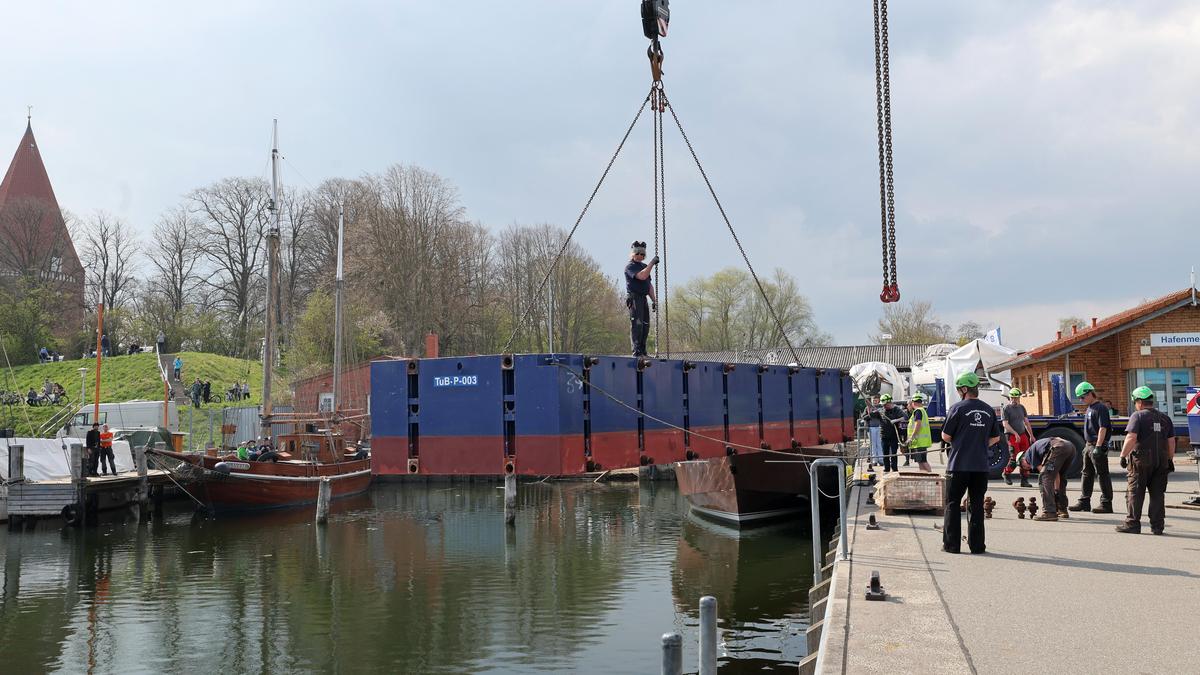
This isn't a weekend DIY project. The equipment being deployed comes from specialized maritime salvage units, the kind of gear usually reserved for raising sunken ships or stabilizing tipped barges.
Breaking the Suction
The first hurdle is the hardest. Divers have to manually dig channels under Timmy’s midsection to slide the flat Kevlar-reinforced bags into place. It’s dangerous work. One wrong move from a stressed whale can crush a diver in seconds. Once the bags are positioned, they’re connected to a manifold system that regulates air pressure with extreme precision.
You can't just blast air into them. You have to inflate them symmetrically. If one side fills faster than the other, the whale rolls. If he rolls, his blowhole goes under, and he drowns in two feet of water. The technicians monitor the pressure gauges like surgeons, aiming for a steady lift of just a few centimeters at a time.
Creating an Artificial Tide
Once Timmy is "buoyant" on these cushions, he’s essentially on a hovercraft. This allows the team to slide him toward deeper water without his skin ever touching the abrasive sand. The air cushions distribute his weight across a massive surface area. It reduces the PSI on his skin to levels that his body can actually handle.
The Biological Risk of Long Term Stranding
Time is the enemy. I can't stress this enough. Every hour Timmy spends grounded, his muscle tissue begins to break down. This process, known as rhabdomyolysis, releases a protein called myoglobin into his bloodstream. In high enough concentrations, myoglobin is toxic to the kidneys.
Basically, even if the German rescuers get him back into the deep water tomorrow, Timmy could still die of kidney failure three days later. This is why the air cushion strategy is so vital. It’s the fastest way to get him off the ground and get his circulation back to normal. The team is also likely using cold-water sprays to keep his skin from overheating and cracking, as whales have thick blubber layers designed to retain heat—a death sentence under the sun.
What Most People Get Wrong About Whale Rescues
Social media is full of people asking why they don't just use a helicopter or a massive crane. It’s a nice thought, but it’s physically impossible. A whale’s skeleton is held together by soft tissue and muscle designed for a 3D environment where gravity is neutralized by water. If you lift a whale by its tail or midsection with a crane, the spine will almost certainly snap under the weight.
German rescuers are being criticized by some for "taking too long." That’s nonsense. Speed kills in these scenarios. They are meticulously calculating the load-bearing capacity of the air bags because a single pop could cause a pressure wave that would kill the whale instantly.
The Odds of Success in the Baltic
Let's be honest. The odds aren't great. The Baltic Sea isn't the natural habitat for a whale of this size. It’s too shallow, the salinity is weird, and the food sources aren't right. Even if this air cushion maneuver works perfectly, Timmy still has a long swim ahead of him to reach the North Sea and the open Atlantic.
However, the German team is one of the most well-equipped in the world. They’ve studied previous strandings in the Netherlands and the UK, and they’ve refined the air cushion technique to a science. They aren't just winging it. They have a clear plan:
- Stabilize the whale's position and keep the blowhole clear.
- Insert the pneumatic lifting bags during the next high tide window.
- Gradually inflate to break the suction of the Baltic silt.
- Tow the whale on the "cushion" to a depth of at least ten meters.
- Monitor for several hours to ensure he can swim under his own power.
If you want to help, the best thing anyone in the area can do is stay away. Drones, boats, and spectators create acoustic stress. Whales "see" with sound. A hundred boat engines nearby is the equivalent of trying to recover from a concussion in the middle of a heavy metal concert.
The next 24 hours will decide Timmy’s fate. If the air cushions hold and the weather stays calm, we might see a miracle. If not, this will be a somber lesson in the limits of human engineering against the raw reality of nature. Watch the tide charts. That’s when the real move happens.