The air in the Bundestag often feels recycled, thick with the weight of decades of consensus. But lately, a cold draft has been blowing through the halls of German power, specifically from the benches occupied by the Alternative für Deutschland (AfD). For years, the script was simple: the populist right in Europe looked toward Mar-a-Lago as if it were a modern-day Oracle of Delphi. If Donald Trump tweeted, the AfD echoed. If he MAGA-ed, they D-EXIT-ed.
The bond seemed unbreakable. Until it wasn't.
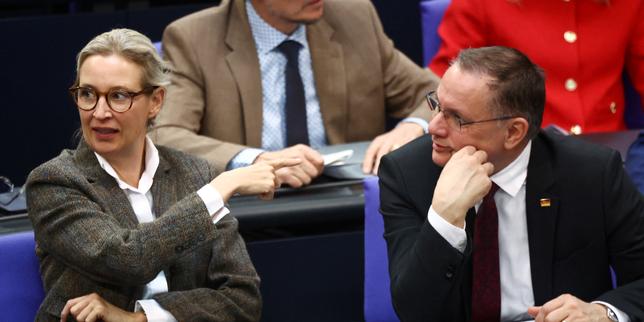
Alice Weidel and Tino Chrupalla, the faces of a party that has built its brand on being the ultimate contrarian, are suddenly finding themselves in an awkward position. They are the jilted lovers of the transatlantic relationship, but they are the ones doing the walking. The shift isn't just a minor policy tweak. It is a fundamental realignment of how the German right views the world and, more importantly, how it views Berlin’s place within it.
Consider a hypothetical voter named Lukas. He lives in a small town in Saxony where the shuttered factories are more than just ruins; they are ghosts of a certainty that no longer exists. For Lukas, Trump was a symbol of the "little guy" finally winning. But as the 2024 American election cycle churns, Lukas is hearing something different from his party leaders. They aren't talking about "making Germany great again" through American-style deregulation. They are talking about protectionism. They are talking about Russia. They are talking about a world where Washington is no longer the guardian, but a competitor—or worse, a burden.
The friction point is economic sovereignty.
When the Trump administration first rose to power, the AfD saw a kindred spirit. They shared an enemy in the "globalist" elite. However, the reality of "America First" is starting to sink in across the Atlantic. Trump’s proposed tariffs don’t discriminate between the "woke" Brussels bureaucrats the AfD hates and the German medium-sized businesses—the Mittelstand—that form the backbone of the party’s donor base. A 10 percent or 20 percent universal tariff on German cars doesn't feel like "populist solidarity." It feels like an eviction notice for German prosperity.
This is where the narrative of the "brotherhood of populists" falls apart. Nationalists, by definition, prioritize their own nation. When two nationalists sit at the same table, they don't share the bread; they fight over who owns the wheat.
The AfD’s leadership has begun to realize that a second Trump term might be more of a wrecking ball than a life raft for the German economy. They see the Inflation Reduction Act and the aggressive luring of German industry to American soil not as a model to emulate, but as a predatory threat. The rhetoric has shifted from "Let’s be like Trump" to "We must protect ourselves from everyone—including the Americans."
Then, there is the shadow of the Kremlin.
Nothing highlights the growing chasm between the AfD and the MAGA movement more than the question of Ukraine and the broader security architecture of Europe. While some segments of the American right have grown weary of funding the war, their motivation is often isolationist—a desire to stop spending money "over there." The AfD’s stance is more deeply rooted in a historical and geographic reality. For many in the party, particularly in the former East Germany, Russia is not a distant villain but a necessary partner for energy and stability.
The AfD is increasingly positioning itself as the party of Frieden—peace—but it is a peace that looks very different from the one envisioned by a Republican hawks or even Trump’s "deal-making" persona. The AfD wants a return to the status quo where cheap Russian gas fueled the German industrial machine. They view the sabotage of the Nord Stream pipelines not just as a crime, but as an American-led assault on German energy independence.
The distance between Berlin and Mar-a-Lago is growing because the AfD has decided that the "West" is a dying concept. They aren't looking to lead a renewed Western alliance; they are looking to survive in a multipolar world where Germany acts as its own pole.
This isn't just about high-level geopolitics. It’s about the emotional core of the German right. There is a simmering resentment that has moved past the old post-war gratitude. You can see it in the way party intellectuals talk about "vassalage." They no longer see the United States as the liberator of 1945 or the protector of the Cold War. They see a hegemon that is dragging Germany into a conflict with Russia that benefits Pennsylvania more than Pomerania.
The shift is visible in the subtle changes of tone in Weidel’s speeches. The praise for Trump’s "strength" has been replaced by a sharper focus on "German interests." It is a cold, calculated pivot. They are signaling to their base that while they still admire the method of Trumpism—the disruption, the defiance of the media, the blunt language—they no longer trust the man or the country he leads to have Germany’s back.
What does this mean for the average observer? It means the global populist front is fracturing under the weight of its own logic.
If you are a nationalist, you eventually have to stop liking the nationalists in other countries because their interests will inevitably collide with yours. The AfD is simply reaching that conclusion faster than most. They are looking at the possibility of a world where America retreats behind a wall of tariffs and security demands, leaving Germany to pay the bill for its own defense while losing its best export markets.
For a party that prides itself on being the only one telling the "truth" to the German people, the truth about Trump is becoming too expensive to ignore.
The divorce is not yet finalized. There are still many in the AfD ranks who cling to the MAGA hat as a symbol of rebellion against the status quo in Berlin. But at the top, the calculation has changed. The romance is over. The pragmatism of survival has taken over.
As the sun sets over the Reichstag, the members of the AfD aren't looking West with hope anymore. They are looking inward, building a fortress of their own, convinced that in the coming storm, they will be standing alone—and that perhaps, that is exactly how they want it.
The bridge across the Atlantic is thinning. The AfD is the first to start sawing through the ropes from the European side, not out of spite, but out of a sudden, shivering realization that the man on the other end is already holding a lighter.