Waiting.
It is the heavy, metallic taste of lukewarm coffee in a Caracas kitchen at six in the morning while the power grid hums, flickers, and dies before the toast even browns. It is the silent math performed by millions of mothers in Cúcuta, Madrid, and Lima, calculating whether the remittance sent through a fractured digital wire will arrive before the pharmacy closes on a Tuesday afternoon. When you have lived inside the slow-motion collapse of a nation, time stops moving in straight lines. It pools. It stagnates. It becomes a currency spent entirely by those who hold the keys to the palace, while everyone else stands in an endless, fluorescent-lit corridor staring at a clock without hands.
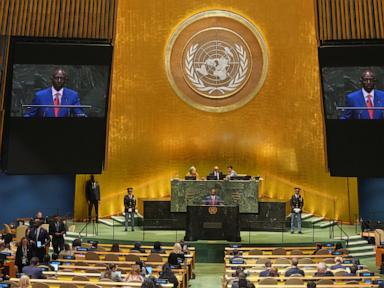
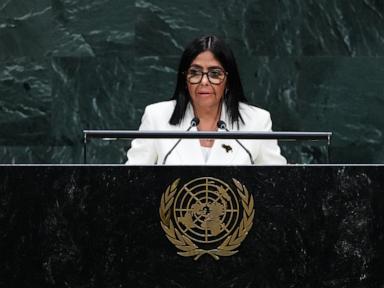
That is the real weight behind the sterile diplomatic headline that rippled out of Turtle Bay this week. Venezuela's acting leader, addressing the United Nations General Assembly for the first time, promised that elections would be held at the "right moment."
Read those three words again. The right moment.
To a diplomat sipping sparkling water in a Manhattan lounge, it sounds like measured statecraft—a prudent acknowledgment of institutional hurdles, logistical bottlenecks, and the delicate choreography required to stabilize a fractured state. To anyone who has ever stood in a voting queue in Petare under a blistering equatorial sun only to watch the polling station close early, or who has watched years of hyperinflation erase a lifetime of civil service pensions, those three words land like a bolted door.
The Architecture of a Promise Without a Date
In diplomacy, vagueness is rarely an accident. It is a shield. When an interim or acting executive steps up to the green marble podium at the United Nations—the grandest theater of international legitimacy on earth—every syllable is weighed against two audiences that want fundamentally incompatible things.
Inside the hall in New York, the audience consists of foreign ministers, regional blocs, sanctions architects, and multilateral lenders. They want to hear a vocabulary of transition. They want to hear words like reconciliation, constitutional order, institutional recovery, and electoral roadmap. Without that vocabulary, frozen assets stay frozen, diplomatic recognition remains conditional, and international legitimacy stays just out of reach.
Back home in Venezuela, however, the audience is listening on cracked smartphone screens between intermittent data drops. They are listening for something far simpler and infinitely harder to fake. They are listening for a date.
Consider a hypothetical family—let us call them the Mendozas, a composite drawn from the lived reality of millions of households split across the Venezuelan diaspora. Elena, a retired high school chemistry teacher in Valencia, keeps her late husband’s university textbooks wrapped in plastic to protect them from the tropical humidity, hoping her grandson will read them when he comes back. Her son, Mateo, drives a delivery van in Santiago, Chile, working twelve-hour shifts so he can wire eighty dollars every two weeks. Neither Elena nor Mateo cares about the rhetorical elegance of a maiden speech at the UN General Assembly. For them, an election is not an abstract exercise in political science. It is the sole mechanism by which a citizen regains the right to fire the people managing their misery.
When a leader says elections will happen at the "right moment" without defining who gets to read the clock, the promise ceases to be a commitment and becomes a discretionary privilege. Think of it like a landlord who refuses to fix a collapsed roof during monsoon season, promising repairs "as soon as the weather feels appropriate," while simultaneously holding the only barometer in the house.
Why "The Right Moment" Is the Oldest Trap in Politics
I have spent years watching political transitions stall in the purgatory between crisis and resolution, and if there is one law that governs power, it is this: incumbency always finds the weather too stormy for a vote.
History offers a sobering ledger of interim authorities, transitional councils, and acting presidents who genuinely—or strategically—believed that stability had to precede democracy. The argument always sounds logical on paper. How do you hold a credible national election when millions of citizens are scattered across borders without updated consular registries? How do you guarantee a fair ballot when state institutions are hollowed out, media outlets are shuttered or self-censored, and the economic infrastructure barely sustains basic logistics?
According to international observers, human rights monitors, and Venezuelan opposition figures, those logistical and institutional obstacles are undeniably real. You cannot simply drop cardboard ballot boxes into a country with a shattered electoral commission and expect magic. On the other hand, supporters of the acting administration and diplomats advocating gradual engagement argue that rushing into a premature vote without institutional guardrails only guarantees another disputed outcome, deeper polarization, and the risk of renewed street violence.
Both arguments contain a kernel of truth. And yet, look at how that tension plays out in practice.
When electoral timelines are tied to subjective conditions—such as "economic recovery," "the lifting of external sanctions," or "national pacification"—the party in power gains a perverse incentive. If peace and prosperity are the prerequisites for an election, then perpetual crisis becomes the ultimate insurance policy against ever facing the voters. As long as the economy remains fragile or diplomatic disputes remain unresolved, the "right moment" can be postponed indefinitely, week after week, quarter after quarter, until an acting administration quietly hardens into a permanent fixture.
The Invisible Stakes Behind the Podium
It is easy to treat a UN General Assembly speech as a distant geopolitical ritual, something happening in a parallel universe of motorcades, tailored suits, and simultaneous translation headsets. Yet the stakes of what was said—and what was left unsaid—at that podium bleed directly into the daily survival of ordinary people across the Western Hemisphere.
First, there is the human tide. Over the past decade, more than seven million Venezuelans have left their country, creating one of the largest displacement crises in modern history. Every month that passes without a verifiable, time-bound democratic horizon is another month in which young doctors, engineers, teachers, and welders conclude that their future lies anywhere except home. Neighboring countries—Colombia, Peru, Brazil, Chile, Ecuador—have absorbed millions of newcomers while wrestling with their own fiscal strains and political backlashes. For those host nations, a vague promise of future elections in Caracas translates into immediate, concrete pressure on local schools, public hospitals, and labor markets.
Second, there is the question of economic oxygen. Venezuela sits atop the largest proven crude oil reserves on the planet, yet its state infrastructure has been crippled by years of mismanagement, corruption, and sweeping international sanctions. Foreign energy firms, multilateral development banks, and private investors do not deploy billions of dollars into long-term infrastructure projects on the strength of an adverb. Capital requires legal certainty. Legal certainty requires a government whose constitutional mandate cannot be challenged at the next turn of the geopolitical wheel. Without a clear electoral calendar, economic relief remains trapped in short-term licenses and patchwork humanitarian waivers—enough to keep the patient breathing, never enough to let them walk.
Third, and perhaps most fragile of all, is civic faith. Democracy does not die only when tanks roll into a plaza. Sometimes it dies quietly, through exhaustion. When citizens organize, march, register, and sacrifice repeatedly only to be told that the finish line has been moved into the fog, cynicism sets in like rust. Once a population stops believing that a ballot can alter its destiny, the vacuum is rarely filled by peaceful institutions.
What Separates a Roadmap from a Mirage
I will be honest: watching Venezuela’s political labyrinth from the outside—and listening to friends inside the country try to decode every official communiqué—can feel disorienting. Analysts themselves are sharply divided over whether this first UN appearance signals a genuine opening toward international reintegration or merely a sophisticated public relations reset designed to buy time and ease diplomatic isolation.
That uncertainty is precisely why the details matter more than the tone.
If an acting leader genuinely intends to steer a nation toward a credible vote, the proof never lives in a speech at the United Nations. It lives in measurable, irreversible milestones that strip the executive of the power to stall. Independent electoral monitors and democratic theorists consistently point to the same non-negotiable markers:
- A fixed, published calendar: Not a seasonal window or a conditional aspiration, but binding dates for voter registry updates, candidate nominations, campaign windows, and election day itself.
- Diaspora enfranchisement: Clear, accessible mechanisms allowing the millions of Venezuelans living abroad to update their registration and cast ballots without impossible bureaucratic hurdles.
- Political prisoner releases and restored civil rights: An election cannot be free if opposition leaders remain barred from running, exiled under threat of arrest, or silenced by state control over broadcast frequencies.
- Independent international observation: Full, unimpeded access for credible multilateral observation missions months before a single ballot is printed, not a curated tour during the final forty-eight hours.
Without those anchors, "the right moment" remains a mirage—always shimmering a few miles down the highway, always receding at the exact speed the traveler approaches.
The Sound of a Key Turning
Back in Valencia, Elena Mendoza does not have a seat in the General Assembly hall. She does not have a diplomatic badge, a press pass, or a voice in the back-channel negotiations over oil licenses and debt restructuring. What she has is a small transistor radio on her kitchen counter, a stack of textbooks wrapped in clear plastic, and a calendar hanging on the wall beside the refrigerator.
Every evening, before she turns out the kitchen light, she looks at the grid of empty squares for the month ahead. Millions of people across Venezuela and across the diaspora are looking at that same blank grid tonight, waiting for someone in power to finally write down a date—and mean it.