The air in Edinburgh during the Six Nations doesn’t just carry the chill of a North Sea wind. It carries the smell of damp wool, spilled stout, and a nervous, electric hope that defies logic. To walk up Rose Street toward Murrayfield is to participate in a ritual of collective delusion. We know the statistics. We have seen the physical disparity in the tunnel. Yet, we believe.
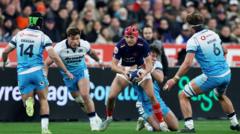
France arrived this year not as a rugby team, but as an inevitability. Under Fabien Galthié, they have transformed from a collection of mercurial artists into a blue-clad industrial complex. They don’t just play; they process. They have the heaviest pack in the northern hemisphere, a scrum that functions like a hydraulic press, and a scrum-half in Antoine Dupont who seems to perceive time a fraction of a second slower than everyone else on the pitch.
The narrative from the pundits was suffocatingly simple. France were on a "Grand Slam procession." They were the steamroller, and Scotland was the scenic, slightly crumbling wall in the way.
But rugby is rarely decided by the cold geometry of the drawing board. It is decided in the dark spaces of the breakdown and the flickering moments of a gambler’s intuition.
The Anatomy of the Risk Taker
To understand the Scottish approach is to understand the soul of Finn Russell. If the French system is a grand cathedral of structured violence, Russell is the man trying to pick the lock with a smirk and a sleight of hand.
Imagine a high-stakes poker game where one player has an infinite bankroll and a perfect mathematical strategy. That is France. Now imagine their opponent has three high cards, a mounting debt, and the audacity to go all-in on every single hand. That is Scotland.
Risk in elite sport is often quantified by "expected points" or "turnover percentages." For the men in dark blue, however, risk is a survival mechanism. They lack the raw mass of the French front five. If they play a standard, territorial game of attrition, they will be ground into the peat. They have to move the point of contact. They have to play in the transition—the chaotic seconds where a tackle is made and the defensive line hasn't yet reset.
This strategy creates a peculiar tension in the stands. When Russell throws a long, looping skip-pass across his own twenty-two-meter line, forty thousand people hold their breath. It is a moment of pure, crystalline terror. If it connects, Scotland are away, sprinting into the green space. If it’s intercepted, the French juggernaut scores under the posts, and the dream dies before the half-time pies are even warm.
The Weight of the Blue Jersey
History sits heavy on Scottish shoulders. There is a specific kind of trauma associated with "The Brave Defeat." It’s the game where you lead for seventy-four minutes, play the most beautiful rugby seen in a decade, and then lose to a deflected kick or a momentary lapse in discipline.
France knows this. They rely on it. Their game plan is designed to squeeze the opponent until the panic sets in. They want you to feel the weight of their three-hundred-kilogram front row. They want you to look at the scoreboard, see you’re only three points down, but feel like you’re drowning.
I spoke to a former international flanker who described the sensation of facing this French side. He said it’s like trying to stop a tide with a broom. You make the tackle, you get back up, and there’s another mountain of a man running at you. Then another. Then, just when you think you’ve held the line, Dupont darts through a gap no wider than a coin.
The question wasn't whether Scotland could match that power. They couldn't. The question was whether they could make the French uncomfortable. Could they turn a rugby match into a street fight where the rules of physics were replaced by the rules of chaos?
The Tactical Gamble
The game shifted when Scotland stopped trying to be "sensible."
In the modern era, "sensible" means kicking the ball away and waiting for the opposition to make a mistake. Against France, that is suicide. Giving France the ball is like giving a shark a head start in a swimming race.
Scotland’s defiance manifested in their refusal to kick. They ran from their own goal line. They used late footwork to target the "soft" shoulders of the French giants. They played with a tempo that looked like a fever dream.
Consider the role of the "jackal"—the player who dives over the ball at the breakdown to steal it. In this match, the Scottish back row weren't just competing; they were scavenging with a desperation that bordered on the fanatical. They knew that every second the ball stayed in French hands, the Grand Slam moved closer to reality.
It was a clash of philosophies. On one side, the "Le Crunch" mentality of clinical, brutal efficiency. On the other, the "Gallant Loser" trying to rewrite his own ending.
The Human Cost of the Collision
By the sixty-minute mark, the aesthetics of the game vanish. The jerseys are torn, the white tape around the players' heads is stained with red, and the "human element" becomes the only thing that matters.
This is where the Grand Slam is won or lost. It’s not in the flashy tries or the tactical masterstrokes. It’s in the lungs. It’s in the player who manages to chase a kick when his legs feel like they are filled with lead.
France, for all their dominance, are human. When you run them side-to-side for an hour, the giants begin to lumber. The "process" starts to glitch. Passes that were crisp in the first half become slightly leaden. The inevitability starts to crack.
The crowd at Murrayfield senses this. The "Flower of Scotland" starts as a whisper and grows into a roar that vibrates in your chest. It is a reminder that while the French might have the better players, the Scots have the ghosts of every near-miss and every heartbreak pushing them forward.
Beyond the Scoreboard
Statistics will tell you one story about this rivalry. They will talk about possession heat maps and tackle completion rates. They will show you that France has a deeper pool of talent and a more lucrative domestic league.
They miss the point.
The point is the kid in the stands wearing a battered Saltire flag around his neck, watching Finn Russell attempt a kick that no coach would ever authorize. The point is the French captain, sweating under the lights, realizing that the "process" isn't working against a team that has nothing left to lose.
Scotland didn't just play a game; they conducted an experiment in pressure. They proved that a Grand Slam isn't a trophy you simply collect at the end of a scheduled tour. It is something you have to wrench out of the hands of people who are willing to risk everything just to see you stumble.
The French machine didn't break. But for eighty minutes in the cold heart of Edinburgh, it rattled. It smoked. It looked vulnerable.
As the fans stream out of the stadium and into the dark, rain-slicked streets, the conversation isn't about the points. It’s about the audacity. It’s about the fact that for a few brief moments, the risk takers made the world look different.
The Grand Slam might still be on the table for France, but they will leave Scotland with bruises that the trophies can't heal. They will remember that the most dangerous opponent isn't the one with the best plan, but the one who refuses to accept that the ending has already been written.
In the end, we don't watch sport for the processions. We watch for the moment the king trips on the rug. We watch for the gamble.
A lone piper plays somewhere in the distance, the sound fading into the roar of the city, leaving only the memory of the collisions and the defiant, beautiful madness of the men in blue.