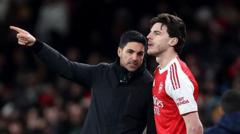
The lights at London Colney don't just illuminate a pitch; they expose the fragile architecture of a hundred-million-pound investment. When Mikel Arteta stands on the touchline, watching his players disperse toward their respective national flags, he isn't just a coach saying goodbye to his pupils. He is a man watching his life’s work being packed into crates and shipped across oceans, praying the handlers are gentle.
Football at the elite level has become a war of attrition where the primary weapon isn't a tactical masterclass or a clinical finish. It is availability.
The recent friction surrounding Arsenal’s international withdrawals isn't a story about lack of patriotism or club-versus-country ego. It is a story about the breaking point of the human body. When Bukayo Saka or Declan Rice limps off a pitch, the collective intake of breath in North London isn't just about the next three points. It is the sound of a multi-billion-pound industry realizing its foundation is made of bone and tendon, both of which have a definitive snapping point.
The Invisible Debt of the International Break
Consider the life of an elite winger.
Imagine a young man whose entire professional existence depends on his ability to decelerate from a full sprint to a dead stop in less than a second. His hamstrings are like violin strings tightened to the verge of snapping. Throughout a grueling Premier League season, his club employs a small army of sports scientists to monitor every micro-movement. They track his sleep, his hydration, the exact milligram of creatine in his blood, and the mechanical load on his joints.
Then, the international break arrives.
Suddenly, that calibrated environment vanishes. He is on a ten-hour flight. He is training on a pitch with a different turf density. He is playing for a manager who, quite naturally, cares more about winning a qualifying match on Tuesday than how that player feels for a domestic fixture on Saturday. This is the "invisible debt." Every minute played in a state of fatigue is a withdrawal from a bank account that doesn't offer credit.
Arteta’s defense of his players withdrawing from international duty isn't an act of defiance. It is an act of preservation. When he speaks about the "physical reality" of his squad, he is talking about the medical reports that the public never sees—the scans showing "gray areas" in a muscle, the inflammation that hasn't quite subsided, the mental fatigue that leads to a split-second delay in a tackle.
The Myth of the Iron Man
We have fallen into a trap of viewing footballers as indestructible avatars in a video game. We see their weekly wages and decide that for that kind of money, the body should never fail.
But the physiology of 2026 doesn't care about a bank balance.
The game is faster than it has ever been. The distance covered at high intensity has skyrocketed over the last decade. We are asking humans to perform at a level that was once reserved for Olympic sprinters, but we are asking them to do it sixty times a year.
When a player like Martin Ødegaard spends weeks in a recovery boot, the narrative often shifts to his "toughness" or his "commitment." This is a fundamental misunderstanding of the stakes. Arteta understands that a player’s career is a finite resource. If you burn the candle at both ends, you aren't just risking a game; you are risking the player’s ability to walk without a limp at forty.
The criticism leveled at Arsenal for "protecting" their assets misses the human element. These players want to play. They are competitors by nature; they would play on a broken leg if the adrenaline stayed high enough. The manager’s job is to be the adult in the room, to say "no" when the player’s heart says "yes" but his MRI says "not today."
The Cold Logic of the Medical Room
Critics often point to the "coincidental" timing of injuries. A player feels a twinge on Sunday, misses the England camp on Monday, and miraculously starts for Arsenal the following Saturday.
On the surface, it looks like a ruse.
In reality, it is the difference between management and catastrophe. If a player has a Grade 1 strain, ten days of specialized rehabilitation at their home base can see them ready for the next club match. However, if that same player travels, trains under a different intensity, and plays 90 minutes for their country, that Grade 1 strain becomes a Grade 3 tear.
Three months out. Surgery. A season derailed.
Arteta is operating in a world where the margin for error is a few millimeters of muscle fiber. He isn't defending a withdrawal; he is preventing a crisis. He knows that the fans who scream about "loyalty" to the national team will be the first to scream for his sacking if his star player is sidelined for the Christmas period because of a meaningless friendly in a different time zone.
The Emotional Toll of the Treadmill
There is a psychological exhaustion that rarely makes the headlines.
The modern footballer is never "off." The pressure to perform for the club is followed immediately by the pressure to carry the hopes of a nation. There is no downtime. There is no moment to breathe, to decompress, or to let the nervous system reset.
When Arteta stands in front of a microphone and deflects the heat from his players, he is acting as a heat shield. He knows the vitriol that comes with a "withdrawal." He knows the accusations of being "soft." By taking the brunt of the criticism himself, he allows his players the mental space to actually heal.
We often talk about the "culture" of a club. Part of that culture is the trust between a player and his manager. If a player knows that his boss will protect his health against the pressures of the external world, he will run through a brick wall for that boss when he is fit. This isn't just about medicine; it's about loyalty. It is a two-way street.
The Breaking Point of the Modern Calendar
The real villain in this story isn't a club manager or a national team coach. It is the calendar itself.
We are squeezing more and more into the same 365 days. Expanded Champions League formats, more international windows, longer domestic seasons. The "product" is being stretched until it is translucent.
Arteta’s stance is a canary in the coal mine. He is pointing out that we are reaching the end of what the human frame can endure. We can keep adding games, and we can keep demanding 100% intensity, but eventually, the stars will simply vanish from the pitch. They will be in the stands, in the treatment rooms, or in the early stages of retirement.
Every time a manager defends a withdrawal, he is issuing a plea for sanity. He is reminding the world that these are not machines. They are sons, fathers, and young men whose bodies are their only currency.
The silence of an empty training ground during an international break is deceptive. For the players who stayed behind, it is a frantic race against time. It is a symphony of ice baths, massage tables, and quiet conversations with specialists. It is the unglamorous, painful work of putting oneself back together.
Arteta isn't trying to win a PR war. He is trying to keep his team alive in a sport that is increasingly designed to consume them.
The next time you see a "doubtful" player pull out of a squad, don't look for a conspiracy. Look for the man behind the curtain, holding a stack of medical reports, trying to ensure that the beautiful game doesn't turn into a graveyard of wasted potential.
The lights at the stadium stay on long after the fans go home. Inside, the sound of a single player running on a treadmill is the heartbeat of the club. It is a fragile, rhythmic thud—a reminder that in the high-stakes world of modern football, the most valuable thing a manager can do is know when to stop.