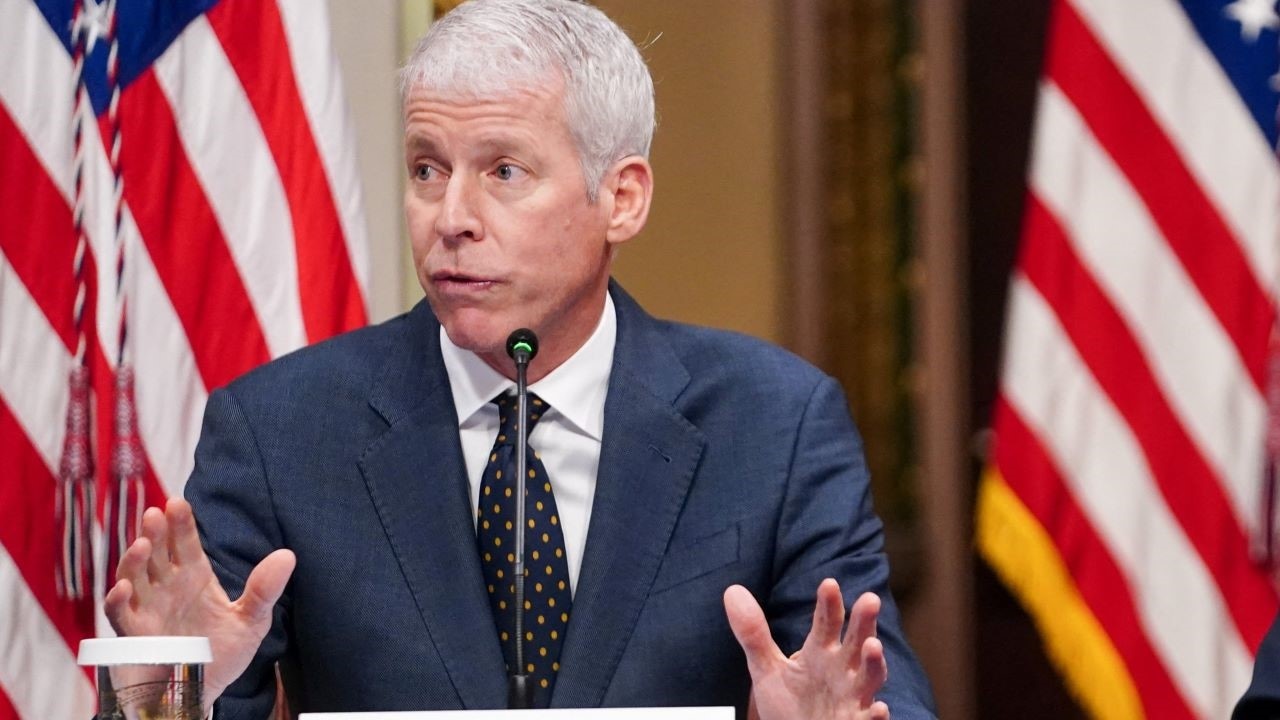
The global oil market is currently functioning on a wink and a nod. US Energy Secretary Jennifer Granholm recently acknowledged that the flow of Russian crude into India—and its subsequent journey to Western gas stations—is a deliberate, if temporary, measure to prevent a global price shock. It is a admission of a strategy that prioritizes the price at the pump over the purity of sanctions. By allowing India to act as the world’s primary refinery for discounted Russian Urals, the US administration has engineered a pressure valve. This prevents a catastrophic spike in energy costs that would otherwise cripple Western economies and jeopardize political stability.
The mechanics are simple but the implications are messy. Russia sells crude to India at a steep discount, often below the G7 price cap of $60 per barrel. Indian refiners, such as Reliance Industries and Nayara Energy, process this crude into diesel and jet fuel. They then export these refined products to Europe and New York. On paper, the sanctions are holding because the raw crude didn't go to the West. In reality, the molecules are the same, and the Russian treasury still gets paid.
The Mathematical Necessity of the Indian Loophole
Washington is trapped by a fundamental reality of energy physics. The world consumes roughly 100 million barrels of oil every day. Russia provides about 10% of that supply. If you remove 10 million barrels from the daily global ledger, the price of a gallon of gas does not just go up; it explodes. The resulting inflation would be more damaging to the NATO alliance than any battlefield setback.
To prevent this, the US Treasury and the Department of Energy have crafted a policy of "managed leakage." They need Russian oil to stay on the market to keep supply high and prices low, but they want to ensure Russia makes as little profit as possible. India is the perfect middleman for this operation. It has the refining capacity, the geographic proximity, and the sovereign indifference to Western moralizing to make the trade work.
The "waiver" Granholm speaks of isn't a formal document signed in a basement. It is a functional absence of enforcement. As long as India pays for the oil using non-dollar currencies or stays within the murky bounds of the price cap, the US looks the other way. This isn't a policy failure. It is the policy.
Why the Price Cap is a Ghost in the Machine
The G7 price cap was designed to be a sophisticated economic weapon. The idea was to use the West’s dominance in shipping insurance and maritime services to dictate the price of Russian oil. If a tanker wanted European insurance, it had to prove the oil on board was sold for less than $60.
Russia responded by building a "shadow fleet" of aging tankers, often owned by shell companies in Dubai or Hong Kong, operating outside the reach of Western insurers. Today, a significant portion of Russian exports to India moves via these ghost ships. When Granholm notes that the current arrangement is "temporary," she is acknowledging that the shadow fleet has grown too large to ignore, but too essential to sink.
If the US were to aggressively sanction the Indian refiners or the shadow tankers tomorrow, the immediate result would be a $120 barrel of oil. For a domestic administration facing an electorate sensitive to every cent of inflation, that is a non-starter. The "temporary" nature of this step is tied directly to the timeline of global supply diversifying—a process that takes years, not months.
The Refiner’s Premium and the Shift in Wealth
The real winners in this geopolitical shuffle are not the Russian oligarchs, but the Indian refining giants. They are buying raw material at a "war discount" and selling the finished product at global market rates. This has resulted in record-breaking margins for Indian energy firms.
The Hidden Flow of Diesel
- Source: Russian Urals crude shipped to the Port of Sikka.
- Transformation: Refined into ultra-low sulfur diesel.
- Destination: The Port of Rotterdam or New York Harbor.
- Economic Impact: The consumer gets fuel, the refiner gets a massive spread, and the sanctions remain technically intact.
This arrangement has created a new trade axis. India’s imports of Russian oil have jumped from near-zero pre-2022 to over 1.5 million barrels per day. This isn't just a trade shift; it is a total reordering of the global energy map. Europe, which once relied on short, cheap pipelines from Russia, now relies on long, expensive tanker routes from India. The carbon footprint of a gallon of gas has increased significantly due to the sheer distance it must travel to be laundered of its political baggage.
Secondary Sanctions and the Looming Credit Crunch
The US possesses a "nuclear option" in the form of secondary sanctions. These would target any bank or entity facilitating the Russian oil trade, regardless of where they are located. For a long time, the administration has kept this weapon in its holster. However, recent executive orders have signaled a shift.
The US is beginning to pressure banks in the UAE and Turkey that handle the payments for these oil deals. When the Energy Secretary calls the Indian route "temporary," she is signaling to New Delhi that the leash is tightening. The goal is to make the trade so difficult and expensive that the "war discount" eventually swallows Russia’s entire profit margin.
But there is a catch. If the US pushes too hard on the financial plumbing, they risk driving the entire trade into the "dark" financial system, where the Yuan or the Rupee becomes the primary settlement currency. This threatens the long-term dominance of the Petrodollar. Washington is currently weighing the cost of high gas prices against the cost of a weakened US Dollar. So far, gas prices are winning the argument.
The Strategy of Intentional Inconsistency
Critics argue that the US position is hypocritical. They are right. You cannot claim to be strangling the Russian war machine while simultaneously cheering for the flow of Russian-originated diesel into the global market. However, the Department of Energy views this not as hypocrisy, but as pragmatism.
In the world of high-stakes commodity trading, purity is a luxury. The administration's priority is a "soft landing" for the global economy. To achieve that, they must keep the Russian bear in a cage, but they can't afford to let it starve to death if that means the rest of the world goes hungry too.
The Indian oil route is a bridge. It is a bridge built to last until more production comes online from the Americas and Africa, or until the transition to renewables significantly blunts the demand for crude. Until then, the US will continue to issue these verbal warnings while privately hoping that not a single tanker from Vladivostok slows down.
The Reality of the "Temporary" Timeline
How long is "temporary"? In bureaucratic terms, it usually means until the next crisis arrives. The US is betting that the Russian economy will eventually buckle under the weight of the discount, even if the volume of oil remains high. They are watching the "breakeven" price for Russian production. If that price rises due to increased shipping costs and financial hurdles, the Kremlin will eventually find itself pumping oil at a loss.
But the Russians are not passive actors. They are reinvesting their remaining profits into more shadow tankers and domestic insurance schemes. This is an arms race of economic engineering. The US is trying to build a smarter trap, while Russia is trying to build a wider exit.
The True Cost of Energy Stability
- Market Fragmentation: The world no longer has one oil market; it has a "clean" market and a "grey" market.
- Increased Logistics Costs: Every barrel of oil redirected through India adds to the global inflationary baseline.
- Weakened Diplomatic Leverage: It is difficult to demand other nations sacrifice their economies when the West is seen as using a backdoor.
The US Energy Secretary’s comments were not an gaffe. They were a signal to the markets that the supply is safe, and a signal to the Kremlin that the "waiver" has an expiration date. The tension lies in the fact that neither the US nor India knows exactly when that date will arrive.
For the investigative observer, the story isn't about the sanctions themselves. It is about the vast, complex infrastructure of evasion that the West has quietly permitted to keep the global economy from seizing up. We are witnessing the birth of a permanent secondary market, one that functions in the shadows but is directed by the very hands that claim to be shutting it down.
Monitor the "spread" between Brent crude and Russian Urals. The moment that gap narrows, the "temporary" waiver will likely vanish, and the real economic war will begin.