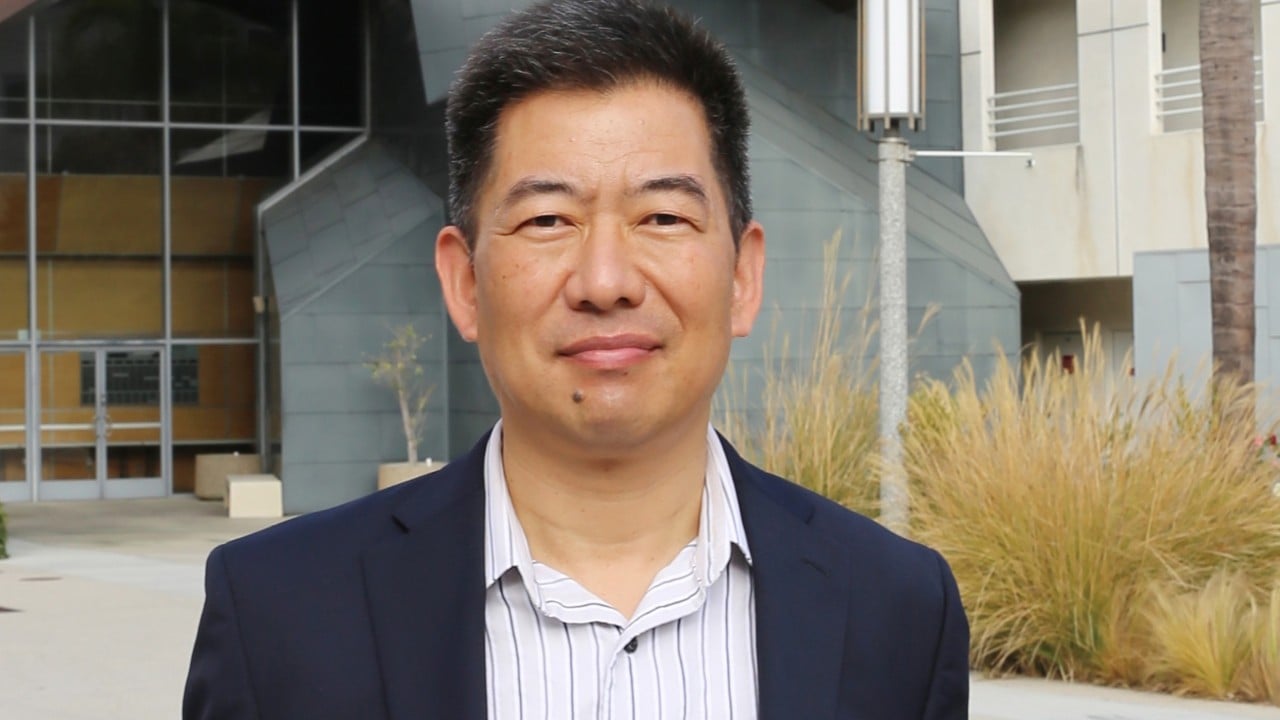
The global chip war just lost another high-value asset to the East. Shi Guojun, a decorated veteran of the American semiconductor industry and a specialist in high-performance memory, has officially moved his base of operations from the United States to a leading Chinese firm. While headlines often focus on the trade bans and the shipment of lithography machines, the real movement is happening in the departure lounges of international airports. This is not just a career change for one engineer. It is a calculated transfer of institutional knowledge that billions of dollars in subsidies cannot easily replace.
Shi’s departure highlights a critical vulnerability in the Western semiconductor strategy. Washington can block the export of a specific Nvidia H100 GPU or a Dutch-made ASML scanner, but it has yet to find a way to cordone off the human brain. When a talent of Shi’s caliber—a man who has spent decades at the literal frontier of DRAM and NAND flash development—decides to switch sides, he takes more than a resume. He takes the "tribal knowledge" of how a fab actually runs, how yields are squeezed from a failing wafer, and how to avoid the R&D dead ends that cost competitors years of progress.
The Intellectual Property of the Mind
In the semiconductor world, blueprints are only half the battle. You can steal a schematic, but you cannot steal the "feel" of the manufacturing process. This is why the recruitment of Shi Guojun is a massive win for Beijing’s self-reliance goals. Memory chips are the commodity backbone of the digital world, found in everything from your smartphone to the massive server farms training the next generation of large language models.
China has historically struggled with yield rates—the percentage of usable chips on a single silicon wafer. You might have the design right, but if 60% of your chips come out as expensive scrap metal, you cannot compete on the global market. Specialists like Shi are brought in specifically to fix this. They are the "yield doctors." By bringing in someone who has seen the inside of every major American and South Korean memory lab, China is effectively buying a shortcut past a decade of trial and error.
Why the Golden Cages are Breaking
For years, the U.S. relied on a "golden cage" strategy to keep its best tech talent. High salaries, massive stock options, and the prestige of working at the world’s most advanced companies kept experts rooted in Silicon Valley or the Research Triangle. However, that gravity is weakening.
Money is no longer the sole differentiator. Chinese firms, backed by state-funded "Big Funds," are now matching or exceeding American total compensation packages. But the real draw is often the scope of the work. In an established U.S. firm, a senior engineer might be a small cog in a massive, slow-moving machine. In a Chinese startup or a state-backed champion like CXMT or YMTC, that same engineer is given a blank check and a mandate to build an entire ecosystem from scratch.
There is also the "Glass Ceiling" factor. Many high-level engineers of Chinese descent have reported feeling that their upward mobility in American corporate structures is limited by the rising geopolitical tensions. When the DOJ’s "China Initiative"—even after being officially rebranded—creates an environment of suspicion around researchers with overseas ties, the decision to move becomes a matter of professional survival as much as personal ambition.
The Memory Wall and the AI Arms Race
To understand why Shi Guojun matters, you have to understand the Memory Wall.
$Bandwidth \propto \frac{Data\ transferred}{Time}$
Modern processors are becoming incredibly fast, but they are being choked by slow memory. If the CPU is a Ferrari, the memory is a dirt road. High-Bandwidth Memory (HBM) is the solution that everyone is fighting over. Currently, the market is dominated by SK Hynix, Samsung, and Micron. China is desperate to break into this trio.
HBM requires complex 3D stacking where chips are layered on top of each other and connected by microscopic wires called Through-Silicon Vias (TSVs). It is one of the most difficult manufacturing processes in the industry. Shi’s expertise in advanced memory architectures is a direct line to China developing its own domestic HBM supply chain. If China can produce its own HBM, the U.S. sanctions on high-end AI chips become significantly less effective.
The Limits of Export Controls
The U.S. Commerce Department has been playing a game of Whac-A-Mole. They tighten restrictions on 14nm chips, so China pivots to 7nm. They block certain software, and China develops an open-source alternative. But the one thing the Bureau of Industry and Security (BIS) cannot effectively regulate is the movement of experienced personnel who hold foreign citizenship or permanent residency.
While the October 2022 regulations attempted to restrict "U.S. persons" from supporting Chinese chip development, the definitions are often murky. Many experts are finding ways to consult through third-party entities or simply renouncing their green cards to take positions that offer them more influence and better long-term security in Asia.
The Manufacturing Reality Check
Let’s look at the actual physics of the problem. A modern fab is a chaotic environment where tiny changes in temperature, humidity, or chemical purity can ruin a multi-million dollar batch of wafers.
- Contamination Control: Even a single dust particle can short a circuit.
- Photolithography Precision: Alignment must be accurate to the nanometer.
- Etching Depth: Removing material at the atomic level without damaging the layers below.
Experienced veterans have a "library" of failures in their heads. When a machine starts behaving erratically on a Tuesday morning, Shi Guojun doesn't need to consult a manual; he’s likely seen that exact error code at a Micron or Intel plant ten years ago. He knows the fix. That 48-hour head start on a solution, when multiplied across three hundred different steps in the manufacturing process, is what separates a world-class semiconductor power from a struggling pretender.
The Institutional Knowledge Void
When a veteran departs, they don't just leave a hole in the org chart. They leave a vacuum in the mentorship cycle. The junior engineers who would have learned from Shi at his previous American employer are now deprived of that expertise. Conversely, the young graduates at his new Chinese firm are getting a masterclass in Western engineering standards.
This is a compounding interest problem. The knowledge Shi imparts to a team of 50 Chinese engineers today will be passed down to 500 engineers five years from now. This is how you build an industry from the ground up. It is exactly how South Korea and Taiwan did it in the 1980s—by aggressively recruiting talent from Bell Labs, Texas Instruments, and RCA. China is simply following a proven historical playbook.
A New Map of Innovation
The departure of Shi Guojun should be viewed as a signal that the center of gravity in hardware innovation is shifting. For decades, the flow of talent was one-way: from the rest of the world to the United States. That flow is now bidirectional, and in some specialized sectors like memory and mature-node manufacturing, the tide is visibly turning.
We are entering an era where "National Security" and "Global Commerce" are in a constant, violent friction. The U.S. is betting that it can spend its way out of this with the CHIPS Act, throwing $52 billion at domestic manufacturing. But factories are just buildings filled with expensive mirrors and lasers. Without the specific, battle-hardened expertise required to run them, they are just very expensive monuments to a bygone era of dominance.
The real war isn't being fought in the halls of Congress or the boardrooms of Santa Clara. It is being fought in the quiet recruitment offices of Shanghai and Shenzhen, where the world’s most talented engineers are being offered the one thing they crave more than a high salary: the chance to build the future of a superpower.
The move of a single expert like Shi Guojun is a data point. When you connect enough of these points, the resulting picture is clear. The technical moat that the West thought was uncrossable is being bridged, one person at a time. The high-end memory market is no longer a closed club, and the next breakthrough in how your data is stored and retrieved is just as likely to come from the lab Shi is currently setting up as it is from the one he left behind.
The era of American semiconductor exceptionalism is facing its most rigorous test, and so far, the response has been to focus on the hardware while the "wetware"—the human element—walks out the door.
Would you like me to analyze the specific patent portfolio of Shi Guojun to see which memory technologies are most likely to be accelerated by his move?