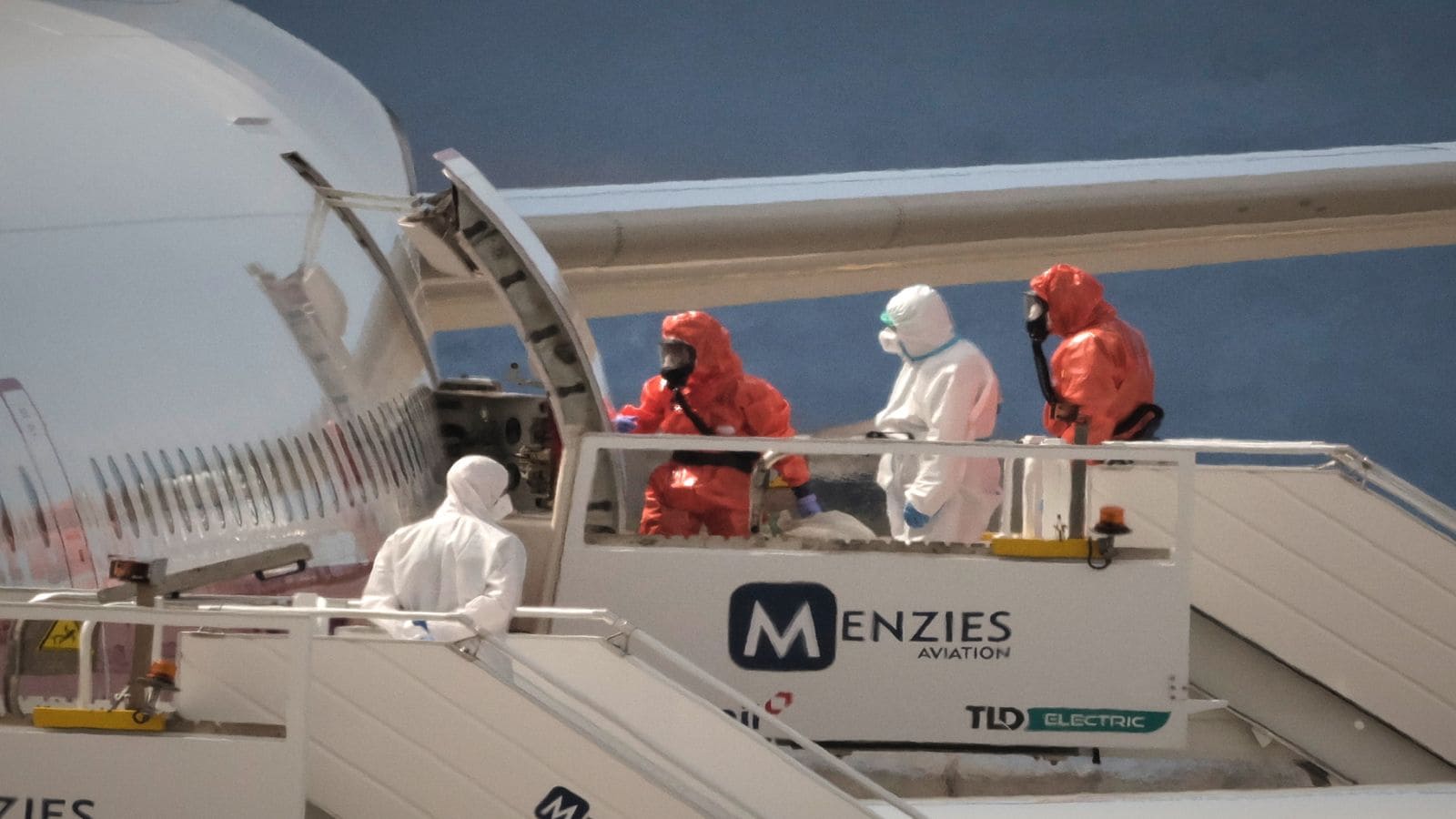
The headlines are screaming about a "Hantavirus-hit" cruise ship in the Canary Islands as if we are witnessing the prologue to a global extinction event. Passengers are disembarking into a sea of flashbulbs and hazmat suits, fueled by a media cycle that values clicks over virology. If you are terrified, you have been played.
The standard narrative suggests that a cruise ship is a floating petri dish where exotic pathogens leap from person to person like wildfire. The reality? The panic surrounding this "outbreak" is a textbook example of how a fundamental misunderstanding of viral transmission creates a manufactured crisis. We are obsessing over the wrong threat, in the wrong environment, for all the wrong reasons.
The Biological Impossibility of a Hantavirus Cruise Outbreak
Let’s get the science straight before the "experts" on cable news further muddy the waters. Hantaviruses, specifically those found in Europe and the Americas, are not human-to-human pathogens. This is not COVID-19. This is not the flu. This isn't even Norovirus, the actual king of cruise ship misery.
Hantavirus is a zoonotic disease. To catch it, you generally need to be in close, prolonged contact with the aerosolized excreta of specific rodent species—think deer mice in the American Southwest or bank voles in Europe.
Unless the cruise line has started offering "extreme rodent trekking" excursions through infested granaries, the risk to the average passenger is statistically indistinguishable from zero. To suggest a ship-wide outbreak is imminent ignores the basic $R_0$—the basic reproduction number—of the virus in a human population. For almost every strain of Hantavirus, that number is a flat zero. You don't "catch" it from the guy in 4B who is coughing near the buffet. You catch it by sweeping up a dusty, mouse-infested cabin in the woods.
The one outlier, the Andes virus in South America, has shown limited human-to-human transmission, but even then, it requires intimate, sustained contact. It does not "sweep" through a deck of 3,000 people. By treating this like a plague ship, health authorities are validating a scientific falsehood.
Why the Canary Islands Response is Theatre, Not Science
The spectacle in the Canary Islands isn't about public health. It’s about liability and optics. When a passenger tests positive for an "exotic" sounding virus, the machinery of bureaucracy grinds into gear. The hazmat suits aren't there to protect the public from the passengers; they are there to protect the port authorities from a lawsuit.
I have spent twenty years watching how maritime health protocols are implemented. I have seen ships quarantined for what turned out to be mild food poisoning because the "abundance of caution" mantra has become a shield for incompetence. In this case, we are seeing the "precautionary principle" weaponized to the point of absurdity.
By isolating an entire ship for a non-communicable virus, the authorities are actually creating a higher health risk. They are pinning thousands of people in a high-stress environment, taxing the ship's medical resources, and potentially causing more harm through stress-induced cardiac events or the spread of actual communicable diseases like the common cold or Norovirus.
The Norovirus Red Herring
While the world bites its nails over a virus that can't spread between humans, we ignore the actual threat that makes cruise ships legitimately dangerous: Norovirus.
The media loves a "mystery virus" because "Hantavirus" sounds like something out of a Michael Crichton novel. "Norovirus" sounds like a bad day in the bathroom. Yet, Norovirus is the true predator of the seas. It is incredibly stable, resistant to many common disinfectants, and requires as few as 18 viral particles to infect a host.
If you want to be a contrarian, stop asking if the ship is "infected" with Hantavirus. Start asking why cruise lines are still allowed to operate with ventilation systems and communal dining structures that were designed in an era before we understood aerosolization and fomite stability. The obsession with a single Hantavirus case is a convenient distraction from the structural health failures of the cruise industry at large.
The Psychology of the "Plague Ship"
Why do we fall for this every time? Because the "Plague Ship" is a potent cultural archetype. It taps into our primal fear of being trapped in a confined space with an invisible killer. It’s the Diamond Princess trauma all over again.
But there is a massive difference between a highly contagious respiratory virus and a rodent-borne pathogen. The fact that the general public—and many journalists—can't distinguish between the two is a failure of our education system. We have become a society that reacts to the vibe of a threat rather than the mechanics of it.
The Real Cost of False Alarms
When we treat a Hantavirus case like an Ebola outbreak, we create "alarm fatigue."
Imagine a scenario where a genuinely dangerous, highly contagious pathogen—something like a novel avian flu—actually hits a major transport hub. Will the public listen? Or will they roll their eyes because they remember the time the Canary Islands went into lockdown over a virus that can't even move from Person A to Person B?
We are burning through our collective "panic budget" on statistical anomalies.
What You Should Actually Be Worried About
If you are on a cruise ship and someone has Hantavirus, your primary concern shouldn't be the virus. It should be:
- Sanitation Logistics: Why were there rodents on a multi-million dollar vessel? Hantavirus is a "poverty disease" or a "wilderness disease." Its presence on a luxury liner indicates a catastrophic failure in pest control and food storage. That is the real scandal.
- Medical Overreach: The risk of being trapped in a foreign port, subjected to mandatory testing, and stripped of your movement rights based on a scientific misunderstanding is far greater than the risk of the virus itself.
- The Secondary Infections: Stress weakens the immune system. Total ship lockdowns are breeding grounds for actual contagious illnesses.
The Hard Truth About Maritime Health
The cruise industry is built on a facade of total control. They want you to believe the "Captain's Log" and the "Health Protocol" keep you safe. The truth is that these ships are jurisdictional nightmares. They fly flags of convenience to avoid labor and safety regulations, and their medical facilities are often staffed by under-qualified contractors who are more concerned with their own liability than your diagnosis.
The Canary Islands "incident" isn't a medical emergency. It's a failure of communication. If a single passenger has Hantavirus, that passenger was likely infected before they ever stepped foot on the gangway. They are a singular victim of a specific environmental exposure. They are not a "patient zero."
To treat them as such is to engage in a form of medical shamanism—performing rituals of containment to appease a public that doesn't understand the difference between a mouse and a man.
Stop reading the fear-porn. Stop looking at the hazmat suits. The virus isn't the threat. The reaction is.
Go back to the buffet, but for the love of God, wash your hands—because Norovirus is the only thing on that ship that actually wants to kill you.