The sound did not belong in a football stadium. It was a sickening, hollow crack, like a dry branch snapping under a heavy boot, amplified across the empty, ghostly tiers of an Emirates Stadium silenced by the pandemic. Then came the screaming. It did not sound like a man who had just broken a bone. It sounded like a man wrestling with the sudden, terrifying realization of his own mortality.
On November 29, 2020, Raúl Jiménez did not just suffer a head injury. His skull fractured. His brain bruised. For several agonizing minutes on that London pitch, as medics pumped oxygen into his lungs and frantically stabilized his neck, the question was not whether the Mexican striker would ever score another goal. The question was whether he would survive the night.
Football is a brutal machine. It chews up human bodies, spits out the wreckage, and moves on to the next multi-million-dollar asset before the grass has even been replaced. When a player suffers an injury that severe, the narrative usually writes itself. The tragic hero. The cautionary tale. The man who had it all, until a stray aerial challenge from David Luiz changed everything.
But nobody told Raúl Jiménez that the story was supposed to end there.
The Invisible Scar
We love a comeback story because it cleanses the palate. It makes us believe that human willpower can conquer biology. We want the montage. The sweat dripping off the chin in a dark gym, the solitary runs in the rain, the triumphant return to the roaring crowd.
The reality is suffocatingly lonely.
Imagine waking up in a hospital bed with a protective band around your head, looking at your newborn daughter, and realizing you cannot remember the match you just played. Imagine the weeks spent in darkened rooms because the light hurts your eyes, your balance is shattered, and the very thing that defined your existence—the instinct to meet a hard, leather ball with your forehead—has been reclassified by doctors as a potential suicide attempt.
When Jiménez finally returned to the pitch nine months later, he was wearing a custom-made protective headguard. To the casual observer, it was a piece of safety equipment. To Jiménez, it was a scarlet letter. It was a constant, physical reminder to every defender, every goalkeeper, and every fan in the stadium that his skull was held together by plates and screws.
The goals did not flow. The explosive movement that had made him one of the most feared strikers in the English Premier League seemed muted. He moved like a man trying to sprint through waist-deep water. The English media began to speak of him in the past tense. Wolverhampton Wanderers, the club where he had become a god, eventually moved on. A transfer to Fulham felt like a dignified twilight, a quiet place to wind down a career that had been tragically interrupted.
Then came the international break of late 2024.
The Weight of an Entire Nation
To understand why a mid-week friendly match between Mexico and the United States in Guadalajara matters, you have to understand the peculiar, heavy burden of wearing the green jersey of El Tri.
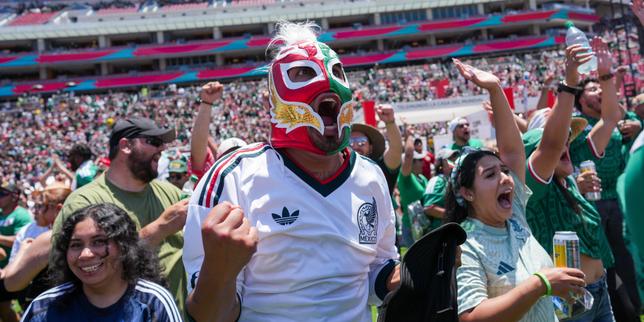
Mexico does not just support its football team; it projects its collective soul onto it. And lately, that soul has been bruised. Years of stagnation, bitter defeats to their American neighbors, and a feeling that the golden generation had withered away left the fans cynical, angry, and starved for a hero. They did not just need a win. They needed an exorcism.
Enter the old soldier.
At 33 years old, Jiménez was no longer the shiny new prospect. He was the survivor. When he walked onto the pitch at the Estadio Akron, he was carrying not just his own history, but the desperation of a football-mad country that had forgotten what joy felt like.
Consider what happens next. Twenty-two minutes into the match, Mexico wins a free kick well outside the penalty area. It is a distance meant for a crossing delivery, an invitation to loft the ball into the box and hope for a chaotic deflection.
Jiménez stands over the ball. He takes a deep breath. The stadium holds its collective breath with him.
He strikes it. It is not a delicate, curling effort designed to fool the goalkeeper. It is a thunderbolt. The ball travels with a ferocious, violent trajectory, bypassing the wall and crashing into the top corner of the net before the American keeper can even fully extend his arms.
The stadium erupted. But the true shift in the atmosphere did not happen in the stands. It happened on the pitch, in the eyes of the man who had just scored.
The Chemistry of Tears
We are conditioned to see athletes as machines. We track their expected goals (xG), their sprint speeds, their completion percentages, and their market values. We look at them through the cold lens of data, turning human beings into algorithms.
But data cannot calculate the weight of tears.
As his teammates swarmed him, burying him beneath a mountain of green jerseys, Jiménez broke. The stoic, fiercely competitive forward who had spent four years refusing to play the victim collapsed under the sheer emotional gravity of the moment. He was crying. Not the performative, camera-conscious tears of a modern celebrity, but the raw, ugly, convulsive sobbing of a man who had finally reached the top of a mountain he was never supposed to climb.
Those tears were not just about a beautiful free kick in a friendly match.
They were for the nights in the hospital. They were for the whispers that he was finished. They were for the fear that crept into his mind every time he challenged for a header. They were for the realization that against all odds, the old Raúl—the predator, the talisman, the king—was still alive inside the scarred body.
Later in the match, he would chase down a seemingly lost ball, slide into a tackle with the ferocity of a teenager trying to earn a contract, and execute a blind, spectacular rabona pass that set up Mexico’s second goal. It was a masterclass in defiance. It was a declaration that he was no longer playing to survive; he was playing to dominate.
The Permanent Light
The sports pages will tell you that Mexico beat the United States 2-0. They will give you the possession statistics, the tactical breakdowns of Mauricio Pochettino’s side, and the tournament implications for the CONCACAF region. They will treat the match as a data point in a long, endless calendar of fixtures.
They are missing the point entirely.
The true value of what happened in Guadalajara cannot be measured in points or standings. It exists in the unspoken agreement between an athlete and the people who watch him. For ninety minutes, a man who had been broken open and stitched back together showed a cynical world that the ending of your story is not dictated by the gravity of your fall, but by the ferocity of your refusal to stay down.
When the stadium lights eventually flickered off and the crowds emptied into the Guadalajara night, the scoreline began its slow fade into the history books. But the image of Jiménez, face buried in his hands, weeping under the floodlights, remains. It is an image that reminds us why we watch sports in the first place—not to see perfect machines win trophies, but to watch flawed, fragile human beings conquer their own ghosts.