Look at your hands. Hold them palms up, side by side. They look identical, right? Now try to stack them directly on top of each other facing the same direction. They don't match. Your thumbs point in opposite ways.
Molecules do the exact same thing. Chemists call this property chirality, derived from the Greek word for hand. Organic molecules can exist in two distinct spatial orientations that act as mirror images of each other, known as enantiomers. For decades, science faced a stubborn puzzle: life on Earth is strictly homochiral, meaning biological systems exclusively select one specific mirror image over the other. Proteins in your body use only left-handed amino acids, while DNA relies on right-handed sugars.
How did nature make that choice?
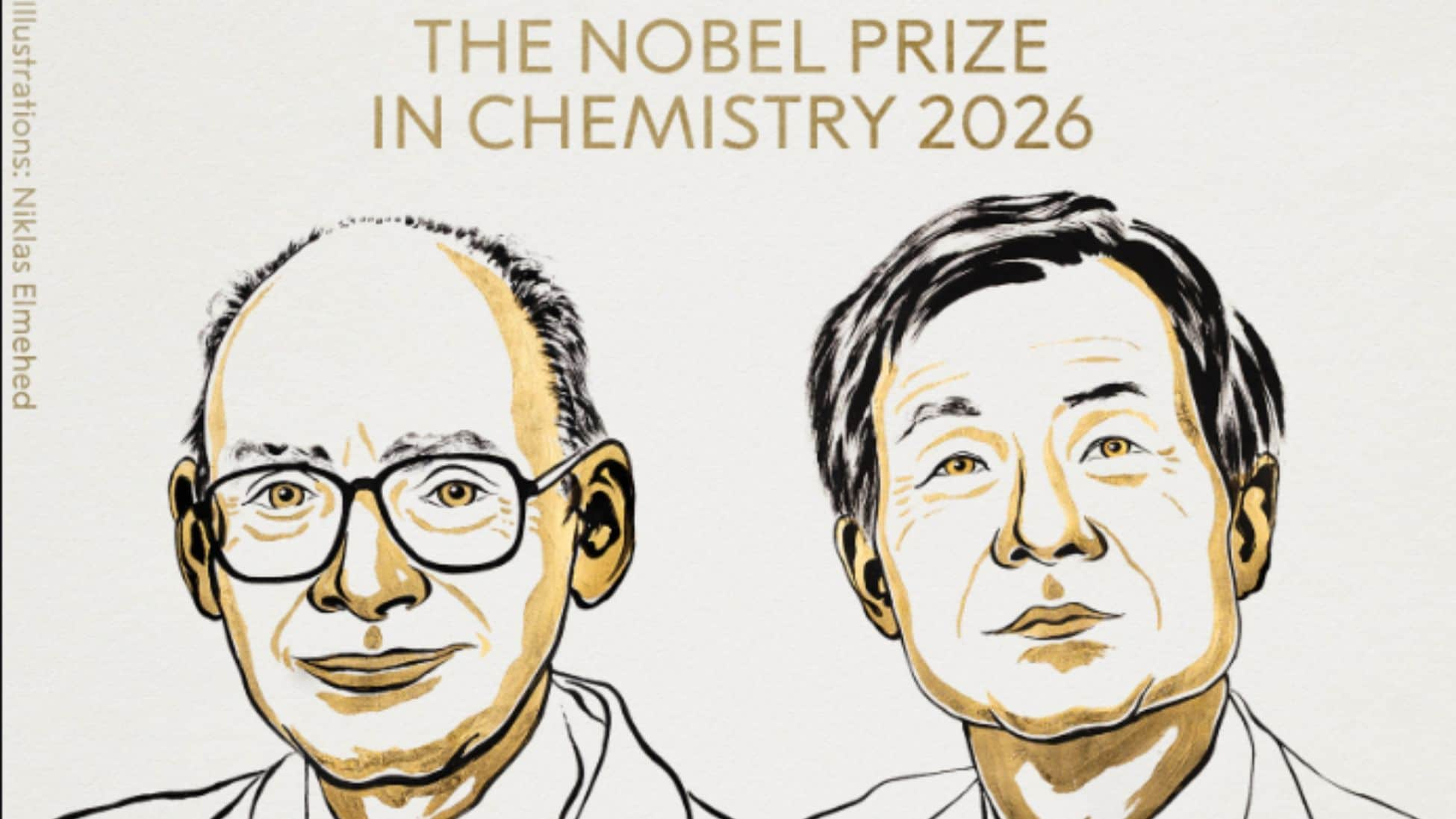
The Royal Swedish Academy of Sciences answered that question by awarding the 2026 Nobel Prize in Chemistry to French chemist Henri B. Kagan and Japanese chemist Kenso Soai. They won the prize for their groundbreaking discovery of non-linear effects and autocatalysis in asymmetric organic synthesis. Their work didn't just satisfy academic curiosity. It changed how modern medicine and chemical manufacturing actually happen.
Breaking Down the Handedness Problem
If you synthesize molecules in a standard laboratory flask using achiral starting materials, you usually get a racemic mixture—a fifty-fifty split of both mirror-image forms. Nature doesn't work that way. If you ingest a pharmaceutical drug where the molecules have the wrong chirality, the results can range from completely ineffective to disastrous.
For a long time, chemists struggled to create reactions that produced an overwhelming excess of just one enantiomer without relying on existing biological catalysts like enzymes. Henri Kagan cracked open the door to this problem during the 1980s. Working at Université Paris-Sud, Kagan discovered what chemists now call non-linear effects in asymmetric catalysis.
Kagan proved that the optical purity of a catalyst doesn't always scale linearly with the optical purity of the final product. Sometimes, even if you feed a reaction a partially flawed, impure chiral catalyst, the resulting product exhibits an unexpected amplification in its enantiomeric excess. This counterintuitive mathematical and chemical reality shocked the field. It proved that chemical systems could disproportionately favor one mirror image through cooperative molecular interactions.
The Soai Reaction And Molecular Self-Replication
Kagan laid the mathematical and theoretical groundwork, but Kenso Soai took the concept to a mind-bending extreme. In 1995, Soai published research detailing a chemical reaction that possessed the capability for asymmetric autocatalysis. By 2003, the Tokyo University of Science professor perfected a reaction where a chiral product acted as its own catalyst.
In what the scientific community immediately dubbed the "Soai reaction," a tiny, almost imperceptible initial imbalance of one mirror-image molecule triggered a runaway loop. The product catalyzed its own creation while continuously favoring its own specific handedness.
The reaction snowballed until the final mixture consisted almost entirely of a single mirror image. Outside of living organisms duplicating proteins or DNA, no human had ever witnessed chemical systems perform this feat. Soai essentially built a chemical amplifier in a flask, demonstrating how tiny environmental asymmetries—perhaps even polarized light from stars billions of years ago—could cascade into the single-handed chemistry of life we see today.
Why This Changes Pharmaceutical Manufacturing
Theoretical chemistry often feels distant from daily life, but this breakthrough impacts every single person who takes prescription medication.
Modern drug development relies heavily on asymmetric synthesis. If a pharmaceutical company wants to produce a targeted cancer treatment or a safe cardiovascular drug, they must isolate the exact molecular hand that interacts with human receptors. The other mirror image can act as toxic ballast.
Before Kagan and Soai unlocked non-linear amplification and autocatalysis, manufacturing single-enantiomer drugs required expensive, wasteful purification steps. By understanding how small enantiomeric excesses can be amplified into pure products, chemical engineers streamlined synthesis routes. They cut down chemical waste, lowered production costs, and made large-scale industrial manufacturing cleaner and more precise.
The Legacy of Two Decades of Persistence
Henri Kagan was born in 1930, and Kenso Soai was born in 1950. Their Nobel recognition proves that fundamental, curiosity-driven chemistry eventually rewrites the rules of industrial application. They spent decades chasing microscopic asymmetries that most researchers viewed as laboratory anomalies.
Next time you pop a pill or look at your own reflection, remember the invisible handedness governing the universe. Chemistry finally chose a mirror image, and these two scientists showed us exactly how it happened.