Let us invent a man for a moment. We will call him Elias.
Elias is a hypothetical taverna owner on the Greek island of Rhodes, but the math dictating his survival is painfully real. For three generations, his family’s white-washed restaurant has sat on a hill overlooking the Aegean Sea. In a normal July, the air smells of grilled octopus and salt.
This July, the air smells of boiling pine sap and sulfur.
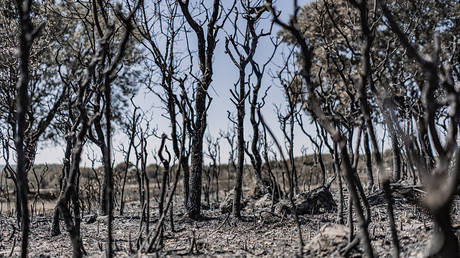
Elias sits in a plastic chair on his terrace. Black snow is falling. It lands in the empty wine glasses and coats the table linens in a fine, greasy grit. The sky above him is bruised purple, choking on smoke from a ridge three miles away. His phone buzzes with cancellation after cancellation. Tourists from Munich, London, and Stockholm are fleeing. His livelihood is evaporating in real-time.
Gone.
When financial newspapers report on the European Union’s wildfire crisis, they speak in the sanitized language of ledgers. They report that the bloc faces billions in economic damages. They cite gross domestic product disruptions and the strain on the EU Solidarity Fund.
But a billion euros is a bloodless number. It is too large for the human mind to actually weigh. To understand what is happening to the Mediterranean, we have to look at the ash on Elias’s tables. We have to look at the terrifying mechanics of a continent that is watching its own vacation destinations, carbon sinks, and agricultural heartlands turn to dust.
The true cost of these fires is a cascading failure of economies, ecologies, and human security.
To grasp the scale of the financial hemorrhage, you must look up at the sky. If Elias is lucky, he might see a yellow amphibious aircraft roaring overhead. This is a Canadair, a specialized water bomber.
Operating one of these machines is brutally expensive. When a fire breaks out, governments scramble to lease or deploy them. A single flight hour can cost thousands of euros. Now multiply that by dozens of aircraft, flying thousands of sorties, across Greece, Spain, Italy, and Portugal, week after agonizing week.
Who pays for this? The European taxpayer.
Historically, southern European countries managed their own firefighting fleets. But the fires have mutated. They are burning hotter, moving faster, and consuming more acreage than domestic fleets can handle. This forced the European Commission to build rescEU, a communal fleet of firefighting planes and helicopters stationed across member states. It is a brilliant display of cross-border solidarity. It is also an incredibly expensive band-aid applied to an arterial bleed.
The European Union has earmarked hundreds of millions of euros just to purchase new aircraft for this fleet by the end of the decade. That is capital diverted from education, from infrastructure, from healthcare. It is money spent just to keep the hillsides from disappearing entirely.
And the planes are only the beginning of the bill.
Consider what happens next: the fire is extinguished. The news cameras leave. The smoke clears, leaving behind a scarred, silent terrain.
For the hypothetical Elias, the immediate danger has passed, but his personal economic depression has just begun. The tourists are gone, taking their wallets with them. The local supply chains are severed.
Now scale Elias up. Entire regions in southern Europe rely heavily on summer tourism. It accounts for a massive percentage of local GDP. When a hillside burns, hotels sit empty. Rental car agencies shutter. Tour guides stay home. The local tax base shrinks precisely when the local government desperately needs funds to rebuild roads, restore power lines, and stabilize scorched earth to prevent winter mudslides.
Governments turn to Brussels for help. They apply to the EU Solidarity Fund, a financial instrument designed to aid member states struck by natural disasters.
There is just one agonizing problem. The fund was built for a climate that no longer exists.
Think of the Solidarity Fund like a family emergency savings account. If your car breaks down once a decade, the account works beautifully. You withdraw the money, fix the car, and slowly build the savings back up. But what happens if the car breaks down every Tuesday? What if the roof caves in on Wednesday, and the basement floods on Thursday?
The account drains. It hits zero.
The European disaster fund is facing unprecedented, relentless withdrawals. It is being stretched past its intended limits because the "unprecedented" disasters of the past are now the scheduled programming of the summer. The money is running out, and the fires are not stopping.
We are watching an economic feedback loop lock into place.
When forests burn, they release centuries of stored carbon back into the atmosphere. This accelerates the very warming that caused the vegetation to dry out into kindling in the first place. The European Union spends billions trying to reduce carbon emissions through green energy initiatives, only to watch its own forests instantly undo a massive chunk of that progress in a single afternoon.
The destruction of the timber industry. The incineration of ancient olive groves that take fifty years to mature. The skyrocketing insurance premiums for homeowners in high-risk zones. The respiratory illnesses flooding rural hospitals.
None of these line items make it into the headline figure. The "billions" quoted by financial analysts are just the floor. They are the tip of a terrifying iceberg.
It is deeply unsettling to watch the map of a continent slowly change color. There is a profound vulnerability in realizing that the systems we built to protect our economies are entirely outmatched by the physics of combustion. We have built our wealth on a fragile equilibrium. That equilibrium is currently on fire.
The story of Europe’s wildfires is not a story about forestry management or bureaucratic budgets in Brussels. It is a story about the agonizing subtraction of wealth, memory, and safety.
Elias wipes the black ash off the table with a damp cloth. It smears, leaving a dark streak across the white linen. He looks down at his phone. Another cancellation. He turns off the lights in the empty taverna and walks out into the falling gray snow.