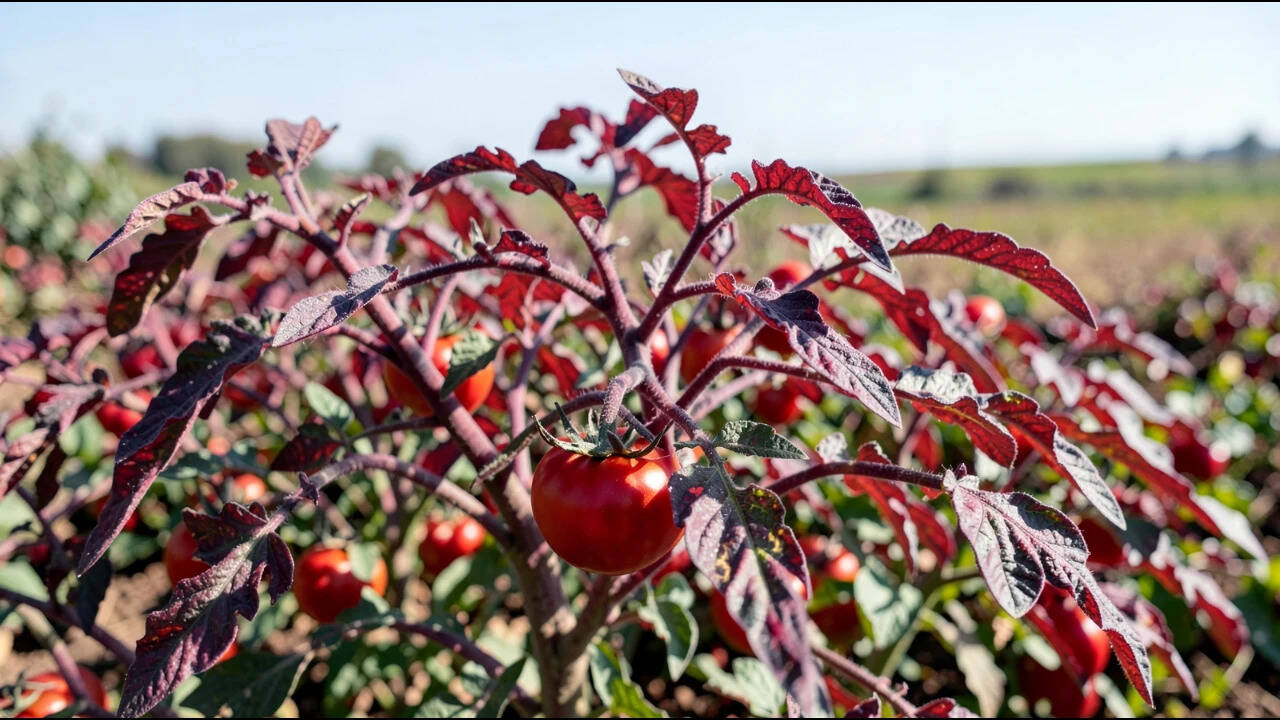
Researchers at Cornell University have engineered tomato plants that visibly change color when deprived of nitrogen, turning their foliage a distinct purple before permanent yield loss sets in. By tying the plant's natural stress-response pigments directly to nutrient-sensing pathways, scientists have created a living diagnostic tool designed to curb synthetic fertilizer overuse, slash agricultural runoff, and give growers a real-time visual alert without expensive soil sensors or lab testing.
It sounds straightforward. Put a biological warning light on a cash crop, and farmers will stop dumping excess nitrogen onto their fields. Yet anyone who has spent time walking commercial acreage knows that a breakthrough inside a climate-controlled university greenhouse rarely translates cleanly to a three-thousand-acre operation running on thin margins and brutal weather cycles.
The real story behind color-changing tomatoes is not just a clever piece of genetic engineering. It is an indictment of how modern agriculture manages its most expensive, environmentally destructive input—and a test of whether biology can outsmart a supply chain built on guesswork.
The Blind Spot Costing Agriculture Billions
Modern farming runs on synthetic nitrogen. Since the widespread adoption of the Haber-Bosch process in the twentieth century, global crop yields have exploded, feeding billions of people who otherwise would have starved. That triumph comes with a massive, systemic flaw. Plants are notoriously inefficient at taking up the nitrogen applied to them.
Across global row crops and specialty vegetables, roughly half of all applied synthetic nitrogen never makes it into the harvested plant. Instead, it leaches past the root zone into groundwater as nitrates, runs off into rivers to fuel massive toxic algal blooms, or volatilizes into the atmosphere as nitrous oxide—a greenhouse gas nearly three hundred times more potent than carbon dioxide over a century.
Growers do not waste fertilizer out of malice. They do it out of fear.
Nitrogen is the primary driver of vegetative growth and chlorophyll production. If a crop runs short during a critical developmental window, the yield penalty is irreversible. Because traditional soil testing takes days or weeks—and leaf tissue analysis requires pulling samples, shipping them to a lab, and waiting for a spreadsheet—farmers treat nitrogen like cheap insurance. They front-load applications or apply extra passes just to be safe. By the time a plant naturally shows the pale yellowing of chlorosis, the standard visual symptom of nitrogen starvation, the damage to the harvest is already locked in.
How the Cornell Biosensor Actually Works
To beat that biological clock, the Cornell research team bypassed external hardware entirely. Rather than asking growers to buy multispectral drones, install buried moisture-and-ion probes, or subscribe to satellite imagery platforms, they turned the plant itself into the sensor.
The mechanism relies on anthocyanins, the same water-soluble flavonoid pigments that give blueberries their deep hue, turn autumn maple leaves crimson, and tint heirloom purple tomatoes. Plants naturally produce anthocyanins as a protective sunscreen and antioxidant shield when subjected to extreme environmental stress, such as intense UV radiation, cold snaps, or severe nutrient deprivation.
Normally, a tomato plant waits too long to trigger this response under mild nitrogen stress. The researchers rewired the plant's internal genetic circuitry—specifically targeting the transcription factors that govern anthocyanin biosynthesis—and linked those switches to promoters that activate the moment cellular nitrogen levels begin to dip.
Here is the practical sequence in the field:
- Baseline Growth: Under adequate nitrogen availability, the engineered tomato looks indistinguishable from a conventional green plant, focusing its metabolic energy on photosynthesis and fruit development.
- Early Depletion: As soil nitrogen drops below optimal thresholds—well before chlorophyll breaks down or growth stunts—the plant's internal nutrient sensors detect the deficit.
- Pigment Activation: Those sensors trigger the upregulated anthocyanin pathway, flooding the leaves and stems with purple pigment within days.
- Targeted Intervention: A grower walking the rows or flying a basic RGB camera over the field spots the color shift immediately and applies a precise dose of fertilizer only where needed.
Consider a hypothetical scenario on a mid-sized commercial tomato farm in California's Central Valley. Under standard management, a grower might apply a uniform broadcast or fertigation schedule across fifty blocks, over-applying in fertile pockets with high organic matter while under-feeding sandy ridges. With sentinel plants interspersed throughout the rows—or an entire crop carrying the trait—the sandy ridges would visibly purple days ahead of the fertile blocks. The grower adjusts the drip irrigation valves for those specific zones, cutting total nitrogen volume while protecting fruit set.
Why Sentinel Plants Beat Silicon Sensors
The agricultural technology sector has spent the last decade trying to solve the nitrogen problem with hardware and software. Silicon Valley startups have pitched everything from laser-induced breakdown spectroscopy to AI-driven satellite analytics. Most of these tools stumble over the same operational hurdles.
Hardware breaks. Soil sensors get sheared off by tillage equipment, chewed by rodents, or fouled by mineral buildup in drip lines. Even when they work, a single probe measures a volume of soil roughly the size of a grapefruit, telling a grower almost nothing about spatial variability fifty feet away.
Remote sensing via drones or satellites solves the spatial issue, yet introduces data bottlenecks. High-resolution spectral imaging requires calibration, clear skies, cloud-processing pipelines, and agronomic interpretation. A farmer during peak summer harvest does not want another dashboard alert or a heat map requiring three software logins to decipher. They want an answer they can see from the cab of a pickup truck.
Biological biosensors collapse the distance between detection and decision. There are no batteries to replace, no cellular dead zones to navigate, and no subscription fees to renew every spring. The data is rendered directly onto the leaf surface in plain sight.
The Metabolic Tax Nobody Wants to Talk About
Every genetic modification carries a physiological trade-off, and plant biology is unforgiving about energy budgets. Producing anthocyanins is not free.
Synthesizing complex flavonoid pigments requires carbon skeletons and metabolic energy (ATP) that the plant would otherwise direct toward vegetative expansion, root architecture, or fruit sugar accumulation. In agronomic terms, this is known as a yield drag or metabolic penalty. If a plant turns purple too easily—say, during a brief cool night or a minor, temporary dip in soil moisture—it could waste precious energy producing pigment instead of tomatoes.
Furthermore, anthocyanin expression is notoriously sensitive to environmental noise. Anyone who has grown tomatoes outdoors knows that cold spring temperatures routinely turn young stems purple because low soil temperatures temporarily block phosphorus uptake. If a field turns purple after an unseasonable cold front, a grower relying on visual cues could easily misdiagnose the problem, dumping expensive nitrogen onto a crop that actually just needs warmer weather.
Separating a true nitrogen signal from background environmental stress remains one of the trickiest hurdles in moving synthetic biology out of growth chambers and into open-air agriculture. A greenhouse maintains steady temperatures, uniform lighting, and sterile potting media. A commercial field is a chaotic battlefield of fluctuating pH, fungal pressure, erratic rainfall, and uneven soil compaction.
The Regulatory and Commercial Gauntlet
Even if the biology performs flawlessly across ten different soil types and climate zones, getting a color-changing tomato into commercial seed catalogs involves navigating a brutal regulatory and market reality.
In the United States, crops modified through targeted gene editing (such as CRISPR-Cas9) that do not introduce foreign DNA from other species can often bypass the heaviest tiers of USDA oversight, provided they mirror traits achievable through conventional breeding. However, if the genetic construct relies on transgenic elements—promoters or regulatory sequences pulled from unrelated organisms—the plant falls under strict regulatory review. That process costs millions of dollars and takes years of field trials to clear.
Export markets complicate the math further. The European Union maintains notoriously restrictive rules governing genetically modified organisms, and major international food processors frequently reject biotech traits in fresh produce out of fear of consumer backlash. While commodity growers in North and South America eagerly adopted biotech corn, soy, and cotton decades ago, the fresh vegetable and specialty crop sectors have largely stayed away from genetic engineering.
Tomatoes occupy a unique middle ground. Fresh-market heirloom buyers might recoil at a biotech label, yet the massive processing tomato industry—which turns millions of tons of fruit into paste, sauce, and ketchup—operates entirely on industrial efficiency and processor contracts. Processing growers care deeply about input costs, Brix sugar levels, and compliance with tightening state groundwater regulations.
To bypass consumer hesitation altogether, seed companies could deploy these engineered plants strictly as indicator sentinels. Rather than planting an entire field of gene-edited tomatoes, a grower could plant a handful of color-changing sentinel plants every hundred feet along a row, ripping them out before harvest or leaving them unpicked. The farm gets the diagnostic benefit of real-time nitrogen mapping across the entire acreage while harvesting 100 percent conventional fruit.
The Policy Hammer Driving Adoption
Ten years ago, a nitrogen-sensing tomato would have been treated as an academic curiosity. Today, regulatory pressure is turning nutrient efficiency into a survival requirement.
In regions like California's Salinas and San Joaquin Valleys, strict agricultural water orders now require growers to report exact nitrogen balances—tracking every pound of fertilizer applied against every pound removed in harvested crops. Exceeding allowable thresholds triggers steep fines, mandatory management plans, and intense scrutiny from regional water boards. Similar nutrient-cap policies are tightening across the Chesapeake Bay watershed, the Mississippi River basin, and throughout Western Europe.
At the same time, global fertilizer markets have proven violently unstable. Geopolitical shocks, natural gas price spikes, and supply chain bottlenecks have repeatedly sent nitrogen prices soaring, squeezing farm profitability at the exact moment equipment and labor costs are hitting record highs.
When fertilizer is cheap and runoff is unregulated, precision agriculture is a luxury. When fertilizer prices double and groundwater nitrates carry legal liability, knowing the exact week a plant begins to run dry becomes a direct financial lifeline.
What Separates Hype From Field Reality
Academic press releases routinely frame early-stage genetic breakthroughs as immediate solutions to global crises. Experienced agronomists know better. Between a proof-of-concept paper in a peer-reviewed journal and a commercial seed packet sits a brutal gauntlet of breeding work.
The trait must be introgressed—bred through multiple generations—into elite commercial tomato varieties that already possess high yield potential, firm fruit skin for mechanical harvesting, and resistance to devastating pathogens like Fusarium wilt, Verticillium wilt, and tomato spotted wilt virus. A farmer will never sacrifice disease resistance just to get a color-changing leaf.
Field trials must also prove that the color change happens early enough to allow corrective action, yet slowly enough that growers have a realistic operational window to respond. In a busy commercial operation, spotting a purple hue on Tuesday means scheduling a fertigation run or a foliar spray by Friday. If the yield penalty hits on Wednesday, the visual alert is useless.
For decades, agriculture has tried to manage living systems with blunt mechanical tools—spreading uniform blankets of chemicals across wildly diverse landscapes and hoping the averages work out. Rewiring the crop itself to broadcast its internal chemistry flips that entire model on its head. Whether the Cornell tomato reaches commercial fields as a standalone cultivar or a sacrificial sentinel planted alongside conventional rows, it proves that the most accurate sensor in farming is not bolted to a tractor or orbiting in low Earth orbit—it is rooted directly in the dirt.