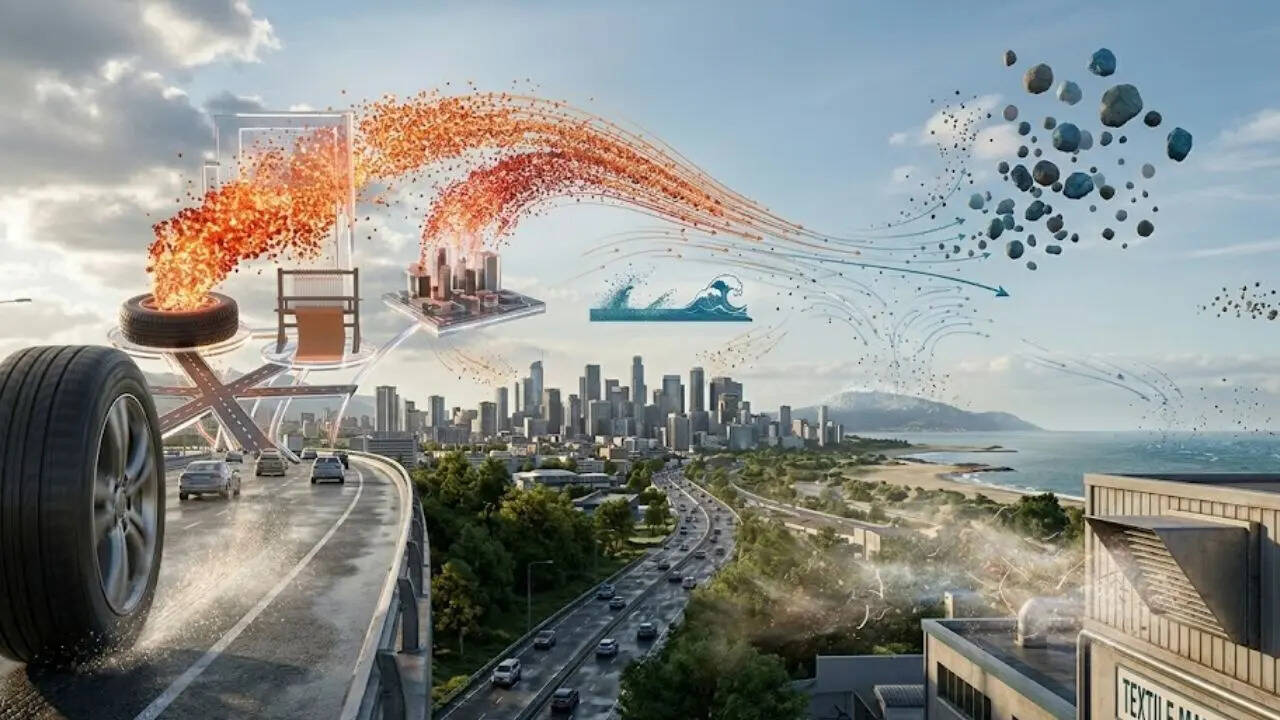
For years, the narrative surrounding microplastics focused on the sea. We were told to worry about the Great Pacific Garbage Patch and the slow degradation of water bottles in the surf. While those are legitimate ecological disasters, they aren't the primary reason you are currently inhaling plastic. The most significant source of airborne microplastics isn't the ocean or even the local landfill. It is the road beneath your feet. Specifically, the relentless friction between rubber tires and asphalt.
The atmospheric plastic crisis is a transport problem. Every time a vehicle accelerates, brakes, or turns, microscopic fragments of synthetic rubber and plastic polymers tear away from the tire. These particles are small enough to be swept up by the wind, traveling thousands of miles before settling in the lungs of city dwellers or on the pristine snow of the Arctic. Recent atmospheric modeling shows that tire wear particles account for nearly a third of all microplastics in the environment, and they represent the lion's share of what we breathe.
The Friction Trap
Modern tires are a chemical marvel and an environmental nightmare. Despite the name "rubber," a standard car tire is composed of about 24% synthetic rubber—essentially a plastic polymer derived from petroleum. When these tires hit the road, they don't just wear down; they disintegrate. This isn't a design flaw. It is a fundamental requirement of grip and safety. Without this shedding of material, your car would slide off the road at the first sign of rain.
The scale of this shedding is staggering. Estimates suggest that the average tire loses approximately four kilograms of material over its lifetime. Multiply that by the billions of vehicles on the road globally, and the result is a constant, invisible blizzard of polymer dust.
Unlike the plastic bags floating in the ocean, these particles are ready-made for inhalation. They are frequently smaller than 10 micrometers ($PM_{10}$) or even 2.5 micrometers ($PM_{2.5}$). At these sizes, the body’s natural filters—the nose and throat—cannot stop them. They penetrate deep into the alveolar sacs of the lungs and can even enter the bloodstream.
The Electric Vehicle Paradox
Heavy cars make the problem worse. This creates a friction-point for the green energy transition. Electric vehicles (EVs) are hailed as the solution to tailpipe emissions, but they are significantly heavier than their internal combustion counterparts due to massive battery packs. A heavier vehicle requires more friction to stop and more force to move.
Early data suggests that EVs can produce up to 20% more tire wear than traditional cars. We are effectively trading carbon dioxide for physical polymer pollution. This doesn't mean we should abandon EVs, but it highlights a massive blind spot in current environmental policy. We are cleaning the air of gases while thickening it with solids.
Regulators have spent decades tightening standards for exhaust emissions. Catalytic converters and particulate filters have made modern engines remarkably clean compared to those of the 1970s. However, non-exhaust emissions (NEE) remain almost entirely unregulated. There is no "muffler" for a tire. As tailpipe emissions drop, the relative contribution of tire dust to urban air pollution grows. In many modern cities, tire and brake wear now contribute more particulate matter to the air than the actual engine exhaust.
The Chemical Cocktail in the Clouds
Tire dust isn't just inert plastic. It is a delivery system for toxic additives. To make tires durable, manufacturers add a variety of chemicals, including antioxidants, antiozonants, and vulcanizing agents. One specific compound, 6PPD, has recently come under intense scrutiny.
When 6PPD reacts with ozone in the atmosphere, it transforms into 6PPD-quinone. This byproduct is highly toxic. Researchers in the Pacific Northwest discovered that 6PPD-quinone was responsible for mass die-offs of coho salmon in urban streams after rainstorms washed road dust into the water. If it can collapse a fish's vascular system at parts-per-billion concentrations, the long-term impact on human respiratory health warrants more than just a passing glance.
The wind carries these toxins everywhere. Research has found tire-derived microplastics in the most remote regions of the Pyrenees and the Alps. The particles are dark, which means they absorb heat. When they land on glaciers or ice caps, they accelerate melting by reducing the "albedo effect," or the ability of the ice to reflect sunlight. The plastic we lose on a highway in Berlin or Los Angeles eventually helps melt the polar ice.
Beyond the Asphalt
While tires are the primary culprit, they aren't the only ones. The "urban shedding" phenomenon includes several other major contributors that the "ocean-first" narrative ignored.
- Synthetic Textiles: Every time someone walks down a city street in a polyester fleece or nylon jacket, they are shedding fibers. These "microfibers" are even more aerodynamic than tire dust.
- Road Markings: The white and yellow lines on the road are not just paint. They are high-performance polymer coatings. As traffic grinds over them, they flake off into the air.
- Brake Pads: Though often metallic or ceramic, brake pads contain binder resins that qualify as microplastics. The heat of braking aerosolizes these materials instantly.
The common thread here is friction. Our entire modern lifestyle is built on materials rubbing against each other. In a world obsessed with "circular economies," we have ignored the fact that our most common materials are designed to be shed and forgotten.
The Engineering Challenge
Solving the airborne microplastic crisis requires a complete overhaul of material science. We cannot simply stop driving. Nor can we return to natural rubber tires, as the global supply of Hevea trees cannot meet the demand of 1.5 billion vehicles without total deforestation.
Some startups are attempting to capture the dust at the source. There are prototypes of "dust collectors" that sit behind the wheel, using electrostatics to pull particles into a canister before they hit the wind. While the tech is promising, it adds weight, cost, and maintenance to a vehicle. Convincing a consumer to pay an extra $500 to catch their own tire dust is a hard sell when that dust is invisible.
The real shift must happen at the molecular level. We need "wear-stable" polymers that don't fracture into the $PM_{2.5}$ range. Or, conversely, we need biodegradable elastomers that break down into harmless organic compounds when they hit the soil. Neither currently exists at a commercial scale.
The Policy Vacuum
Government agencies are slow to move because measuring this pollution is difficult. You can put a sensor on an exhaust pipe. You cannot easily put a sensor on every square meter of a highway.
Current air quality standards focus on the mass of particles, not their composition. A microgram of soot is treated the same as a microgram of toxic tire polymer. This is a mistake. Until we have specific limits on polymer-derived particulates, the industry has no incentive to change its formulas.
The industry likes the current ambiguity. As long as the public believes microplastics are just a "water problem," tire manufacturers can continue to treat the atmosphere as a free disposal site. They frame the issue as a matter of "road safety," suggesting that any change to tire composition would result in more accidents. It is a classic false choice. We should not have to choose between a car that stops and a child who can breathe.
Identifying the Hotspots
If you live within 500 meters of a major highway or a busy intersection, you are in the "red zone" for tire dust. The concentration of these particles drops off significantly as you move away from the road, but it never hits zero.
Urban "canyons"—streets with tall buildings on both sides—act as traps. The wind swirls the particles, keeping them suspended at street level for hours. If you are a cyclist or a pedestrian in these areas, your exposure is at its peak. The very act of exercising in these environments increases your respiration rate, drawing more of this polymer dust deeper into your lungs.
It is a bitter irony that the people trying to reduce their carbon footprint by walking or biking are the ones most exposed to the plastic shedding of the cars passing them.
The Limits of Filtration
Can we filter our way out of this? Indoor air purifiers with HEPA filters are effective at catching tire dust that drifts into homes. But we don't live our lives in sealed bubbles. The sheer volume of material being generated daily dwarfs our current filtration capacity.
We are essentially conducting a global, uncontrolled experiment on human lung tissue. We know that these particles cause inflammation. We know they carry heavy metals and endocrine disruptors. What we don't know is the tipping point—the level of cumulative exposure where the body's repair mechanisms simply give up.
A New Metric for Sustainability
We need to change how we define a "clean" vehicle. The current "Zero Emissions" label is a lie of omission. It refers only to the tailpipe. A truly sustainable vehicle must be measured by its total environmental output, including the mass of the tires it consumes and the chemicals those tires release.
This requires transparency from the chemical and rubber industries. Currently, the specific formulations of tires are "trade secrets." This prevents independent researchers from fully understanding the health risks associated with specific brands or models. We need a "Nutrition Facts" label for tires, detailing the polymer types and chemical additives.
The focus must shift from the ocean to the air. While we spend millions of dollars trying to skim plastic out of the sea, we are ignoring the fact that we are breathing the same material every time we step outside. The road isn't just a way to get from point A to point B. It is a massive, decentralized factory for airborne plastic.
Stop looking at the beach for the source of the problem. Look at the black marks on the pavement. That is the plastic that is actually inside you.