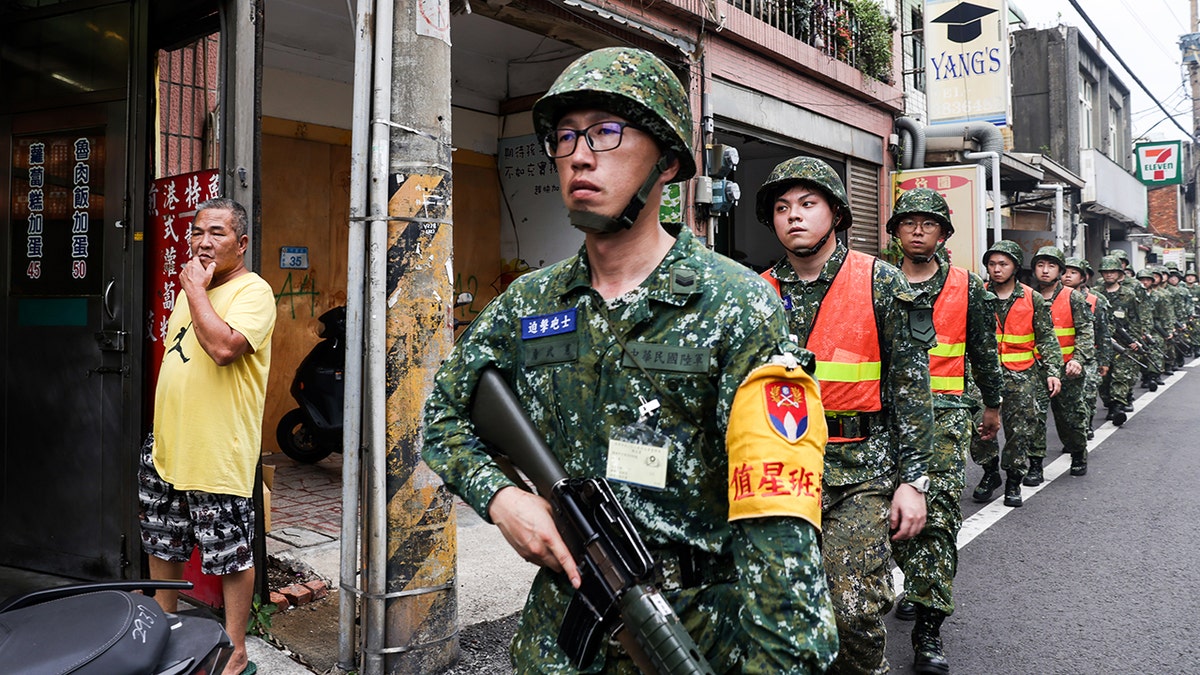
The math of modern warfare is becoming a nightmare for Taipei. While diplomats in Washington talk about "ironclad" commitments, the physical reality in American munitions factories tells a different story. The United States is currently burning through its strategic reserves of interceptor missiles and precision-guided munitions at a rate that far outpaces its ability to build them. This isn't a theoretical problem for the future. It is a live crisis triggered by the widening conflict between Israel and Iran, which has forced the U.S. Navy to expend hundreds of Standard Missiles—the same assets intended to deter a Chinese blockade of Taiwan.
Taiwanese officials are watching the skies over the Middle East with growing dread. Every time a $2 million interceptor strikes a $50,000 Iranian drone, the "porcupine strategy" designed to protect Taiwan loses a quill. The fundamental issue is that the American defense industrial base is optimized for a world that no longer exists—a world of short, limited engagements rather than prolonged, high-intensity attrition.
The Burning Fuse of the American Stockpile
The arithmetic is brutal. During recent exchanges, the U.S. and its allies have used a significant portion of their available SM-2 and SM-6 interceptors to neutralize Iranian threats. These missiles are the backbone of carrier strike group defense. For Taiwan, these are not just American weapons; they are the primary deterrent against the People’s Liberation Army (PLA) Air Force.
Building a single high-end interceptor is not like rolling a car off an assembly line. It requires specialized chemicals, rare earth minerals, and highly trained technicians. Lead times for these components often stretch beyond 24 months. If the U.S. empties its magazines in the Middle East today, it cannot simply "surge" production to refill them by tomorrow. The "just-in-time" manufacturing logic that rules the commercial sector has crippled military readiness. We are seeing a mismatch between geopolitical ambition and industrial capacity.
The Missile Gap That Nobody Wants to Admit
For decades, the U.S. relied on a qualitative edge to offset quantitative disadvantages. That edge is sharpening, but the volume is shrinking. China’s rocket force operates on home turf with short supply lines and a massive, state-directed manufacturing engine. In contrast, the U.S. must ship every crate of ammunition across the Pacific while competing with active war zones in Ukraine and the Levant for the same limited pool of parts.
Specific bottlenecks include solid rocket motors and aging microelectronics. The Pentagon is currently trying to entice private contractors to reopen lines that were shuttered after the Cold War, but private capital is wary of the "boom and bust" cycle of defense spending. Why would a company invest $500 million in a new factory if they fear a peace treaty or a budget cut will cancel the orders in three years? Without long-term, multi-year procurement guarantees, the industrial base will remain brittle.
Taiwans Nightmare Scenario of Prioritization
The fear in Taipei is not just that the missiles will run out, but that Taiwan will be moved down the priority list. When a conflict is active, as it is in the Middle East, the immediate tactical need usually wins out over long-term strategic deterrence. The Biden administration has used Presidential Drawdown Authority to send weapons to Ukraine and Israel, but Taiwan requires specific, high-end capabilities that are currently in short supply.
If a crisis breaks out in the Taiwan Strait, the U.S. would need thousands of Long Range Anti-Ship Missiles (LRASMs) and Joint Air-to-Surface Standoff Missiles (JASSMs) within the first week. Current production rates for these items are measured in the hundreds per year, not thousands. This creates a "window of vulnerability" where Beijing might calculate that the U.S. simply doesn't have enough rounds in the chamber to sustain a second front.
The Illusion of Foreign Military Sales
Taiwan has a massive backlog of purchased equipment—over $19 billion worth—that has been delayed by supply chain hiccups and the diversion of resources to other conflicts. While the U.S. argues that these are different "pots" of money and equipment, the reality is that they all come from the same handful of factories.
- Harpoon Missiles: Essential for coastal defense, but production lines are strained.
- Stinger Missiles: Effectively depleted by the war in Ukraine.
- Patriot Interceptors: High demand in Europe and the Middle East makes delivery to Taiwan a secondary concern.
This backlog is more than a logistical annoyance; it is a signal of weakness. Deterrence only works if the adversary believes you have the tools to back up your words. Right now, the tools are stuck in a shipping container or haven't even been cast in a mold yet.
Why the Industrial Base Failed to Pivot
The blame lies in thirty years of "peace dividend" thinking. After the Soviet Union collapsed, the U.S. defense industry consolidated from dozens of major players down to five "primes." This removed the redundancy and competition required for a rapid wartime footing. We traded resilience for efficiency.
In a hypothetical scenario where the U.S. enters a hot war with China, the military would likely exhaust its entire inventory of long-range precision missiles within eight days. After that, the conflict turns into a war of industrial endurance. China currently holds the advantage in that category, controlling a massive percentage of the global shipbuilding and steel-making capacity. To win a war of attrition, you need a deep bench. The U.S. bench is currently empty.
The Microchip Irony
The most stinging irony is the role of semiconductors. Taiwan produces the vast majority of the world's advanced logic chips, which are required for the very missiles the U.S. is struggling to build. If China moves on Taiwan, the global supply of chips halts. If the chip supply halts, the U.S. cannot build more missiles to defend Taiwan. It is a circular dependency that ends in a total collapse of defense manufacturing.
Washington has attempted to address this with the CHIPS Act, aiming to bring manufacturing back to American soil. However, these factories take years to build and even longer to reach the yields necessary for military-grade hardware. We are racing against a clock that is ticking faster in the Taiwan Strait than it is in the halls of Congress.
Rebuilding the Arsenal of Democracy
If the U.S. wants to maintain a free and open Indo-Pacific, it must move toward a "warm start" industrial policy. This means paying companies to keep assembly lines running even during peacetime and stockpiling critical components like seekers and sensors. It also means moving away from "exquisite" systems that take years to build in favor of "attritable" systems—cheaper, mass-produced drones and missiles that can be fielded in the thousands.
The current strategy of using million-dollar missiles to swat down cheap drones is a fiscal and strategic dead end. It is a slow-motion surrender by exhaustion. To fix this, the U.S. must integrate its defense supply chains with allies like Japan, Australia, and Taiwan itself. Co-production is no longer an option; it is a necessity. If a missile can be built in Taipei or Sydney, it relieves the pressure on the overstretched American plants.
The hard truth is that Taiwan cannot rely on a miracle. The missiles they need are being spent elsewhere, and the factories are not catching up. Until the U.S. treats its industrial capacity as a frontline combat capability rather than a back-office logistical concern, the risk of a Pacific conflict will continue to rise.
Audit your current defense partnerships and demand a clear, component-level breakdown of delivery timelines before the next regional flare-up turns a supply delay into a national catastrophe.