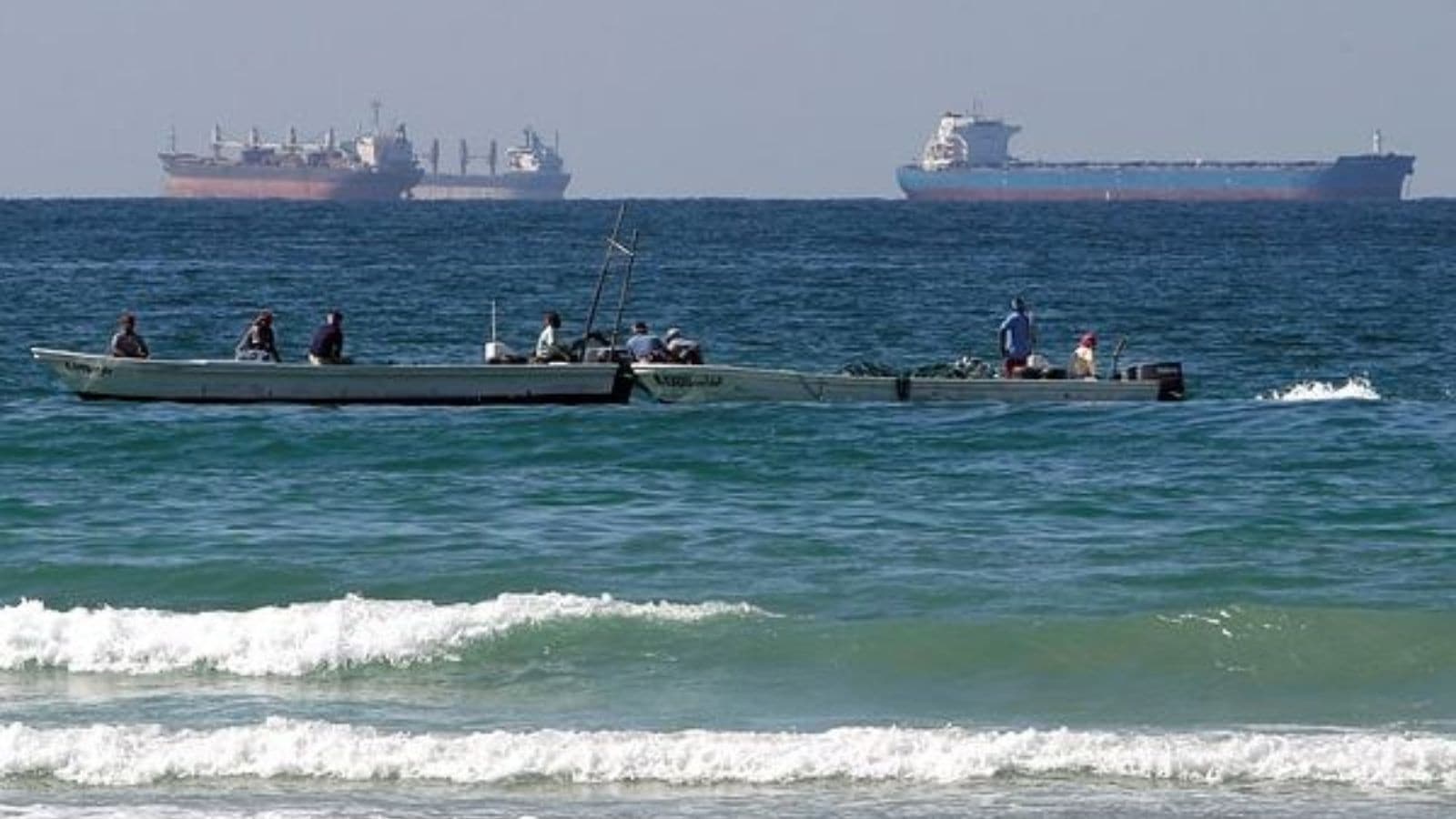
The headlines are predictable. They read like a script from a 1980s Cold War thriller. US warships "brave" the Strait of Hormuz. Iranian fast boats "force" a retreat after a thirty-minute warning. The media eats it up because tension sells advertising. The public eats it up because we love a clear protagonist and antagonist.
But if you believe this is a story about imminent naval warfare or "territorial integrity," you are being played.
The "confrontation" in the Strait of Hormuz is not a military event. It is a highly choreographed, high-stakes marketing campaign for two aging military-industrial complexes. One side needs to justify a bloated carrier strike group budget; the other needs to maintain the illusion of regional dominance to keep a domestic population from looking at its failing economy.
Let’s dismantle the "lazy consensus" of the evening news.
The Myth of the "Warning"
The reports claim Iran issued a "thirty-minute warning" that caused US vessels to turn back. This is a fundamental misunderstanding of how the Law of the Sea and naval rules of engagement actually function.
Under the United Nations Convention on the Law of the Sea (UNCLOS), specifically the doctrine of Transit Passage, international vessels have the right to pass through straits used for international navigation. The Strait of Hormuz is the textbook example. Iran may claim these are its "territorial waters," but international law disagrees.
The US Navy does not "turn back" because a guy on a radio in Bandar Abbas says so. If a US destroyer alters its course, it is because of a pre-planned navigational waypoint, not a sudden onset of fear.
Why do we hear this narrative then? Because it serves both parties.
- Tehran gets to broadcast to its proxies in Lebanon, Yemen, and Iraq that it "stood up to the Great Satan."
- Washington hawks get to use the "aggression" to lobby for more littoral combat ships and increased funding for the 5th Fleet.
It’s a symbiotic relationship built on a lie.
The Math of a Real Blockade
Every armchair general loves to talk about Iran "closing the Strait." It’s the ultimate bogeyman for the global economy. "Oil will hit $300 a barrel!" they scream.
Let’s look at the actual physics.
The Strait of Hormuz is roughly 21 miles wide at its narrowest point. However, the shipping lanes—the actual deep-water channels where the VLCCs (Very Large Crude Carriers) travel—are only two miles wide in each direction, separated by a two-mile buffer zone.
Closing that gap isn't about scaring a destroyer. It requires a sustained, multi-domain denial of access that Iran simply cannot maintain.
To actually "close" the strait, Iran would have to:
- Deploy thousands of smart mines (which are cleared by US and allied mine-countermeasure ships faster than they can be laid).
- Sustain a missile barrage against the Aegis Combat System, which is designed specifically to handle "saturated" environments.
- Willingly commit economic suicide.
China is Iran's biggest customer. If Iran chokes the Strait, they choke the Chinese economy. Does anyone honestly believe the IRGC is going to bite the hand that feeds them just to prove a point to a passing US frigate?
The Asymmetric Obsession
The media loves the "David vs. Goliath" narrative—the idea that Iranian swarming boats can take down a billion-dollar American warship. I have spent years analyzing maritime security, and I can tell you: the "swarm" is a tactical nuisance, not a strategic threat.
The US Navy has spent the last two decades perfecting point-defense systems like the Phalanx CIWS and the Mk 38 25mm machine gun system. A swarm of fiberglass boats equipped with RPGs and heavy machine guns against a modern destroyer is like bringing a toothpick to a chainsaw fight.
The real danger isn't the boats. It’s the miscalculation.
The danger is that some junior officer on either side gets itchy. But even then, the escalation ladder is far more rigid than people think. These "confrontations" are handled with professional boredom by the crews on the water. They are shouting at each other over Bridge-to-Bridge radio while drinking lukewarm coffee. The "tension" is a product of the editing room, not the bridge of the ship.
Your Questions Are Wrong
When people ask, "Will this lead to war?" they are asking the wrong question.
The right question is: "Who profits from the appearance of a near-war?"
- Defense Contractors: Nothing secures a contract for a new class of unmanned surface vessels like a grainy video of an Iranian drone buzzing a carrier.
- Oil Speculators: Every time a "warning" is issued, the Brent Crude ticker jumps. Fortunes are made on the volatility of fear.
- The Iranian Regime: Friction with an external enemy is the oldest trick in the dictator’s handbook to suppress internal dissent.
The Technology Gap is Expanding, Not Closing
There is a common take that "cheap drones" have leveled the playing field. This is the "lazy consensus" of the tech-bro era.
While it's true that a $20,000 Shahed drone is a cost-effective way to harass a target, it doesn't change the fundamental reality of blue-water naval power. A carrier strike group is a floating city with its own sovereign airspace.
We are seeing the integration of directed-energy weapons (lasers) on US ships. The cost-per-shot for a laser to down a drone is roughly the price of a gallon of diesel. The "asymmetric advantage" of cheap drones is being neutralized by the physics of light.
The competitor's article wants you to feel a sense of dread. It wants you to feel like the world is on the brink. It isn't. It's just business.
Stop Reading the Script
If you want to understand the Middle East, stop looking at the ships and start looking at the insurance rates.
Lloyd's of London and other maritime insurers are the real barometers of conflict. When they stop insuring tankers, then you can worry. Right now? They are charging a "war risk" premium—a tidy little profit center—while knowing full well that the chances of a tanker being sunk in a total war scenario are statistically negligible.
The "30-minute warning" was a PR stunt. The US crossing the Strait was a routine commute.
Stop falling for the theater. The Strait of Hormuz isn't a flashpoint; it's a billboard.
Don't buy what they're selling.