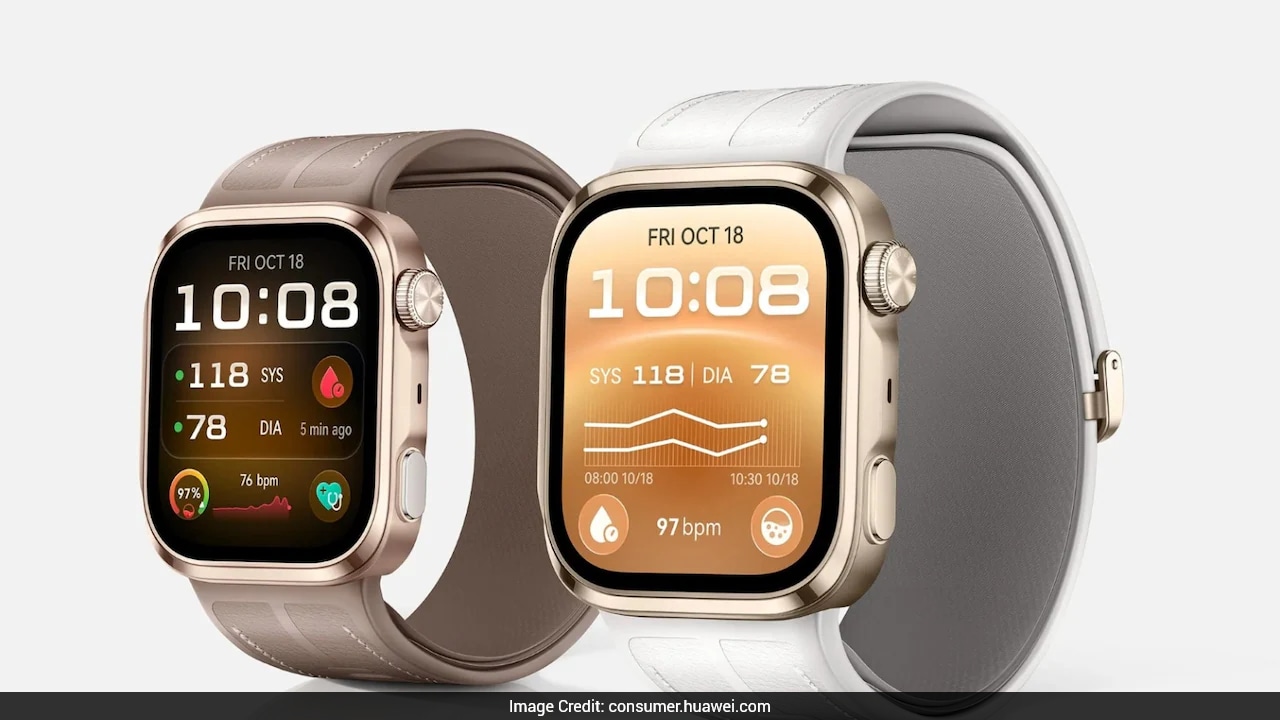
The consumer technology press spent years treating blood pressure on the wrist as an optical illusion. Silicon Valley giants chose to rely on light-based photoplethysmography, attempting to coax systolic and diastolic numbers out of flickering green and red LEDs against skin tissue. The results were largely directional approximations. Huawei took a completely different path by abandoning the pure software approach and shrinking a literal, mechanical sphygmomanometer into a wearable chassis. With the arrival of the Huawei Watch D3, the company continues its stubborn refusal to abandon hardware physics in favor of algorithmic guesswork.
The device uses a miniaturized internal pump and a specialized mechanical airbag hidden inside a narrow strap. When triggered, the strap physically inflates, compressing the radial artery in a manner identical to a clinical doctor's office cuff. This is not a software trend or a cloud-computed prediction. It is classic oscillometric measurement scaled down to dimensions that fit on a human arm without looking like a piece of industrial hospital equipment. If you found value in this piece, you should look at: this related article.
Silicon Valley companies avoided this path for structural reasons. Building a pump, valves, and inflatable bladders into a consumer gadget adds weight, consumes battery life, and introduces mechanical failure points. For a long time, the industry consensus dictated that watches should be thin, pretty, and primarily focused on step counts and passive heart rate tracking. Blood pressure was deemed too legally sensitive and too physically cumbersome to pack into a daily-wear accessory.
Huawei ignored that consensus. The engineering challenge of the Watch D3 line has never been about making software smarter; it has been about making micro-pneumatics smaller. The iteration shrinks the profile down to an 11.3mm thickness, shedding roughly nine percent of the weight of its predecessors while retaining a European CE-MDR medical device certification. That regulatory stamp matters. In the realm of digital health, holding a medical-grade certification separates a wellness novelty from a clinical tool. For another angle on this event, refer to the latest coverage from ZDNet.
The inclusion of Ambulatory Blood Pressure Monitoring changes the clinical utility entirely. Single, isolated blood pressure measurements taken in a sterile doctor's office are notoriously skewed by white-coat syndrome, stress, or caffeine intake. True hypertension diagnosis requires observing how pressure shifts during a full twenty-four-hour cycle of sleeping, working, and exercising. By programming the Watch D3 to quietly inflate at scheduled intervals throughout the day and night, the hardware captures the physiological volatility that single-point readings miss entirely.
Critics still point to the ergonomic compromises. A wrist strap that needs to double as an inflatable tourniquet cannot feel like a featherlight silicone band. Posture during measurement remains strictly governed by physics; if the user's arm is not held level with the heart, or if the wrist is bent incorrectly, the oscillometric algorithm reads flawed pressure data. Water infiltration from careless swimming or heavy rain can also clog the tiny air intake channels, temporarily disabling the pressure sensor until dried out.
These friction points highlight a broader truth about hardware innovation in health tech. Perfect accuracy demands compliance, and mechanical solutions demand physical upkeep. Apple and Google may eventually crack optical blood pressure estimation through advanced machine learning, but until algorithms can reliably bypass the laws of fluid dynamics, actual air pressure remains the gold standard.
The absence of this hardware in Western markets due to ongoing geopolitical trade restrictions leaves a massive void for North American consumers. While domestic buyers remain limited to optical approximations and disclaimers warning that data is for reference only, international users have access to a fully certified wrist cuff.
Hardware manufacturing often rewards the companies willing to deal with the messy reality of pumps, bladders, and mechanical seals. Huawei built a specialized medical instrument, wrapped it in consumer aesthetics, and dared the rest of the industry to match its physical engineering.