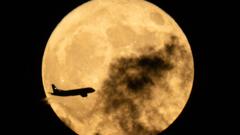
On Friday, May 1, the lunar cycle reaches its peak. While digital feeds and calendar alerts will flood with mentions of the "Flower Moon," the reality of this event is far more grounded in human psychology and ancient agricultural utility than modern headlines suggest. The moon will appear fully illuminated, casting a stark glow across the landscape, but the significance often attached to this specific timing is a byproduct of cultural branding rather than a shift in astronomical power.
The Flower Moon is a label, not a physical change in the moon's composition. It marks the moment when the moon sits directly opposite the sun in its orbit around Earth, reflecting the maximum amount of sunlight back to our eyes.
The Agriculture of Nomenclature
We have inherited a naming system that prioritized survival over science. The "Flower Moon" moniker stems from a blend of Native American, Colonial American, and European folklore, specifically denoting the period in May when spring blooms become reliable indicators of the planting season. For centuries, these names served as a navigational and temporal framework for people without digital clocks. They were tools for synchronization.
In the modern context, we have stripped away the utility and kept the branding. This creates a disconnect. People expect a visual spectacle—perhaps a shift in hue or a noticeable increase in size—that simply doesn't happen during a standard full moon. The moon on May 1 is the same rock we saw in April, just viewed from a slightly different angle relative to the sun.
The Myth of the Supermoon
The current discourse often conflates every full moon with a "supermoon" event. This is a mistake. A true supermoon occurs only when the moon is at perigee, its closest point to Earth in its elliptical orbit. When a full moon coincides with perigee, it can appear up to 14% larger and 30% brighter than when it is at its furthest point.
The May 1 event does not always hit these specific marks. Without that proximity, the difference in brightness is often indistinguishable to the naked eye. We see what we are told to see. Atmospheric conditions, such as humidity and particulate matter in the air, actually play a larger role in the moon's appearance than the "Flower Moon" designation itself. If the air is heavy with dust or smoke, the moon may appear amber or red, a phenomenon often misattributed to the "blood moon" cycle.
Why the Full Moon Distorts Our Perception
Humans are prone to the "Moon Illusion." When the moon sits near the horizon, our brains compare it to trees, buildings, or mountains, making it appear massive. As it rises higher into the empty sky, that point of reference vanishes, and the moon seemingly shrinks.
This is a failure of human processing. Our brains are not designed to accurately judge the distance and size of celestial bodies in a void. The frenzy surrounding the May 1 moon relies heavily on this illusion. Photographers use long-telephoto lenses to compress the background and the moon, creating those viral images of a giant orb hanging behind a city skyline. These images are technically "real," but they do not represent what you will see standing on your balcony.
The Biological Undercurrent
Beyond the visual, the full moon has long been blamed for shifts in human behavior. Emergency room workers and police officers often speak of the "lunar effect," citing increased chaos during a full moon.
Data tells a different story. Numerous peer-reviewed studies have looked for a correlation between the lunar cycle and hospital admissions, crime rates, or psychiatric incidents. The results are consistently flat. What we are actually witnessing is confirmation bias. We notice the one chaotic night that happens during a full moon and ignore the twenty chaotic nights that happen during a crescent or new moon. We are hardwired to find patterns, even when they are nonexistent.
The Light Pollution Barrier
For the majority of the population, the Flower Moon will struggle against a more powerful adversary: artificial light. Urban dwellers live under a permanent orange dome that washes out the stars and dulls the brilliance of the lunar surface. To actually witness the full moon as it was intended—as a functional light source—one has to travel miles away from the nearest LED streetlamp.
In a truly dark sky environment, the full moon is bright enough to read by. It casts shadows with sharp, defined edges. This is the experience the "Flower Moon" name was built upon. In a modern city, it is merely a bright spot in a hazy sky.
Industrialization of the Night
The way we interact with the night has fundamentally shifted. We no longer rely on the moon to extend our working hours or guide our travel. Consequently, our interest in the lunar cycle has shifted from the practical to the aesthetic. We treat it like a recurring media event.
This commodification of the sky leads to a shallow understanding of astronomy. We track the dates, but we stop asking how the gravitational pull of that same moon dictates the tides that move the world's shipping containers. We focus on the "flower" and forget the physics.
Observing the May 1 Peak
If you intend to view the moon on Friday, the timing is everything. It will rise in the east around sunset. This is the optimal window for the "Moon Illusion" effect. Finding a high vantage point with a clear view of the horizon will provide the most dramatic visual results, regardless of whether the moon is technically a "supermoon" or not.
Equipment is secondary to location. While a pair of 10x50 binoculars can reveal the craters of the Tycho and Copernicus regions, the naked eye is sufficient for appreciating the stark contrast of the lunar maria—the dark, solidified basaltic plains that early astronomers mistook for seas.
The Physics of Reflection
The brightness of the full moon is actually quite low when you consider its albedo. The moon’s surface is about as reflective as worn asphalt. It appears brilliant only because of the profound darkness of space surrounding it. When the sun, Earth, and moon align on May 1, we are seeing 100% of the illuminated side, but we are also seeing the moon at its least textured. Because the sunlight is hitting it head-on, there are no shadows to define the mountain ranges or crater walls.
For serious observers, the days leading up to or following the full moon are actually better for viewing. The "terminator line"—the boundary between light and dark—creates long shadows that reveal the true topography of the lunar surface. A full moon is flat; a gibbous moon is three-dimensional.
The Real Power of the May Cycle
The importance of the May 1 moon isn't in its name or the folklore attached to it. Its importance lies in its role as a reminder of our position in a moving system. The moon's orbit is shifting away from Earth at a rate of approximately 3.8 centimeters per year. Millions of years from now, the "Flower Moon" will be a smaller, dimmer ghost of what we see today.
We are living through a specific, temporary window of celestial history where the moon is the perfect size and distance to perfectly eclipse the sun and to dominate our night sky. Every full moon is a countdown.
Ignore the social media hype and the "Flower Moon" branding for a moment. Look at the horizon on Friday evening. What you are seeing is a massive, dead satellite locked in a gravitational dance that has lasted billions of years. It doesn't care about the flowers, and it doesn't care about the calendar. It simply reflects.
Watch the moon rise. Note the way the atmosphere bends the light into a deep orange before it bleaches into a cold, clinical white as it climbs. That transition is the only truth the event offers.