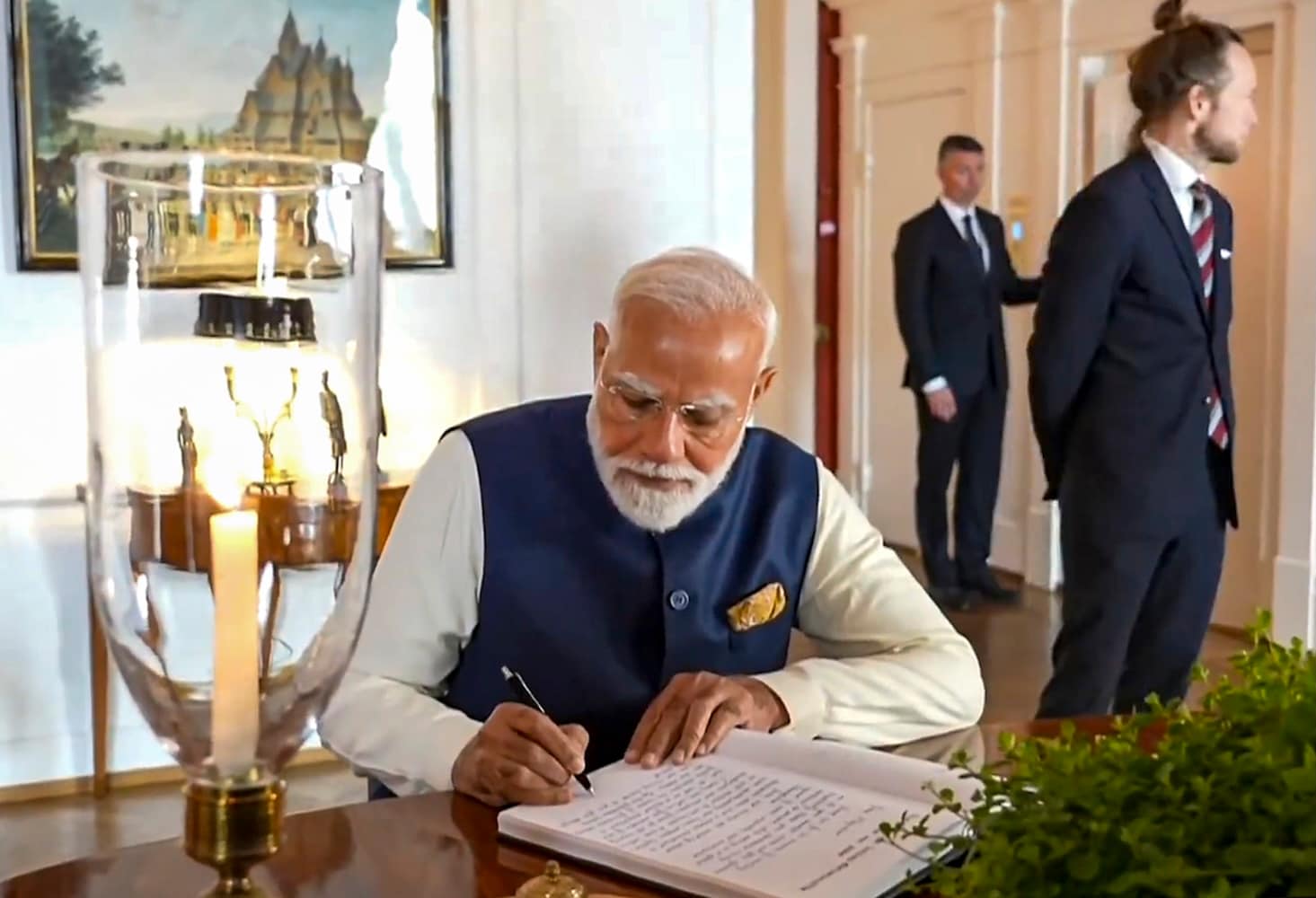
Geopolitical agreements signed in opulent European guest houses rarely survive their own ink. When Prime Minister Narendra Modi landed in Oslo, marking the first time an Indian premier set foot on Norwegian soil in 43 years, the stage was meticulously set for a diplomatic masterclass. The result was a suite of 12 agreements wrapped under a headline-grabbing Green Strategic Partnership.
On the surface, it looks like a textbook victory. The diplomatic machinery on both sides immediately began touting a future of green shipping, space exploration, and clean energy, anchored by a promise to double bilateral trade by 2030.
But public relations handouts do not build deep-water wind farms or clear supply chain bottlenecks.
Beneath the celebratory handshakes lies a highly transactional, asymmetric gamble. India is trading access to its massive domestic manufacturing market and engineering workforce for Norway’s specialized maritime technology and massive capital reserves. For the deal to move from bureaucratic paperwork to commercial reality, both nations must bridge an immense operational gap.
The Scale and Speed Trap
The cornerstone of the Oslo meetings is the activation of the India-EFTA Trade and Economic Partnership Agreement. This deal outlines a target of $100 billion in investments into India and the creation of one million jobs over the next 15 years.
Norway’s primary tool for this economic injection is its mammoth Government Pension Fund Global, which already holds nearly $28 billion in the Indian capital market.
India-Norway Economic Targets (By 2030 / 15-Year Horizon)
┌──────────────────────────────────────┬──────────────────────────────┐
│ Metric                               │ Target Objective             │
├──────────────────────────────────────┼──────────────────────────────┤
│ Bilateral Trade Volume               │ Double current value by 2030 │
│ EFTA Investment Commitment           │ $100 billion over 15 years   │
│ Domestic Job Creation (India)        │ 1 million manufacturing/tech │
└──────────────────────────────────────┴──────────────────────────────┘
The underlying friction is a fundamental mismatch in industrial pace. Modi routinely highlights India’s ability to execute projects at a speed and scale that few nations can match. Norway operates on a model of deep, slow, hyper-regulated precision.
When a Norwegian entity invests in a project, it brings an intense scrutiny regarding corporate governance, environmental impact, and long-term sustainability metrics. India’s infrastructure sector, while rapidly modernizing, is still plagued by land acquisition delays, shifting state-level regulations, and bureaucratic inertia.
If Norway's capital allocators find themselves trapped in local regulatory loops, that promised $100 billion will dry up before the decade ends.
Shipping and the Blue Economy Illusion
Much has been made of Norway joining the Indo-Pacific Oceans Initiative and India's commitment to anchor a dedicated pavilion at Nor-Shipping 2027. The joint objective is clear: modernize port infrastructure and pioneer green shipping technologies, specifically focusing on hydrogen and ammonia-powered cargo vessels.
Norway is an undisputed global leader in maritime tech. India owns some of the world's busiest shipping lanes but operates an aging domestic fleet that relies heavily on fossil fuels.
The obstacle is entirely financial. Transitioning to green shipping requires a complete overhaul of port bunkering infrastructure. Building specialized berths that can handle alternative green fuels costs billions.
Right now, Indian shipping companies operate on razor-thin margins. They cannot afford to absorb the premium cost of green-tech vessels without massive, sustained state subsidies.
Norway's SINTEF research foundation signed pacts with India’s Council of Scientific and Industrial Research to look into ocean energy and wave technologies. Research is valuable. Yet, converting lab-scale wave energy prototypes into commercial power grids that can survive the harsh monsoonal conditions of the Indian coastline is an engineering hurdle that these agreements merely acknowledge, rather than solve.
Space and the Geotechnical Underbelly
The Memorandum of Understanding signed between the Indian Space Research Organisation (ISRO) and the Norwegian Space Agency highlights a shift toward commercializing outer space. Norway’s geographical position gives it an edge in satellite ground station tracking in the polar regions. ISRO possesses some of the cheapest, most reliable launch vehicles on earth.
This is a functional partnership, but it is not the most urgent infrastructure deal on the table.
The unglamorous, highly critical component of the 12 outcomes is an agreement focused on geotechnical engineering and tunnel development. India is currently pushing massive highway and rail projects through the fragile, landslide-prone ecosystem of the Himalayas.
Norway's experience in carving complex tunnel networks through Scandinavian granite is world-class.
Key Areas of the 12 B2B and G2G Agreements
* Space Exploration: ISRO and Norwegian Space Agency tracking alignment.
* Infrastructure: Geotechnical consulting for Himalayan tunnel safety.
* Digital Export: Triangular deployment of India's Digital Public Infrastructure.
* Clean Tech: Carbon Capture, Utilization, and Storage (CCUS) frameworks.
The partnership with Emerald Geomodelling AS to provide geoscientific support for large-scale Indian infrastructure projects is arguably the most practical outcome of the entire visit. It tackles an immediate, costly, and deadly problem: slope instability and catastrophic tunnel collapses that halt vital transit corridors for months at a time.
Exporting Digital Public Infrastructure
One of the more unique diplomatic maneuvers to come out of Oslo is the India-Norway Digital Development Partnership. Under this framework, the two nations intend to deploy India's Digital Public Infrastructure (DPI) models to developing countries across the Global South.
India wants to export its identity and payment systems, like UPI, to establish itself as the premier tech provider for emerging economies. Norway provides the international development funding and geopolitical validation.
This triangular cooperation sounds ideal on paper, but it faces severe geopolitical headwinds. Many nations in the Global South are wary of adopting wholesale digital architecture that makes them reliant on external powers for core governance functions.
Furthermore, Western European definitions of data privacy often clash with the swift, centralized deployment strategies favored by New Delhi. Striking a balance between Norway's stringent standards on digital rights and India's pragmatic, high-velocity rollout style will require constant diplomatic calibration.
The Elephant in the Room
Diplomacy is as much about what is omitted as what is spoken aloud. Norwegian Prime Minister Jonas Gahr Støre noted during his press conference that Norway and India do not always see eye-to-eye on every issue. He chose his words with care, but the tension was obvious.
Norway shares a direct border with Russia and has seen its regional security calculus completely upended over the last few years. India continues to maintain deep defense ties and a major energy import relationship with Moscow.
While Modi and Støre issued a standard, synchronized condemnation of terrorism and called for an early end to global conflicts, the strategic divergence remains. Norway views the violation of international borders through an existential lens. India views it through the lens of strategic autonomy and energy security.
This friction limits how far defense industrial collaboration can actually go. The joint statement dutifully noted "potential in defense cooperation," but notable absent were any major defense procurement or joint production deals. Norway will not export its most sensitive military technologies to a nation that maintains an open defense pipeline with Russia.
The success of this entire Nordic excursion rests on whether both nations can compartmentalize their deep geopolitical disagreements and keep their focus entirely on industrial execution. If the green transition goals get bogged down in bureaucratic box-checking, or if capital flows are disrupted by geopolitical realignments, this historic visit will be remembered as nothing more than a scenic detour on Europe’s long, slow path to industrial decarbonization.