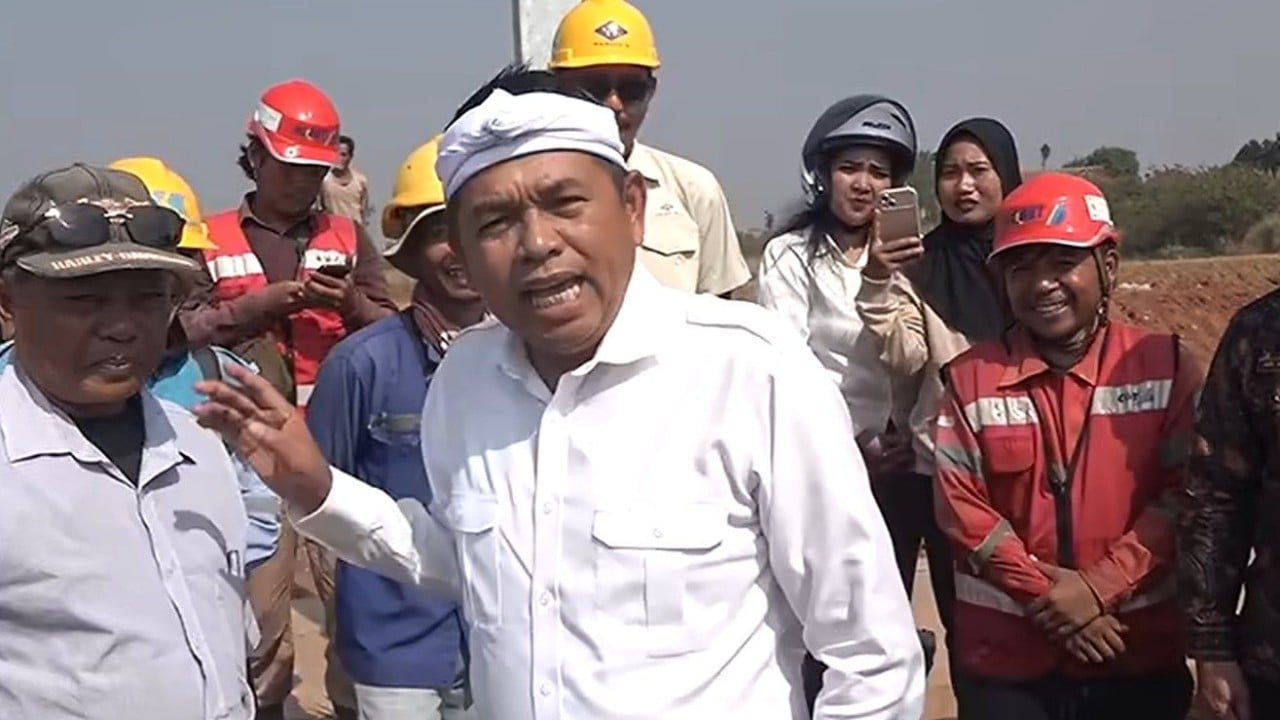
Political commentators in Jakarta are currently suffering from a severe case of algorithmic myopia.
Whenever a regional leader racks up ten million views on TikTok for yelling at a contractor or handing out cash to a crying street vendor, the pundit class immediately starts printing 2029 presidential ballots. The lazy consensus surrounding Dedi Mulyadi—West Java’s hyper-online "content governor"—is that his digital dominance naturally translates into a viable threat against Prabowo Subianto’s political machine.
It does not. In fact, mistaking short-form video virality for national executive viability is the oldest trap in modern Indonesian politics.
I have watched regional media darlings burn through billions of rupiah in consulting fees trying to scale a local persona into a national movement, only to crash into the brick wall of Java-centric electoral math and party oligarchies. The mainstream press loves the "David versus Goliath" narrative of a populist YouTuber taking on the palace. They miss the structural reality that Indonesia’s presidential race is not won on the For You Page. It is won in smoke-filled coalition rooms, through institutional patronage networks, and via cold, hard logistics that an iPhone tripod simply cannot replicate.
The Myth of the Algorithmic Mandate
The core flaw in the "content governor" thesis is the assumption that views equal votes. They do not. Views equal attention, and political attention in Southeast Asia is notoriously cheap, fleeting, and geographically distorted.
When Dedi Mulyadi films himself resolving a neighborhood dispute in Purwakarta or Subang, the engagement metrics look staggering. Millions of impressions. Tens of thousands of tearful comments praising his empathy. Pundits look at those numbers and project them across an archipelago of 280 million people.
Here is the reality check those commentators ignore:
- Engagement is not endorsement. A voter in Makassar or Medan might double-tap a video of a West Javanese politician fixing a pothole because it makes for satisfying doomscrolling. That same voter has zero institutional loyalty to him when the ballot box opens.
- The saturation ceiling hits fast. Hyper-local micro-management plays brilliantly when you are a regent or a governor. At the national level, voters do not want a president who acts like a neighborhood watch captain. They want a commander-in-chief who projects geopolitical weight and macroeconomic stability.
- Algorithms reward extremity, elections reward coalitions. Social media platforms boost emotional spikes—anger, pity, confrontation. Indonesian presidential politics, governed by strict presidential threshold laws and multi-party consensus, rewards the exact opposite: broad, unthreatening, elite-approved compromise.
We have seen this movie before. Look back at Ganjar Pranowo’s trajectory leading into the 2024 cycle. For years, Ganjar was the undisputed king of regional digital branding—jogging through villages, posting charismatic vlogs, dominating every youth-oriented social metric. Yet when the actual campaign machinery kicked into gear, digital warmth evaporated against Prabowo’s entrenched coalition and Gibran Rakabuming Raka’s transactional ground game.
Why Jakarta’s Gatekeepers Control the Ballot
To run for president in Indonesia, you do not just file paperwork and launch a YouTube channel. You must survive the presidential threshold—the constitutional and statutory requirement that a candidate be nominated by a political party or coalition holding at least 20 percent of the seats in the House of Representatives (DPR) or 25 percent of the national popular vote from the previous legislative election.
Let us do the math that the viral-politics crowd refuses to do.
Dedi Mulyadi is a member of Gerindra. Prabowo Subianto owns Gerindra.
Think about the sheer absurdity of suggesting a Gerindra cadre will use the party’s own regional platform to mount an insurgency against the party’s founder and sitting president. Unless Prabowo voluntarily steps aside in 2029—which remains an open question given his age, though his inner circle is already grooming successors—no Gerindra politician is building an independent presidential vehicle without explicit palace blessing.
Even if Prabowo declines a second term, the line of succession inside the ruling coalition is crowded with heavyweight institutional players who control actual state budgets, ministries, and party chairs:
- Gibran Rakabuming Raka: As sitting Vice President, he holds the constitutional pole position and inherits the residual power of the Jokowi network.
- Agus Harimurti Yudhoyono (AHY): He controls the Democratic Party’s parliamentary seats outright—an asset infinitely more valuable in coalition negotiations than ten million YouTube subscribers.
- Zulkifli Hasan and Bahlil Lahadalia: Men who command the bureaucratic and financial arteries of PAN and Golkar, respectively.
Notice what every single one of those figures possesses that a content-driven governor lacks: hard institutional leverage. You cannot trade TikTok views for cabinet seats. You trade parliamentary votes and campaign financing.
The West Java Trap
Politicians and journalists routinely fall into the trap of overvaluing West Java. Yes, it is Indonesia’s most populous province, home to roughly 50 million people and the largest single block of voters in the country. Winning West Java is essential for any presidential contender.
However, dominating West Java as a local son does not make you a national unifier. It often does the exact opposite.
Indonesian electoral sociology remains deeply sensitive to regional and cultural identity. A political brand built entirely around Sundanese cultural tropes, traditional attire, and hyper-localized rural mediation plays like magic from Bogor to Cirebon. Take that exact same aesthetic to East Java—where Nahdlatul Ulama (NU) networks dictate the political weather—or to Sumatra and Eastern Indonesia, and it reads as foreign, parochial, and slightly theatrical.
Prabowo Subianto spent twenty years and three consecutive presidential campaigns building cross-archipelagic infrastructure to overcome the "Java-only" perception. He had to forge alliances with regional military veterans, religious boarding school (pesantren) leaders, and local business dynasties from Aceh to Papua.
A governor spending his days filming content in West Java is actively neglecting the grueling, unglamorous, off-camera travel required to build a national network. Every hour spent editing a vlog for local constituents is an hour not spent negotiating with power brokers in Surabaya, Medan, and Makassar.
The Hidden Liabilities of Performative Governance
There is a massive downside to governing by camera that mainstream profiles completely gloss over: the paper trail of contradiction.
When a politician turns every administrative decision into a daily reality show, they create an archive of thousands of unscripted moments. Opposition researchers do not even have to dig for dirt; the candidate uploaded it themselves in 4K resolution.
- Every off-the-cuff promise made to a villager on camera becomes an unfulfilled policy failure two years later.
- Every public dressing-down of a lower-level civil servant alienates the massive state bureaucracy (ASN) whose quiet cooperation is mandatory to run a national election campaign.
- Every emotional intervention in a local dispute exposes a lack of systemic policy thinking.
Let me be clear about the nuance here: I am not claiming Dedi Mulyadi’s communication strategy is ineffective for his current job. As a regional executive, bypassing legacy media to speak directly to constituents is brilliant political theater. It builds immense local approval ratings and insulates him from regional legislative pushback.
The mistake is confusing a tactical masterclass in regional survival with a strategic blueprint for the presidency.
Stop Asking Who Is Viral and Start Asking Who Owns the Ground
If you want to accurately predict who will actually contest the 2029 Indonesian presidential election, stop looking at social media analytics. Those dashboards are noise designed to sell advertising and generate lazy headlines.
Instead, track the three metrics that actually decide Indonesian power transitions:
| Metric | What Pundits Watch | What Actually Decides 2029 |
|---|---|---|
| Reach | TikTok views and YouTube subscribers | Village-level RT/RW and religious network mobilization |
| Backing | Positive comment sections | Oligarchic capital and party chairmanship control |
| Authority | Viral clips scolding contractors | Control over strategic national ministries and state budgets |
Imagine a scenario where 2029 arrives, Prabowo steps back due to health or age, and the ruling coalition fractures into competing camps. Even in that chaotic open-field race, the survivors will be the figures who control party apparatus and state resources—not the ones who mastered the vertical video algorithm. A viral governor might be courted as a regional vote-getter, perhaps dangled a cabinet post or a vice-presidential vetting slot to secure West Java’s ballot boxes.
That is the ceiling. Kingmaker in one province, supporting cast on the national stage.
The Verdict on Digital Populism
Indonesia’s democracy is maturing past the novelty phase of social media politics. Voters in 2014 and 2019 were captivated by the illusion of proximity that cameras provided. By 2024, that illusion had hardened into cynicism. Voters enjoy the entertainment, consume the clips over morning coffee, and then cast their ballots based on economic self-interest, entrenched patronage, and perceived strength.
Treating a content-obsessed governor as a credible threat to the Indonesian presidency misunderstands both the man and the machine. Social media can make a politician famous overnight, and it can win a provincial governor's mansion. It cannot buy a party coalition, it cannot command a national bureaucracy, and it will never survive the brutal arithmetic of a 2029 presidential run.