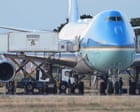
When Donald Trump walked up the steps of the iconic blue-and-white presidential aircraft in Ankara, Turkey, and turned to wave at the press corps, the performance was absolute. Cameras captured the familiar ritual, anchoring a narrative of standard executive transit following a tense NATO summit. Minutes later, the president was gone. He slipped out the opposite side of the cabin, descending via a hydraulic airport catering truck into the shadows of the tarmac to board a discreetly waiting military C-32A transport.
Left behind inside the fuselage of the primary jet were more than a hundred White House staffers, secret service details, and traveling journalists. They buckled in for an overseas flight under the firm impression that the commander-in-chief was sitting a few compartments away. They were flying into British airspace as the high-altitude bait in a calculated shell game designed to counter an alleged active threat from Iranian intelligence.
The revelation of this tactical charade has triggered intense blowback across Washington, transforming a textbook exercise in executive protection into a sharp ethical debate over statecraft, deception, and the duty of care.
The Anatomy of a High-Altitude Shell Game
Executive protection in an era of precision guided munitions and ubiquitous satellite tracking demands extreme measures. Modern state security relies heavily on misdirection, electronic countermeasures, and physical camouflage. The operation executed on the Ankara tarmac mirrors historical precedents, such as Bill Clinton's clandestine 2000 flight into Pakistan aboard an unmarked jet while his primary aircraft served as an empty decoy.
Yet, the mechanics deployed in Turkey pushed the envelope of conventional operational security. The threat matrix was stark. U.S. intelligence agencies had gathered intelligence pointing to an active plot targeting the president or the presidential aircraft. Rather than altering the flight schedule entirely or canceling the departure, security planners chose a path of elaborate theatricality.
The primary aircraft maintained its prestigious call sign and took off right on schedule. It operated as a floating proxy, drawing potential hostile tracking while the actual target quietly slipped away in a modified Boeing 757 military variant alongside Defense Secretary Pete Hegseth. Journalists aboard the decoy jet were explicitly instructed to keep their window shades drawn for the duration of the oceanic crossing, a directive that effectively blinded the press pool to the substitution happening outside their line of sight.
The Ethical Fracture Over Unwitting Participants
While national security specialists defend the operational logic of shielding a sitting president from a credible assassination plot, the decision to utilize civilian staff and accredited reporters as unwitting chess pieces has exposed a raw nerve.
Critics point to the fundamental asymmetry of risk imposed on the passengers. A decoy is, by definition, meant to absorb hostility or misdirect attention away from the high-value asset. By keeping aides and reporters completely in the dark, planners stripped those individuals of their agency to assess personal danger.
Legal and intelligence analysts have raised pointed questions regarding federal safety directives. Intelligence Community Directive 191 mandates a strict duty to warn individuals who are identified as the specific targets of targeted violence or kidnapping plots. While exemptions exist to protect sensitive intelligence sources and methods, critics argue that deploying unaware citizens as flying shields stretches administrative waivers past their breaking point.
The operational reality is brutal. If hostile actors had possessed the capability and intent to strike the primary aircraft mid-flight under the assumption that the head of state was on board, the human toll would have been catastrophic.
The Mechanics of Public Illusion
The conclusion of the journey added another layer of psychological theater. Upon arrival at RAF Mildenhall in the United Kingdom, the choreography of the landing was engineered to preserve the illusion. The C-32A carrying the president arrived first. Minutes later, the decoy aircraft touched down with the exhausted press pool still inside.
In a final flourish of staging, Trump was secretly reunited with the primary aircraft on the British tarmac, descending the stairs before cameras as though he had simply stepped off the legendary jumbo jet after a routine transcontinental journey. Official digital channels reinforced the narrative, publishing updates that maintained the fiction of a continuous voyage.
This systematic bending of the truth to preserve operational security highlights a growing friction between the executive branch's absolute mandate for self-preservation and the public's expectation of transparent governance.
As congressional committees draft requests for formal briefings to dissect the operation's chain of command, the episode stands as a stark reminder of the lengths to which modern state security will go. When the life of a leader hangs in the balance, the line between protecting the office and exposing the innocent blurs into a gray expanse where standard rules of disclosure simply cease to exist.