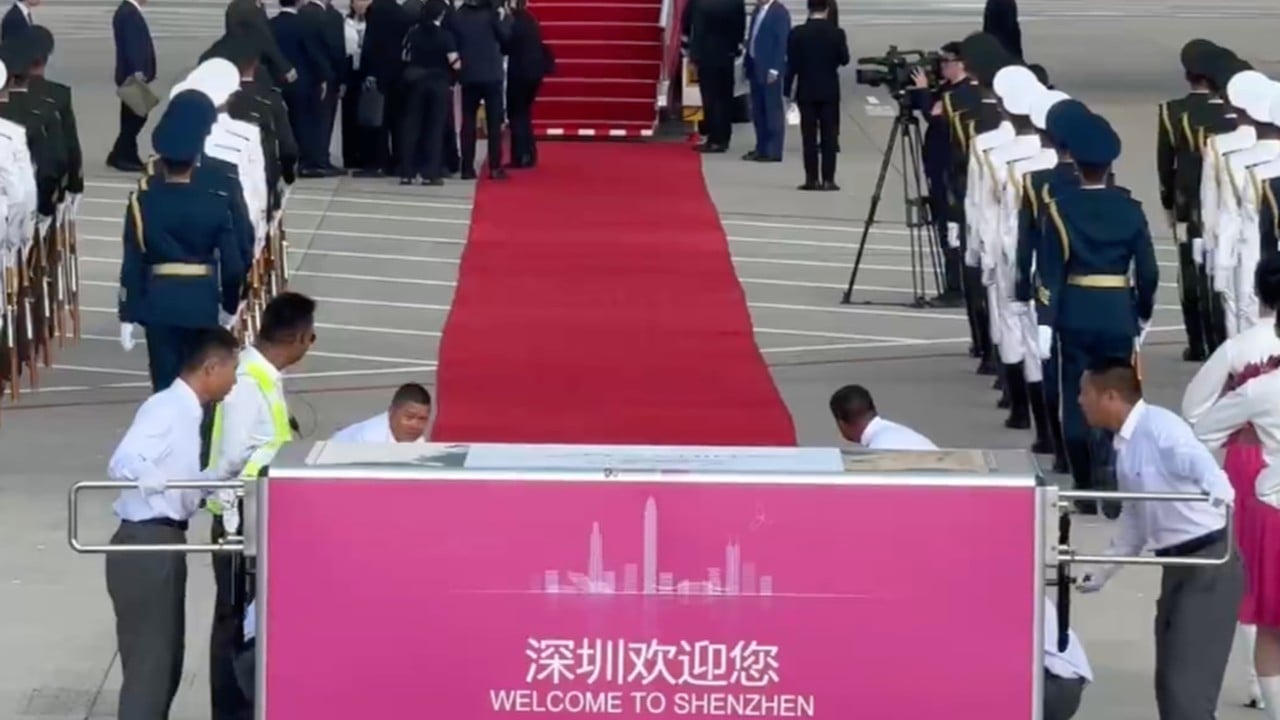
China’s selection of Shenzhen to host the 2026 Asia-Pacific Economic Cooperation (APEC) Economic Leaders' Meeting is far more than a routine diplomatic rotation. It is a calculated, multi-billion-dollar exercise in urban statecraft designed to showcase Beijing’s vision of technological self-reliance to the world's most powerful economies. While surface-level coverage treats the event as a standard red-carpet rollout, the reality on the ground reveals a massive, coordinated mobilization of state capital, municipal engineering, and corporate muscle aimed at rewriting the narrative around China’s economic slowdown.
For decades, Beijing has treated major international summits as stress tests for its governance model. The 2008 Olympics announced China’s arrival as a global superpower. The 2016 G20 in Hangzhou demonstrated its digital commerce ambitions. Now, in late 2026, Shenzhen serves as the ultimate stage to prove that Western export controls and supply chain decoupling have failed to stall Chinese innovation.
The Architecture of High-Stakes Diplomacy
Hosting APEC requires an administrative apparatus that operates with military precision. In Shenzhen, that apparatus is anchored by the Guangdong provincial government and supervised directly by central authorities in Beijing. The preparation timeline began the moment China secured the 2026 hosting rights, triggering a wave of infrastructure retrofitting across the city’s core districts—specifically Futian, Nanshan, and Qianhai.
Unlike traditional diplomatic capitals such as Beijing or Washington, Shenzhen lacks centuries-old palaces or sprawling state guesthouses built for imperial pageantry. Instead, municipal planners have leaned into the city's identity as a hyper-modern hardware and software metropolis. The logistical blueprint relies heavily on the Shenzhen World Exhibition & Convention Center in Bao'an and the Futian Shangri-La corridor, transforming commercial hubs into fortified diplomatic zones.
Security protocols for a gathering of 21 member economies—including the United States, Japan, South Korea, and Russia—demand total spatial control. Traffic management systems in Shenzhen, already among the most digitized globally, undergo complete reconfiguration during summit windows. Intelligent transport grids prioritize motorcade corridors, clearing multi-lane arteries like Shennan Boulevard within seconds using predictive traffic-light algorithms developed by local tech giants.
The environmental engineering behind these summits is equally aggressive. Observers who have covered Chinese state events for years recognize the familiar playbook of "APEC Blue"—the temporary halting of regional factories, construction sites, and heavy diesel transport across the Pearl River Delta to guarantee pristine air quality for visiting delegations. While Shenzhen’s baseline air quality has improved drastically over the past decade due to its near-total electrification of public buses and taxis, surrounding industrial cities like Dongguan and Foshan still bear the brunt of pre-summit production curbs.
The Corporate Engine Behind the Curtain
A critical oversight in mainstream reporting on APEC 2026 is treating the Chinese state and Shenzhen's private sector as separate entities. They are not. In Shenzhen, the boundary between municipal administration and corporate engineering is virtually nonexistent, and the city’s flagship technology firms act as the operational backbone of the summit.
Consider the telecommunications and logistics infrastructure required to host thousands of delegates, intelligence officers, and international journalists. Huawei and ZTE provide the underlying 5G-Advanced and fiber-optic networks securing diplomatic communications, deploying private enterprise networks designed to isolate summit traffic from the public internet. Meanwhile, Tencent integrates summit logistics directly into its WeChat ecosystem, issuing digital credentials, translation tools, and localized payment mini-programs so foreign delegates can navigate a cashless society without friction.
Transportation showcases the city's industrial dominance. BYD, headquartered in Shenzhen’s Pingshan district, supplies the official fleets of executive electric vehicles and autonomous shuttles moving leaders between venues. This is product placement on a geopolitical scale. When heads of state step out of luxury electric sedans built a few miles from the conference hall, the message to visiting trade ministers is unmistakable: China owns the supply chain for the green transition.
Even low-altitude airspace is weaponized for soft power. Shenzhen is the epicenter of China's "low-altitude economy," home to drone titan DJI and dozens of urban air mobility startups. Summit hospitality routinely features synchronized drone light shows over Shenzhen Bay, replacing traditional fireworks with programmable aerial displays that double as demonstrations of dual-use aviation technology.
Geopolitics Dressed as Trade Cooperation
APEC was founded in 1989 to promote free trade and economic integration across the Pacific Rim. In 2026, that founding mission collides head-on with an era of hardened economic nationalism.
By placing APEC in Shenzhen—the birthplace of Deng Xiaoping’s Reform and Opening-up policy in 1980—Beijing is attempting a delicate ideological balancing act. On one hand, Chinese diplomats use the city's history as a fishing village turned megacity to argue that China remains open for foreign direct investment. On the other hand, Shenzhen is the ground zero of China’s push for indigenous technology substitution, a direct response to U.S. semiconductor restrictions and tariff walls.
This tension defines every bilateral meeting on the sidelines of the summit. Visiting CEOs and trade representatives are ushered through curated tours of Nanshan’s high-tech parks, viewing robotics labs, artificial intelligence clusters, and biotech facilities. The subtext is clear: Western capital is still welcome, provided it flows into sectors aligned with Beijing's industrial policy, and foreign companies that abandon the Chinese market risk losing access to the world's most efficient hardware prototyping ecosystem.
Yet beneath the polished choreography lies deep economic anxiety. Foreign direct investment into China has faced historic headwinds over the past three years, driven by geopolitical friction, strict data-security laws, and domestic real estate stagnation. Shenzhen itself, despite its tech wealth, has had to navigate declining export growth in traditional manufacturing and fierce local government debt pressures across Guangdong province. The red carpet rolled out for APEC leaders is therefore an essential instrument of economic damage control, designed to project unstoppable momentum to skittish global markets.
The Hidden Friction of the Showcase Model
Veteran analysts know that high-gloss diplomatic productions always obscure local costs. For Shenzhen’s 17 million residents, hosting a premier global summit brings immediate disruptions alongside long-term civic upgrades.
In the months leading up to the leaders' arrival, urban renewal campaigns sweep through the city’s famous chengzhongcun—the dense "urban villages" that house millions of migrant workers, delivery drivers, and entry-level engineers. While municipal authorities frame these initiatives as safety inspections and aesthetic improvements, they routinely result in the sudden closure of informal street markets, strict curfews on logistics hubs, and heightened surveillance checkpoints across transit stations.
Small- and medium-sized enterprises operating outside the favored high-tech sectors often experience a temporary freeze. Logistics firms face unpredictable customs delays as border crossings between Shenzhen and Hong Kong—such as Huanggang and Shenzhen Bay Port—tighten screening protocols for incoming freight and personnel. For a city whose lifeblood is frictionless cross-border trade, turning the tap down even slightly sends ripples through regional supply chains.
There is also the financial accounting to consider. While the central government subsidizes major diplomatic events, municipal budgets absorb enormous expenses for venue retrofits, security overtime, hospitality stipends, and international media operations. In an era where Chinese municipalities are under strict orders from Beijing to tighten their belts and manage local government financing vehicle (LGFV) debt, justifying billions of yuan in summit spending requires delivering tangible trade agreements and investment pledges in return.
Why Shenzhen Matters More Than Beijing
If China wanted to project sheer imperial authority, it would host every major summit in Beijing’s Great Hall of the People. Choosing Shenzhen signals a fundamentally different strategic intent.
Beijing represents the political center—hierarchical, ideological, and state-controlled. Shenzhen represents the commercial edge—pragmatic, iterative, and relentlessly focused on execution. By bringing APEC leaders to the shores of the Pearl River Delta, China is asking the Asia-Pacific region to judge it not by its political rhetoric, but by its industrial output.
Look at the physical layout of the Greater Bay Area, the mega-region linking Shenzhen, Hong Kong, Guangzhou, and Macau. From the top of the Ping An Finance Centre in Futian, visiting leaders can literally see Hong Kong’s New Territories across the Shenzhen River. That proximity is intentional. It visually reinforces Beijing’s integration strategy, demonstrating how Hong Kong’s financial markets and legal infrastructure are being fused with Shenzhen’s manufacturing and R&D capabilities to create a self-contained economic powerhouse.
For Western policymakers, this presents a complicated reality. It is easy to dismiss state-run media narratives about Chinese economic resilience when reading macroeconomic reports in Washington or Brussels. It is much harder to dismiss when standing inside a fully automated factory in Longgang watching thousands of electric vehicles, batteries, and industrial robots roll off assembly lines without human intervention.
The machine rolling out the red carpet in Shenzhen is not merely a hospitality committee. It is a fully integrated industrial, digital, and administrative apparatus built to prove that the center of gravity in global manufacturing and applied technology remains firmly anchored in southern China—regardless of who signs the trade communiqués when the cameras turn off.