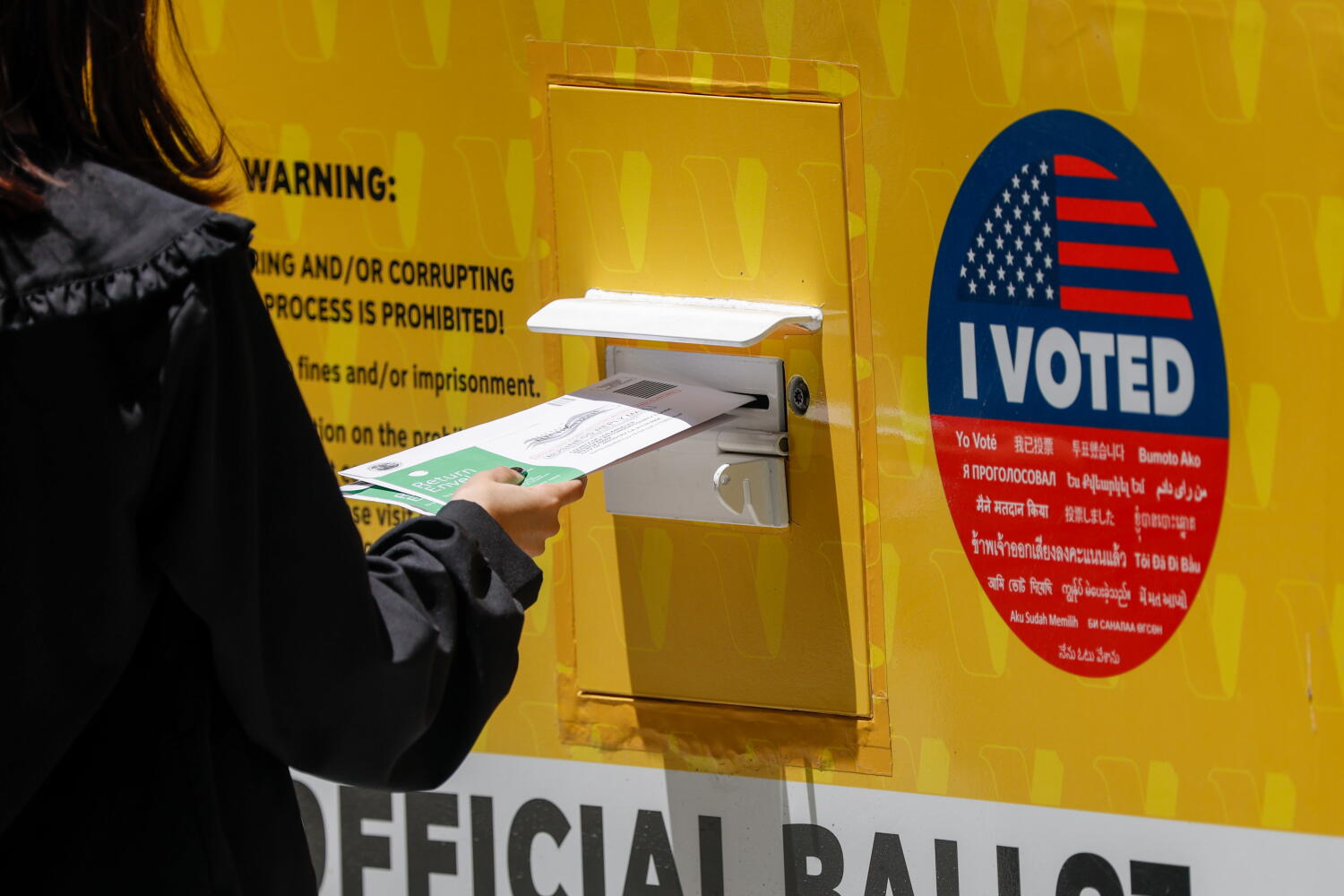
Federal prosecutors and Homeland Security agents spent the final weeks of the 2026 midterm cycle issuing grand jury subpoenas to Los Angeles County election officials, demanding records and testimony over an alleged pool of 20,000 noncitizen voters. That paper trail—spanning early records demands in September and escalating to post-election witness summonses—reveals an aggressive, multi-agency legal strategy. When federal civil lawsuits hit a wall in court, the Trump administration pivoted to criminal grand jury compulsion to extract internal communications and voter data from the nation's largest local voting jurisdiction, even as independent audits found that more than 40% of the names on the government's master list did not even appear on California's voter rolls.
The Paper Trail Behind the Grand Jury Subpoenas
For decades, federal oversight of local ballot boxes followed a predictable, cautious script. You waited until votes were certified, audited specific anomalies, and brought targeted cases only when intent could be proved beyond a reasonable doubt. That playbook was torn up in the autumn of 2026.
Records obtained through public disclosures and court filings show that the federal probe into Los Angeles County voters began quietly in September with subpoenas seeking registration files for specific individuals suspected of registering illegally. By late October, however, the scope shifted dramatically. On October 21 and October 24, federal prosecutors dispatched a fresh wave of grand jury subpoenas directly to employees of the Los Angeles County Registrar-Recorder/County Clerk.
Unlike the September requests, these documents did not merely ask for a handful of voter registration cards. They demanded all internal documents and communications tied to warning letters sent by federal officials in July and October. They also sought records detailing any local efforts—or lack thereof—to prevent suspected noncitizens from having their ballots counted. Most starkly, the summonses ordered at least three L.A. County election staffers to appear before a federal grand jury on November 4, exactly 24 hours after the polls closed.
An accompanying cover letter sent to the registrar's Custodian of Records offered a crucial clue about the machinery driving the inquiry. The subpoena was not merely a routine Civil Rights Division inquiry; it was issued in connection with an official criminal investigation conducted by Homeland Security Investigations (HSI), the investigative arm of the Department of Homeland Security.
Why the Administration Pivoted From Civil Lawsuits to Criminal Compulsion
To understand why HSI and the Department of Justice escalated to grand jury subpoenas days before an election, you have to look at the civil docket in the Central District of California.
On October 15, the federal government sued the State of California, Secretary of State Shirley Weber, and L.A. County Registrar-Recorder Dean Logan. Spearheaded locally by U.S. Attorney Bill Essayli, the lawsuit accused state and county officials of violating the Supremacy Clause by refusing to quarantine ballots cast by roughly 20,000 registered voters whom federal databases flagged as potential noncitizens. Essayli went further in public statements, warning that any election worker who knowingly processed a noncitizen's ballot was opening themselves up to personal legal jeopardy.
The civil strategy ran straight into a brick wall of federal statute and physical logistics.
U.S. District Judge David O. Carter rejected the government's emergency bid to segregate those 20,000 ballots. His reasoning rested on two pillars that election administrators have tried to explain to politicians for years:
- The 90-Day Quiet Period: Under the National Voter Registration Act (NVRA), states are barred from executing systematic purges or altering voter roll eligibility rules within 90 days of a federal election. Ordering counties to pull 20,000 voters off the active tabulation track in mid-October collided directly with federal statutory protections designed to prevent last-minute clerical errors from disenfranchising eligible citizens.
- The Secret Ballot Architecture: Once a mail-in ballot is verified, separated from its signed outer envelope, and fed into a high-speed scanner, the link between the voter and the paper ballot is permanently severed. By the time Judge Carter heard arguments, L.A. County had already processed more than 500,000 ballots. Asking clerks to reach into a pool of half a million anonymous ballots and extract specific ones wasn't just legally dubious—it was physically impossible without invalidating the secrecy of the vote.
Judge Carter also issued a blunt warning from the bench, advising federal prosecutors that any threats directed at state and county election employees needed to stop immediately. Both the 9th U.S. Circuit Court of Appeals and the U.S. Supreme Court subsequently declined to grant the administration's emergency requests to block the ballots.
Blocked on the civil side, prosecutors leaned on the one tool that operates largely outside immediate judicial interference. A federal grand jury answers to prosecutors, not a civil motions calendar. By framing the inquiry as a criminal probe into whether local officials obstructed federal law—and pairing DOJ attorneys with HSI agents—the government could compel testimony and seize internal county emails that civil discovery rules would have tied up for months.
The Data Problem Inside the 20,000-Voter List
Whenever an administration builds a massive legal offensive around a single spreadsheet, the first question an investigator asks is simple. Where did the numbers come from, and how clean is the data?
In this case, the federal government's list of roughly 20,000 suspected noncitizen voters was generated by cross-referencing state voter registration files against federal immigration records maintained by the Department of Homeland Security. On paper, matching two databases sounds straightforward. In practice, matching administrative records across separate bureaucracies is notoriously prone to false positives.
"They're asking California to determine citizenship. The federal government should be the one who knows the citizenship." — Former U.S. Attorney in California, assessing the federal demand letters
Immigration databases frequently lag behind naturalization ceremonies. When a permanent resident takes the oath of citizenship and registers to vote the very same afternoon outside a convention center, legacy DHS systems often still reflect their prior green card status for months or even years. Name collisions—common surnames paired with identical birthdates—compound the error rate.
Even before Judge Carter appointed a special master, digital forensics expert Daniel B. Garrie, to audit the reliability of the government's list, outside researchers and county clerks ran their own checks. Their findings exposed massive flaws in the underlying dataset:
- Phantom Registrations: A legal analysis filed by immigrant-rights groups and academic researchers found that more than 40% of the names flagged by the Justice Department as suspected noncitizen voters in California did not actually appear on the state's active voter rolls at all.
- Verified Citizens: Spot checks conducted by county registrars across California turned up numerous naturalized U.S. citizens who were legally eligible to cast ballots. Even Justice Department attorneys conceded during court hearings that the federal list contained an unspecified number of legitimate American citizens.
- County-by-County Pushback: Across California, local election administrators rejected the DOJ's demand letters as legally baseless and factually flawed. Only one county—San Luis Obispo—announced it would open local investigations into the individuals named on the federal letters.
Federal prosecutors did manage to bring targeted criminal charges against 28 foreign nationals in California in mid-October, arresting 11 individuals accused of illegally registering or voting. Those cases proved that traditional, individualized criminal enforcement works when federal agents do the legwork to verify a specific person's immigration status and voting history. What those 28 indictments did not prove was a systemic conspiracy involving 20,000 illegal voters or criminal complicity by county clerks.
The Counter-Argument and the Gray Areas
To dismiss the entire federal probe as pure political theater, however, ignores real structural tensions in how American voter rolls are maintained.
Federal prosecutors and eleven Republican-led states that filed supporting briefs argued a straightforward legal principle: federal law strictly prohibits noncitizens from voting in federal elections under 18 U.S.C. § 611. From the Justice Department's perspective, if federal immigration databases indicate that thousands of individuals on a state's voter roll previously held non-immigrant or permanent resident visas without a recorded naturalization update, state officials have an affirmative duty to verify those records rather than waving the ballots through.
As Ninth Circuit Judge Patrick Bumatay wrote in his dissent from the appellate panel's refusal to halt ballot counting, telling the federal government that local systems cannot separate potentially ineligible ballots before tabulation risks eroding public confidence in election integrity.
That argument highlights a genuine bureaucratic blind spot. Under California's automatic voter registration system—often called Motor Voter—eligible residents are registered when they obtain or renew a driver's license unless they opt out. While applicants must attest to their citizenship under penalty of perjury, the DMV does not adjudicate naturalization records in real time, and state privacy laws restrict how easily local registrars can demand documentary proof of citizenship once an attestation is signed.
Yet acknowledging that gap does not validate the federal government's methods. There is a vast legal difference between collaborating with state secretaries of state months ahead of an election to clean up data mismatches and dropping grand jury subpoenas on rank-and-file county technicians ten days before Election Day.
Witness or Target
Justice Department spokespeople sought to downplay the November 4 grand jury summonses, noting that federal prosecutors generally do not subpoena individuals they consider targets of a criminal investigation. Under standard DOJ manual guidelines, a "witness" is simply someone believed to possess relevant information, whereas a "target" is a person against whom the prosecutor has substantial evidence linking them to a crime.
Anyone who has covered federal courthouses for long knows how blurry that line feels when you are the civil servant holding the subpoena.
For a mid-level records custodian or IT administrator at the L.A. County Registrar-Recorder's office, receiving a grand jury summons backed by Homeland Security Investigations means hiring criminal defense counsel, preparing for sworn testimony before a closed-door panel, and turning over years of internal emails. Legal scholars pointed out that even if prosecutors never indict a single county employee, the subpoenas impose an immediate financial and psychological toll on local election administrators.
The timing also created an acute operational bottleneck. November 4 is the single busiest day of the year for a county registrar's office—the exact moment staff are reconciling provisional ballots, processing late-arriving mail ballots postmarked on Election Day, and auditing precinct totals. Pulling key operational personnel out of ballot processing centers to sit outside a federal grand jury room in downtown Los Angeles directly disrupted the post-election canvass.
What Happened When the Dust Settled
The broader legal crusade collapsed almost as quickly as it escalated once voters actually cast their ballots on November 3.
On November 6—just three days after Election Day and one day after Assistant Attorney General for Civil Rights Harmeet Dhillon resigned from the Justice Department—federal prosecutors moved to voluntarily dismiss their civil lawsuit against California and Los Angeles County. Having lost at the district court, the Ninth Circuit, and the Supreme Court, and with the contested ballots already irreversibly mixed into the certified canvass, the government conceded in court filings that it no longer had legal standing to pursue the injunction.
The dismissal of the civil suit halted Judge Carter's scheduled November 13 evidentiary hearing, effectively shutting down special master Daniel Garrie's court-ordered audit of the government's 20,000-name list before its error rate could be entered into the permanent judicial record.
Yet a dismissed civil complaint does not automatically extinguish a grand jury inquiry or an HSI investigation. While the public courtroom battle ended with a quiet procedural withdrawal, civil rights watchdogs have already filed Freedom of Information Act lawsuits against DHS to uncover how immigration databases were weaponized to challenge state voter rolls—leaving the subpoenaed records in Los Angeles as the primary paper trail of a federal pressure campaign that pushed election law to its breaking point.