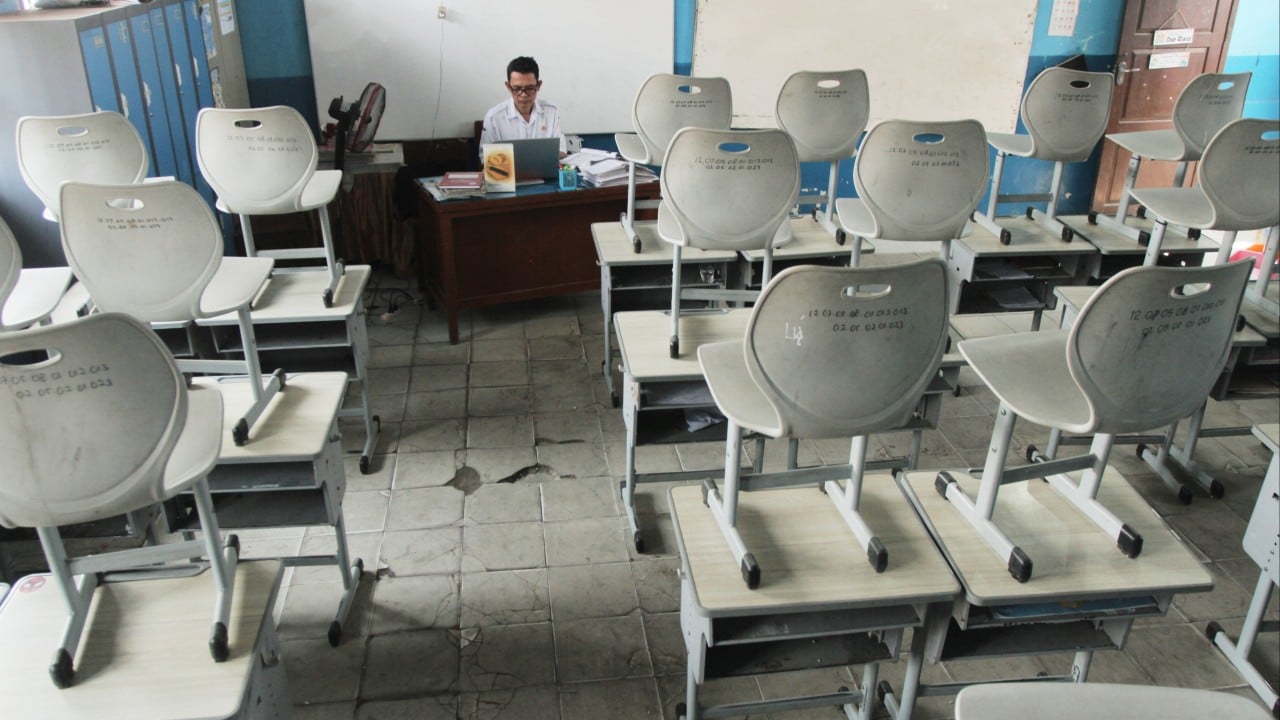
More than 1.4 million students are sitting at home while toxic smoke blanks out the sun across large stretches of Indonesia and neighboring countries.
The headlines report empty classrooms, shuttered school gates, and emergency air quality alerts. They treat these school closures as isolated weather-related disruptions, minor administrative pauses brought on by seasonal burning.
That framing is dangerously superficial.
What is unfolding across Sumatra, Kalimantan, and beyond is not an accidental act of nature. It is a systemic structural failure born of decades of unchecked land exploitation, corporate negligence, and delayed climate adaptation. The resulting toxic haze has turned millions of children into collateral damage, forcing an urgent examination of why Southeast Asia's skies catch fire with clockwork brutality.
The Anatomy of an Avoidable Catastrophe
To understand why thousands of schools remain bolted shut, one must look below the surface of the dry brush. The immediate driver is a powerful El Nino phase, which has dragged out the dry season and baked carbon-rich peatlands until they turn into gunpowder. When moisture vanishes from these subterranean ancient bogs, they do not just burn on the surface. They smolder underneath, releasing vast plumes of carbon monoxide, sulfur dioxide, and fine particulate matter that defy normal containment efforts.
Yet nature only loads the weapon. Human choices pull the trigger.
Official figures show that hotspots have multiplied exponentially compared to previous years, scorching hundreds of thousands of hectares. Much of this land clearing is tied directly to agricultural expansion. Commercial interests and smallholders alike utilize fire as a cheap tool to clear land for palm oil and pulpwood production. Despite strict nominal bans on slash-and-burn practices, enforcement remains inconsistent, plagued by bureaucratic inertia and localized corruption.
When the peatlands catch fire, the governance structures meant to protect public health buckle immediately. Local authorities respond reactively, issuing mask mandates and shifting classrooms online only after particulate concentrations cross hazardous thresholds. By then, the damage to young lungs is already underway.
The Invisible Toll on the Next Generation
Children bear the heaviest burden of this policy failure. Their respiratory systems are still developing, and they breathe faster relative to their body weight than adults. This physiological reality means a child sitting in a smoke-choked room in Pontianak or Palembang absorbs a far heavier toxic load than an adult standing right beside them.
Health clinics across West Kalimantan and South Sumatra have logged thousands of emergency room visits weekly for acute respiratory infections. Beyond immediate coughing fits and burning eyes, prolonged exposure to high-density particulate matter impairs long-term lung development and cardiovascular health.
Then there is the hidden educational regression. Shifting over one million students back to remote learning sounds manageable on paper, but the reality on the ground is starkly different. Many affected districts lack the stable digital infrastructure required for effective online education. Intermittent electricity, limited hardware, and stretched household resources mean that "learning from home" often translates to months of stagnation. For vulnerable families, school is not merely a place of academic instruction; it is a safe shelter, a source of nutrition, and a structured environment. Pulling children out of school disrupts the fragile socio-economic fabric of entire provinces.
The Cross-Border Ripple Effect
Smoke recognizes no national boundaries. The transboundary nature of the haze turns a domestic environmental crisis into an international diplomatic friction point.
Winds sweep the dense smog northward across the Malacca Strait, enveloping parts of Malaysia and drifting as far as the Philippines. Major cities like Kuala Lumpur experience hazardous air quality alerts, prompting their own local mitigation measures, office closures, and emergency warnings.
Bilateral tensions routinely flare during these episodes. Neighboring governments quietly and sometimes openly pressure Jakarta to crack down on errant plantation companies. Indonesia responds by deploying thousands of firefighters, mobilizing waterbombing aircraft, and initiating cloud-seeding operations to induce artificial rain.
These firefighting measures are expensive, high-profile band-aids. Waterbombing treats the symptom while the root disease spreads unchecked. As long as economic incentives favor cheap, destructive land clearance over sustainable management, the cycle will repeat. Each El Nino cycle simply acts as an amplifier, turning predictable fires into existential regional emergencies.
Breaking the Cycle of Smoke
Solving this crisis requires shifting capital and political will away from emergency firefighting and toward structural prevention.
Transparency is the first casualty in corporate land disputes. Granting public access to concession maps and holding parent corporations legally accountable for fires burning on their leased land would change the economic calculus of illegal burning. When corporations face multi-million-dollar liabilities for every hectare of smoked-out peatland, prevention suddenly becomes cheaper than negligence.
Simultaneously, local farming communities must receive genuine economic support to transition away from fire-dependent clearing methods. Punitive measures alone fail when subsistence farmers have no viable alternative tools for land preparation. Investment in mechanical clearing cooperatives and community-led peatland re-wetting programs offers a proven, albeit unglamorous, path forward.
Until governments prioritize structural land reform over short-term commodity output, the annual migration of smoke across Southeast Asia will remain an unmanaged disaster. The empty classrooms are not a temporary weather glitch. They are a warning written in gray smoke across the sky.