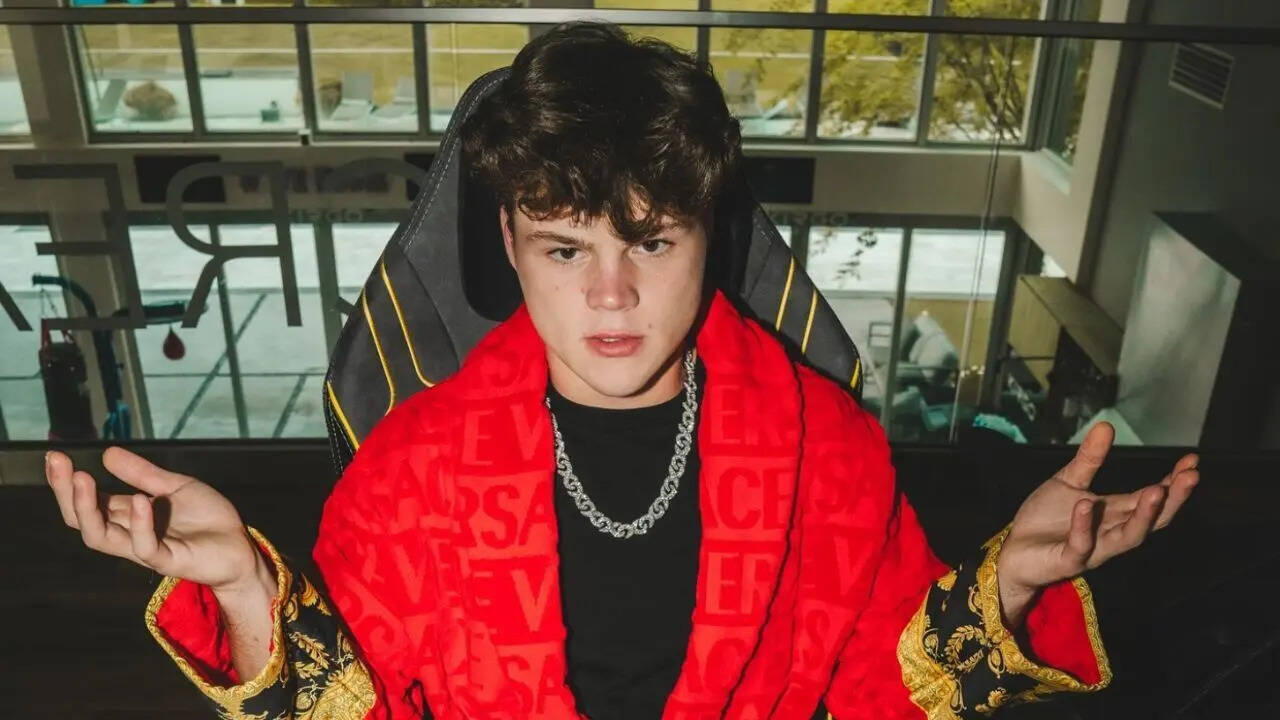
Controversial internet streamer Jack Doherty has been placed under house arrest following a series of severe legal escalations tied to his November 2025 arrest in Miami Beach, Florida. The 22-year-old content creator, known for generating millions of views through high-risk pranks and public disruptions, revealed the judicial restriction himself. In a brief video posted to social media, Doherty flaunted an electronic ankle monitor while pacing through his luxury mansion, joking that being confined to a multi-million dollar property was not the worst possible outcome.
While the streamer attempts to frame the restriction as a minor inconvenience for his "haters" to celebrate, the underlying legal reality is far more perilous. This court-ordered confinement is the direct result of a multi-charge criminal case that includes felony possession of an controlled substance (amphetamine), misdemeanor possession of marijuana, and resisting an officer without violence.
The house arrest order serves as a boiling point for an industry that has long struggled to regulate creators who monetize chaotic, real-world behavior. For Doherty, the judicial system has finally stepped in where platform moderation failed.
The Miami Beach Arrest and the Escalation to House Arrest
The path to Doherty's current confinement began on November 14, 2025, outside a Miami Beach smoke shop. According to police reports and recently released law enforcement bodycam footage, Doherty blocked traffic to film a social media stunt. When officers ordered him to clear the roadway, the streamer refused to cooperate, leading to an immediate intervention by local police.
A subsequent search by authorities uncovered illicit substances. The state of Florida filed a heavy slate of charges against him:
| Charge Type | Specific Offense | Legal Severity |
|---|---|---|
| Felony | Possession of a Controlled Substance (Amphetamine) | Severe (Potential prison sentence) |
| Misdemeanor | Possession of Marijuana (Under 20 grams) | Moderate |
| Misdemeanor | Resisting an Officer Without Violence | Moderate |
The situation worsened during the preliminary court phases in early 2026. Reports surfaced indicating that Doherty failed to appear in person for his scheduled court proceedings, choosing instead to have his legal counsel attend remotely via Zoom. The administrative confusion surrounding his charges, combined with his apparent disregard for standard court protocols, heavily influenced the judge's decision to restrict his travel.
Faced with a high-profile defendant who repeatedly monetizes non-compliance, the Florida judiciary opted for an electronic monitoring program. This keeps Doherty anchored to a single geographic location while the state prepares its broader criminal case.
A Pattern of Unchecked Escalation
To view Doherty’s house arrest as an isolated incident is to misunderstand the mechanics of modern streaming algorithms. The incentive structures of live-streaming platforms reward boundary-pushing behavior. Consequence-free escalation is built directly into the business model.
In October 2024, Doherty made national headlines after crashing his $200,000 McLaren sports car on a rainy Miami highway. He was looking at his mobile phone while driving, broadcasting the entire sequence live to tens of thousands of viewers. The crash sent his cameraman to the hospital with head injuries requiring stitches. The immediate penalty? A brief ban from the streaming platform Kick and a minor traffic citation for distracted driving.
The platform mechanics followed a predictable loop:
- October 2024: Permanent ban from Kick following the McLaren highway crash.
- January 2025: Kick reverses the ban, reinstating Doherty's channel.
- January 2025 (Nine days later): A second ban is issued after Doherty, his private security team, and a heckler engage in a live-streamed street brawl.
When digital penalties fail to curb dangerous public behavior, physical intervention becomes inevitable. The real-world stakes caught up to the digital theater.
The Weaponized Security Model on Trial
Beyond his immediate drug charges, Doherty faces a deeper systemic reckoning regarding how he utilizes private security guards to manufacture confrontational content. In April 2026, a Los Angeles Superior Court judge denied Doherty’s motion to dismiss a civil lawsuit filed by Chase Cameron Gardella.
The lawsuit stems from a 2023 live-streamed Halloween party. Court documents allege that Doherty ordered his large security guard, Justin "Kane Kongg" Goslee, to physically assault Gardella for the sake of "good content." The punch left Gardella with injuries to his head and face, and the entire incident was promptly sliced into short-form videos for YouTube, TikTok, and X.
"Doherty has a history... of filming himself harassing, assaulting and antagonizing members of the public by having his security guards step in to intimidate and assault them if they react to Doherty's harassment."
— Excerpt from Gardella v. Doherty court pleadings
The ruling cleared the path for a full jury trial set for late 2026, where Doherty faces substantial punitive damages. The legal theory behind the case threatens the very core of how prank creators operate. If a court establishes that an influencer can be held directly liable for the violent actions of hired security used to escalate situations for profit, the financial liability framework for the entire streaming sector changes overnight.
The Limit of the Digital Shield
Even as his criminal trial looms, Doherty’s instinct has been to convert his legal misfortune into content. In February 2026, just weeks before his house arrest order, he was removed from the WM Phoenix Open and barred indefinitely from all future PGA Tour events. Security personnel ejected him after he allegedly paid a spectator to scream during a professional golfer's pre-shot routine.
The house arrest video is merely the latest attempt to maintain relevance while losing access to the public sphere. By bragging about the luxury of his mansion, Doherty attempts to shield his brand from the stigma of criminal prosecution. It is a calculated public relations defense designed to show his young audience that wealth insulates a creator from actual societal consequences.
The strategy carries immense risk. Judges rarely look favorably upon defendants who mock court-ordered supervision on public channels. As his drug possession case moves closer to a final disposition in Florida, the visual evidence of Doherty treating an ankle monitor as a lifestyle accessory may very well transform a temporary period of house arrest into a permanent stint behind bars. The digital shield is wearing incredibly thin.