On Saturday afternoon, November 7, 2026, a 24-year-old Polish lathe operator named Michał Oksiński drove into Kraków's historic Main Market Square around 3 p.m. and opened fire with a rifle, killing six people and wounding roughly a dozen others before a shootout with police near Stradomska and Dietla streets. He died in the hospital two days later. Investigators also linked him to the fatal shootings of his father, mother, and 21-year-old sister back in their apartment in Ostrowiec Świętokrzyski.
Surface accounts treat the attack as a sudden bolt from the blue in a country rarely hit by mass gun violence. That reading misses the mechanics. A closer look at the timeline, firearm permitting, radicalization clues, and immediate information warfare reveals how a preventable convergence of household weapons access, unaddressed warning signs, and online manipulation turned a quiet Saturday afternoon into a national shock.
How the Attack Moved from a Quiet Flat to Central Krakow
Violence rarely starts at the moment the first public shot is fired. In Ostrowiec Świętokrzyski, roughly 200 kilometers from Kraków, police discovered the bodies of 53-year-old Janusz Oksiński, 52-year-old Renata Oksińska, and 21-year-old Magdalena Oksińska inside the family home, along with two dead family cats. Each person had been shot twice in the head while wearing sleepwear, and investigators noted that a silencer may have kept neighbors from hearing anything.
Once that threshold was crossed, the geography of the threat shifted fast. Oksiński took his father's vehicle and made the drive south to Kraków, a city his sister attended at the Academy of Fine Arts and one of Poland's busiest tourist magnets. Driving directly onto the Main Market Square at mid-afternoon put him inside a dense mix of locals, students, and international visitors.
Witnesses described a familiar sensory confusion that happens when gunfire hits a public space built for strolling rather than cover. Some people initially thought the pops were fireworks. Others hit the pavement or scrambled into gift shops and cafés while staff locked doors and cut the lights.
The Pursuit and the Shootout
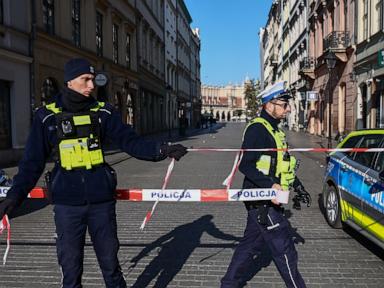
Police did not allow the gunman to linger unchallenged in the square. Officers pursued him through the surrounding streets and caught up to him minutes later near the intersection of Stradomska and Dietla streets.
The ensuing exchange of gunfire was brutal. Two police officers, Jakub Kulik and Artur Morański, were seriously injured and required emergency surgery, while Oksiński suffered critical wounds that proved fatal on November 9. By the time the dust settled, six bystanders were dead—four women and two men, including Polish nationals as well as a man from the United Kingdom and a woman from Austria—and around 15 to 16 people were wounded, among them visitors from several countries and the two injured officers.
For Kraków, the emotional shock registered in rituals older than living memory. St. Mary's Trumpet Call, sounded hourly from the tower of St. Mary's Basilica on the square, went silent overnight from Saturday into Sunday—the first interruption since World War II.
Permissive Gun Access Inside a Low-Crime Country
Poland's reputation as a low-crime destination makes a mass shooting feel anomalous, yet the legal pathway to heavy firepower is narrower and more accessible than outsiders often assume. Oksiński had no criminal record and no military service. He worked as a lathe operator at the Ostrowiec Refractory Materials Plant and had belonged to a shooting club since 2022.
Club membership matters. In early 2026, Oksiński obtained a permit covering two firearms—a rifle and a pistol—while his father held permits for nine other firearms. When authorities tallied the arsenal connected to the case, they accounted for 11 weapons across the family home, his car, and the scene in Kraków, including four firearms in his possession or vehicle and roughly 500 rounds of ammunition.
| Detail | Verified Fact | Why It Matters |
|---|---|---|
| Permits & Club Ties | Gun club member since 2022; permit for 2 guns in early 2026; father licensed for 9 more | Shows legal sport shooting pathways can scale quickly inside a household |
| Arsenal Recovered | 11 total weapons linked to family home, vehicle, and attack; about 500 rounds | High firepower and ammunition volume concentrated in one actor's reach |
| Prior Record | No criminal record and no military background | Standard initial background screens did not flag an impending mass attack |
| Policy Response | Urgent review of permit vetting and periodic checks announced by officials | Exposes the gap between one-time approval and ongoing risk monitoring |
After decades covering security policy, I have learned to watch the gap between initial vetting and ongoing reality. A person can pass a clean background check and club requirements on paper in January and spiral into domestic homicide and public mass violence by November. Prime Minister Donald Tusk ordered an urgent review of firearms regulations, and Justice Minister Waldemar Żurek pointed to regular examinations for sporting permit holders.
Still, periodic checks are no silver bullet. Even strict licensing regimes struggle when licensed firearms sit inside a home alongside an unaddressed mental health or ideological crisis, or when an applicant's behavior shifts after a permit is issued. Policymakers face a genuine trade-off between protecting legitimate sport shooters and building early-warning triggers that do not turn routine administrative hurdles into theater.
Warning Signs in Plain Sight and the Motive Debate
Long before November 7, fragments of troubling behavior existed around Oksiński, though none triggered formal intervention. Former classmates recalled that he kept to himself and sketched scenes of attacks in a notebook during school, joking among peers in ways nobody treated as a real threat. Neighbors described him as withdrawn, someone who often walked around wearing a hood and a mask, while his grandmother remembered him as shy and close to his mother.
None of those traits prove homicidal intent on their own. Plenty of socially isolated young men sketch dark fantasies or wear hoodies without hurting a soul. The mistake lies in treating isolation as harmless noise while ignoring how grievances harden over time.
Investigators opened a terrorism probe and focused heavily on far-right extremism. Justice Minister Żurek stated that Oksiński had visited websites linked to mass murderer Anders Breivik, that a Gadsden flag hung in his home, and that workplace markings pointed toward far-right ideology. At the same time, officials and analysts stressed that investigative work into motive and networks remains ongoing, and political opponents fiercely disputed early framing.
When Lone Actors Meet Political Fault Lines
Whenever a high-casualty attack happens in Europe, political factions rush to fit the shooter into their preferred villainy. In Poland, government officials highlighted far-right indicators, while opposition leader Jarosław Kaczyński dismissed claims of far-right framing as a lie.
That tug-of-war is predictable, yet it can obscure a messier truth. Modern attackers frequently blend online extremism, personal grievance, and family crisis in ways that resist neat ideological boxes. Focusing exclusively on a single political label risks missing the domestic violence that preceded the public rampage—a pattern that shows up again and again in mass shootings worldwide.
How Disinformation Hijacked the Aftermath Within Hours
The physical attack in Kraków lasted minutes; the information battle around it exploded almost instantly. According to Poland's NASK research institute and European disinformation monitors, false narratives surged across social platforms while emergency crews were still locking down the city.
Some claims tried to pin the massacre on Ukraine, alleging the gunman was Ukrainian or a mercenary wearing Ukrainian patches—narratives fact-checkers and Polish investigators debunked as false. Other viral threads accused the Polish government and the European Union of orchestrating the attack, or claimed the shooter held opposite political views based on doctored or AI-altered images. High-profile amplification on major social platforms pushed fabricated angles to massive audiences before verified facts could catch up.
Anyone who has watched crisis coverage over the last decade knows this playbook. Speed rewards invention, while accuracy moves at the speed of forensic verification. When authorities are still confirming identities and ballistics, rumor fills every vacuum—turning a tragedy in Kraków into ammunition for domestic culture wars and foreign influence operations alike.
What Lasting Accountability Requires Now
A city square can be scrubbed, cordoned off, and reopened to foot traffic, and a traditional trumpet call can return to its schedule. Restoring public trust takes harder work: transparent reporting on how permits and household arsenals are tracked, sober investigation into both ideological radicalization and domestic warning signs, and faster, clearer public communication that starves fabricated narratives of oxygen.
If leaders treat the Kraków shooting merely as a freak accident or a convenient talking point, the next warning sign will be just as easy to miss until gunfire echoes across another public square.