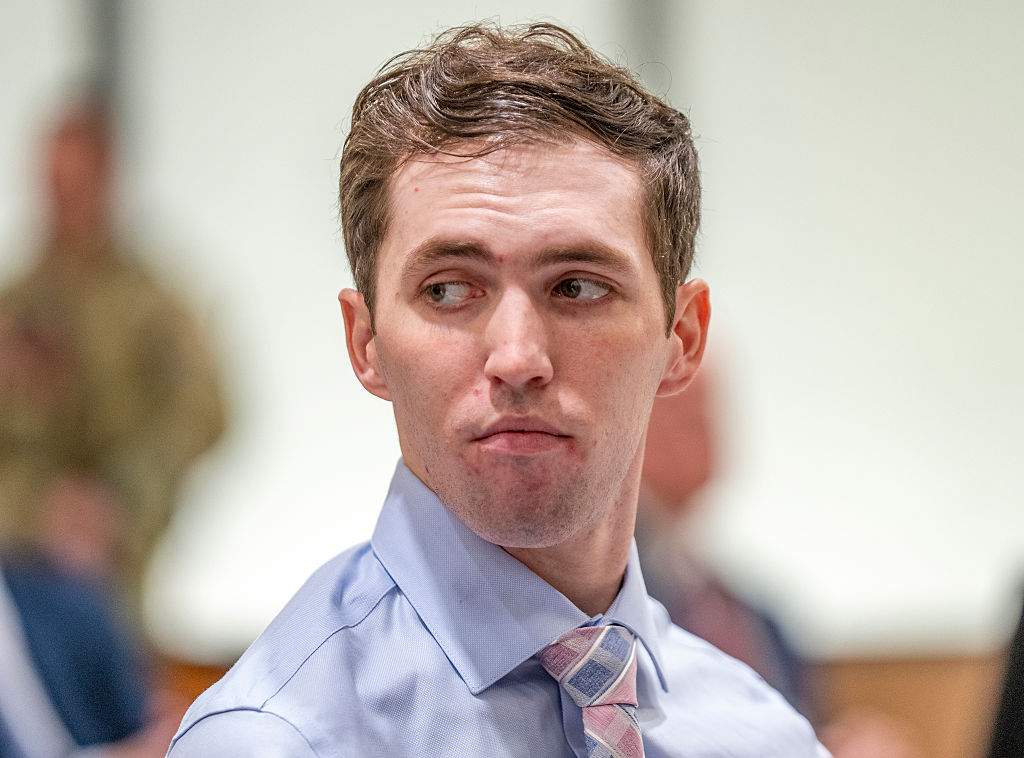
Nearly a year after a single bullet ended the life of conservative activist Charlie Kirk at Utah Valley University, the machinery of capital punishment grinds forward. Fourth District Judge Tony Graf ruled that Tyler Robinson, the 23-year-old accused of the assassination, must stand trial for aggravated murder. The decision keeps the death penalty firmly on the table, setting the stage for what promises to be one of the most contentious courtroom battles in recent Utah history.
The legal mechanics of how this case reached trial reveal a high-stakes clash over statutory interpretation, ballistic evidence, and the precise legal threshold required for a capital offense.
The Core Battleground of Aggravated Murder
To secure a death sentence in Utah, prosecutors must clear a steep legislative hurdle. They cannot simply prove intentional homicide; they must establish at least one statutory aggravating factor. In this case, the Utah County Attorney's Office anchored its capital case to the claim that Robinson knowingly created a great risk of death to multiple people.
Prosecutor Ryan McBride argued that firing a high-powered, bolt-action rifle from a rooftop more than four hundred feet away into a crowded campus plaza containing over three thousand people inherently endangered bystanders. The statistical probability of a stray round or a deflected projectile striking someone else in that dense assembly forms the backbone of the state's argument for capital punishment.
The defense countered with a strict literalism that exposes vulnerabilities in the prosecution's theory. Defense attorney Staci Visser dismantled the state's mass-endangerment narrative by pointing to the physical reality of the incident.
"There was one shot. One bullet. One victim," Visser argued during court proceedings.
The defense emphasized that Kirk occupied an elevated stage, isolated from immediate peers at the exact moment of impact. Under prior Utah case law, defense counsel argued, the state must demonstrate a high probability—not a mere theoretical possibility—of collateral casualties. Judge Graf ultimately sided with the state on procedural sufficiency for a trial, citing the layout of the tent and surrounding crowds, but the debate over endangerment will likely form the central axis of future appeals.
Evidence, Ballistics, and the Paper Trail
Beyond the legal definition of aggravation, the evidentiary foundation assembled by investigators presents a complex matrix for the upcoming trial. Law enforcement agencies recovered a bolt-action rifle on a nearby rooftop, complete with DNA matching Robinson on the trigger and weapon components. Investigators also retrieved a tool allegedly used to engrave ammunition.
Yet, the state's physical evidence is not entirely airtight. A report from the Bureau of Alcohol, Tobacco, Firearms and Explosives revealed that the microscopic fragment recovered from Kirk's body could not be definitively linked to the recovered rifle. While a spent shell casing found at the scene matched the weapon, the inconclusive nature of the bullet fragment provides the defense with a technical opening to challenge the weapon's direct tie to the fatal wound.
To offset potential gaps in ballistic certainty, prosecutors lean heavily on a digital and physical paper trail of alleged confessions. Court documents detail a handwritten note left for Robinson's roommate and romantic partner, containing the phrase, "I had the opportunity to take out Charlie Kirk, and I took it". Additional electronic messages on platforms like Discord, alongside subsequent statements made to acquaintances prior to Robinson's surrender, paint a picture of premeditation and ideological motive.
The Motive Equation and Political Animus
The state intends to pursue sentencing enhancements based on the allegation that Robinson targeted Kirk explicitly for his political expression. Prosecutors highlight text messages and digital communications wherein Robinson expressed deep frustration with Kirk's public platform, particularly regarding LGBTQ issues and conservative social commentary.
The legal challenge of proving a political hate crime within a capital framework requires establishing state-of-mind beyond a reasonable doubt. The defense maintains that prosecutors are rushing to conclusions, attempting to criminalize unpopular ideological disagreements rather than proving the statutory elements of the crime. As the case shifts toward a jury trial, the courtroom will become a forum not only for forensic science but for a wider examination of political polarization and radicalization.
The formal arraignment saw Robinson enter a plea of not guilty across all seven charges. With family members of the victim observing from a heavily secured gallery and legal teams preparing for exhaustive evidentiary motions, the timeline toward a definitive verdict remains long. The looming threat of capital punishment ensures that every motion, objection, and expert testimony will be scrutinized under the harshest judicial light.


