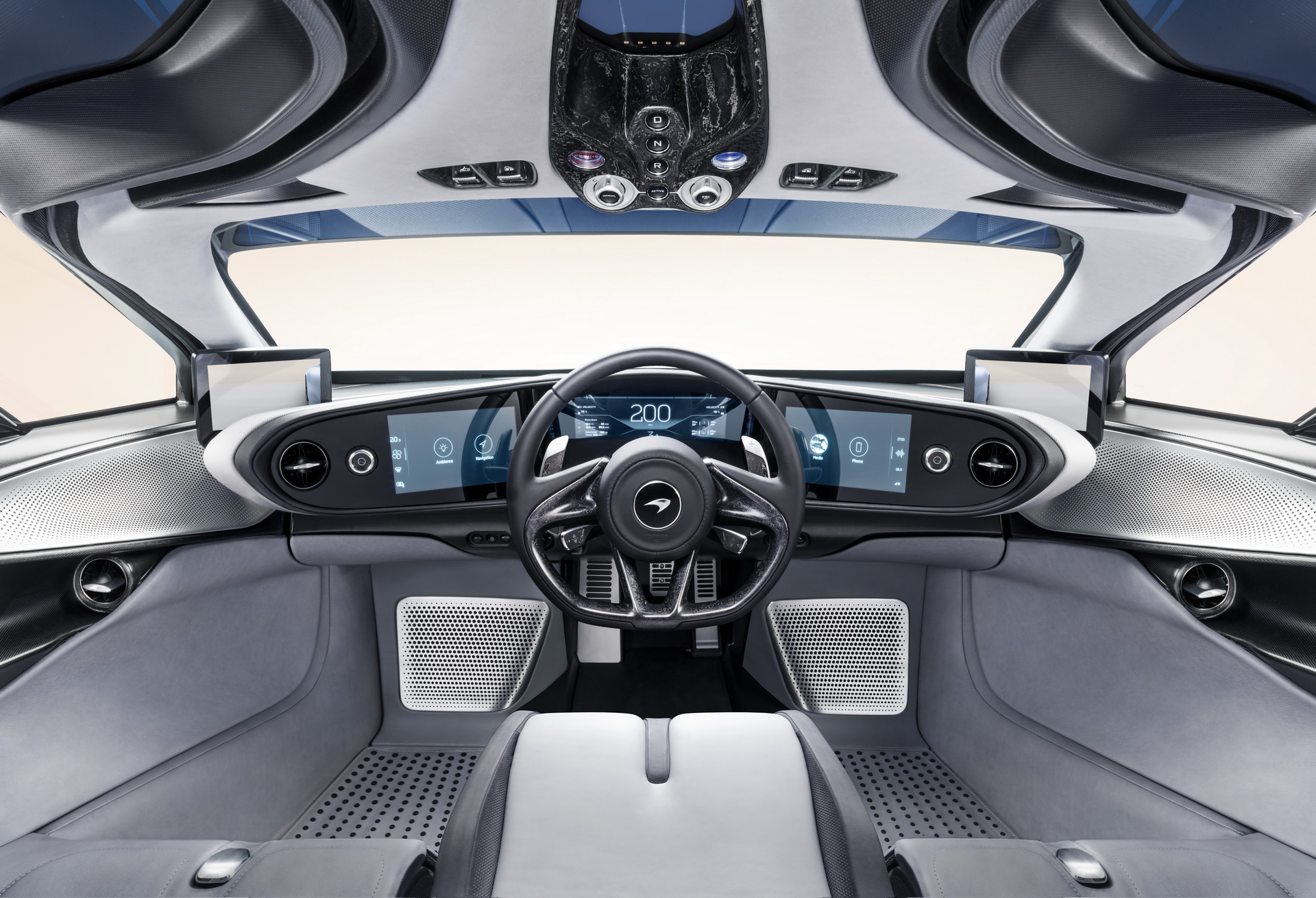
McLaren is building its first four-door, two-row SUV for delivery before 2030, backed by a £500 million UK investment from Abu Dhabi sovereign backer L'IMAD, to chase the lucrative volume and daily-driver loyalty that have made the Lamborghini Urus and Ferrari Purosangue cash engines for its rivals. For a decade, Woking treated the mere mention of a high-riding McLaren like heresy. Now the spreadsheet has won.
Watch the scoreboard and the reversal makes sense. Lamborghini delivered 10,747 vehicles worldwide in 2025, with the Urus accounting for more than half of those sales—meaning a single Italian SUV outsold McLaren's entire model lineup by more than two to one. McLaren, by contrast, built around 2,000 cars in 2025, with more than half shipped to the United States, the exact market where luxury SUVs do the heaviest lifting on dealer margins.
Back in 2016 at the Geneva motor show, then-CEO Mike Flewitt laid out three strict tests for any car wearing the McLaren badge: consistency with the brand, leadership as the best driver's car in its segment, and profitability. An SUV, Flewitt argued flatly, failed all three. Two years later, the Track25 business plan promised 6,000 cars a year by 2025 without an SUV, while McLaren peaked at 4,806 sales in 2018 before financial strain, program delays, and balance-sheet resets pulled output back down.
Ideology is expensive when you are building low-volume, high-cost exotics. Two-seat mid-engined supercars are thrilling on a track or a Sunday morning canyon road, yet they are terrible primary vehicles for wealthy buyers who have school runs, ski trips, or clients to ferry around town. Ferrari saw that gap and built the Purosangue. Lamborghini rode the Urus to record global scale. McLaren watched from the sidelines while its own balance sheet bled.
Why Woking Surrendered on the Four-Door Rule
A pure sports car maker has a structural problem. Demand for ultra-expensive, two-door exotics fluctuates sharply with interest rates, equity markets, and model refresh cycles, leaving factories exposed when a car gets long in the tooth. An SUV smooths out that curve because buyers cross-shop it against luxury flagships and daily performance wagons rather than treating it strictly as a weekend toy.
Still, entering the segment in the late 2020s is nothing like Porsche launching the Cayenne in 2002. In 2002, Porsche was a pioneer taking a massive reputational gamble. Today, the luxury performance SUV aisle is crowded, mature, and fiercely contested by entrenched players with years of real-world calibration data.
Under CEO Nick Collins and chief operating officer Michael Straughan, McLaren has stopped pretending that carbon tubs alone can fix a volume deficit. Straughan has been blunt that McLaren's volume sits around half that of Aston Martin, and a brand building roughly 2,000 cars a year cannot endlessly amortize next-generation powertrains, safety homologation, and software architectures across tiny production runs.
| Metric or Trait | McLaren SUV Plan | Lamborghini Urus | Ferrari Purosangue |
|---|---|---|---|
| Target Window or Status | Confirmed for delivery before 2030 | Established volume pillar (30,000+ built historically) | Active four-door four-seater |
| Powertrain Direction | Front-engined hybrid architecture | High-output V8 / hybrid variants | 6.5-liter naturally aspirated V12 (725 cv) |
| Primary Structural Material | Weighing a carbon tub (under study) | Aluminum / steel-aluminum architecture | Aluminum chassis architecture |
| Volume Posture | Scale-up via second UK assembly line | Over half of Lamborghini's 10,747 sales in 2025 | Deliberately capped share of Ferrari output |
| Core Buyer Hook | Lightweight DNA for F1 fans with families | Aggressive street presence and broad reach | V12 drama and tight scarcity |
Notice what that table highlights. McLaren is not arriving as an underdog with nothing to lose; it is arriving late to a fight where every rival already has a clear identity. If McLaren's SUV simply looks like a jacked-up supercar with extra doors, buyers will ask why they should pick it over a Ferrari with a 7,750-rpm V12 or a Lamborghini backed by Volkswagen Group scale.
Follow the Sovereign Money From Bahrain to Abu Dhabi
You cannot understand McLaren's sudden pivot without following the capital behind it. For years, Bahrain's Mumtalakat shouldered heavy restructuring costs as McLaren fought to stabilize liquidity and hit production targets. That chapter shifted when CYVN Holdings acquired full control of McLaren Automotive from Mumtalakat around late 2024 and early 2025, folding in the UK electric vehicle startup Forseven along the way.
In September 2026, Abu Dhabi's L'IMAD stepped forward with a £500 million UK investment commitment tied to integrating CYVN's automotive assets and accelerating next-generation models, including the SUV. The money is earmarked to create at least 1,000 direct UK jobs by 2032—with potential knock-on support for up to 3,000 supply-chain roles—while funding a second British vehicle assembly site alongside Woking.
Woking simply does not have enough floor space to build a large four-door SUV alongside its existing two-door cars, even though prototypes can be assembled there. McLaren is also expanding its South Yorkshire composites facility, which produces carbon tubs, while pulling in engineering and design work across Bicester and the MIRA proving ground inherited via Forseven.
- Manufacturing footprint: A new UK assembly plant complements Woking, avoiding a bottleneck on existing mid-engined sports car lines.
- Composites expansion: Scaling South Yorkshire supports higher composite output if McLaren commits to a carbon structure.
- Talent timing: With Jaguar Land Rover announcing 4,000 job cuts in September 2026, McLaren plans to court experienced UK automotive engineers, though getting Midlands workers to relocate south remains a real hurdle.
- Advisory bench: Leadership has brought in seasoned industry figures, including advisory support from former Ferrari boss Luca di Montezemolo alongside executive chairman Paul Walsh and former Rolls-Royce chief Torsten Müller-Otvös.
Sovereign wealth brings patience and deep pockets, which is a massive upgrade over chronic cash crunches. Yet patience in the car business is measured in five- to seven-year cycles, and a pre-2030 launch still leaves plenty of execution risk on suppliers, software, and homologation.
The Carbon Tub Trap and the Ricardo Divorce
Straughan has described the upcoming SUV as front-engined and hybrid, with either four-wheel drive or rear-wheel drive, while leaving the exact body structure open to engineering trade-offs. Crucially, he has ruled out partnering with a rival automaker like BMW on the platform, insisting the architecture must belong wholly to McLaren.
Going solo is bold, and it is also expensive. Every established rival in the performance SUV bracket—from the Aston Martin DBX to the Ferrari Purosangue—relies on aluminum structures. McLaren is weighing whether to put the SUV on a carbon tub, a move that would be a first in the class and immediately test the limits of composite engineering on a taller, heavier family-capable vehicle.
Refinement Versus Weight on Broken Asphalt
Carbon fiber gives McLaren its signature stiffness and weight story, which matters enormously when you are trying to keep a heavy four-door SUV from feeling top-heavy and numb. A lighter base structure reduces unsprung and sprung mass loads on tires, brakes, and active suspension, helping a tall car change direction without sloppy body roll.
That upside comes with real headaches. Carbon tubs are notoriously tricky to package for high-volume four-door apertures, expensive to tool, and far harder—and costlier—to inspect or repair after a fender bender or curb strike than aluminum. Luxury SUV owners drive their cars in tight urban garages, bad weather, and everyday traffic where minor impacts happen far more often than on a race circuit; if insurance or repair times turn into a nightmare, wealthy buyers notice quickly.
What Happens When You Cut Out Ricardo
Equally dramatic is McLaren's decision to end roughly 15 years of relying on Ricardo in Shoreham to design and build its core engines. Since the 12C arrived in 2011, Ricardo-built V8s and V6s have powered McLaren's core road cars, while Ricardo continues other engineering work without shipping engines to Woking.
McLaren now plans to design and build two new hybrid engines and matching transmissions in-house, building from the current V8 or its next generation. Reports have also pointed to the V6-powered Artura being phased out around 2028 as the lineup reshapes.
Developing two proprietary hybrid powertrains plus custom gearboxes from scratch is a massive engineering undertaking for a boutique automaker. Powertrain electronics, battery thermal management, and emissions compliance across global markets have tripped up far larger companies than McLaren, so bringing that work inside must be judged by reliability and throttle response, not press releases.
Where Ferrari and Lamborghini Are Actually Vulnerable
To beat Ferrari and Lamborghini, McLaren has to find daylight between two very different Italian playbooks. Lamborghini turned the Urus into a mainstream status symbol with thunderous low-end torque and unmistakable styling, selling thousands of them globally and proving that badge appeal plus SUV practicality can carry a supercar brand.
Ferrari took the opposite tack with the Purosangue. By pairing a 725-cv naturally aspirated V12 with four doors and deliberately capping SUV production around a modest slice of its overall output, Ferrari turned scarcity and acoustic drama into its moat. Buyers who want a rare, high-revving collector piece with back seats already have a clear target.
McLaren's opening sits in tactile agility and modern hybrid punch rather than V12 nostalgia or sheer production volume. Straughan has suggested the SUV can appeal to Formula One fans with children who still care about steering feel, braking precision, and weight control—qualities that often get buried under four-ton luxury bloat.
There is a catch, of course. A hypothetical buyer cross-shopping a McLaren SUV against a Lamborghini Urus or Ferrari Purosangue is not just buying lap times or composite tub trivia; they are buying service network confidence, resale stability, and brand cachet on the valet stand. If McLaren nails the chassis dynamics and delivers a sharp, dependable hybrid before 2030, the SUV could finally give Woking the cash flow it has chased for a decade. If it arrives late, heavy, or buggy, no amount of carbon weave will save it from becoming an expensive distraction.