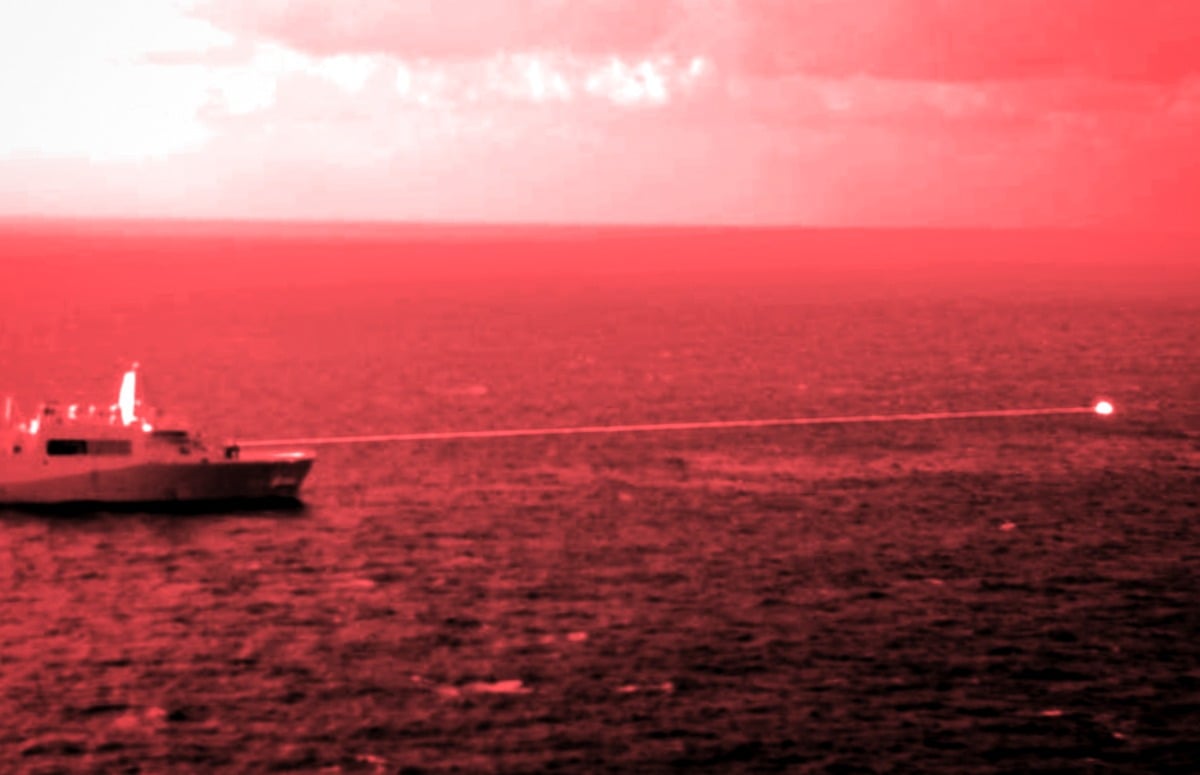
The United States Navy just handed a California defense contractor seventeen million dollars to build the most powerful high-energy directed-energy weapon ever deployed on a maritime platform.
That transaction represents a fundamental pivot in naval warfare strategy. Surface combatants face asymmetric threats that cost mere pennies to manufacture, while interceptor missiles routinely run into the millions. A single hypersonic threat or swarming drone attack can exhaust a destroyer's physical magazine in minutes. Directed-energy weapons promise an infinite magazine restricted only by fuel and cooling capacity. The physics underlying this shift rely on focusing concentrated photon beams onto a target to thermally overwhelm structural integrity.
Contract awards of this magnitude usually generate press releases celebrating technological supremacy. Behind closed doors, procurement officers and fleet commanders harbor deep anxieties. Power generation, thermal management, and atmospheric interference remain stubborn barriers. Throwing funds at a prime contractor does not automatically solve thermodynamic realities.
The Thermodynamic Wall
Energy beams sound instantaneous in science fiction. In the messy reality of maritime salt air, high-humidity environments, and violent ship motion, they face severe operational degradation. Photons scatter. Beams bloom. Water vapor absorbs thermal energy before it ever reaches the intended hull.
Defense acquisition programs routinely underestimate the cooling footprint required for multi-kilowatt or megawatt-class systems. Generating a directed beam of sufficient wattage to destroy an incoming cruise missile requires massive electrical input. Much of that energy converts directly into waste heat. On a cramped guided-missile destroyer, thermal management is already an acute engineering bottleneck. Adding a high-energy laser means ducting colossal amounts of heat away from sensitive electronics and dumping it into the surrounding ocean without detection. Infrared signatures matter. A warship glowing brightly on thermal sensors defeats the purpose of stealth.
Contractors love to showcase laboratory successes. A controlled indoor chamber with pristine atmospheric conditions bears zero resemblance to the deck of an Arleigh Burke-class destroyer pitching in the North Atlantic. Salt spray coats optical lenses instantly. Without advanced adaptive optics capable of correcting wavefront distortions hundreds of times per second, the beam disperses into useless warmth.
The Economics of Directed Energy
Financial ledgers drive military procurement just as much as tactical necessity. An SM-6 missile costs upwards of four million dollars. Using a multi-million-dollar interceptor against a commercial drone modified with a hobbyist explosive payload creates a brutal economic asymmetry. The adversary wins by bankrupting the defender.
High-energy lasers flip that ledger on its head. Each firing cycle costs the price of diesel fuel used to turn the ship's generators.
+-------------------+----------------------------+
| Weapon System     | Approximate Cost Per Shot  |
+-------------------+----------------------------+
| Standard Missile  | $2,000,000 - $4,000,000    |
| Phalanx CIWS      | $15,000 - $30,000          |
| High-Energy Laser | $1.00 - $10.00             |
+-------------------+----------------------------+
That math explains why the Pentagon keeps writing checks despite repeated delays and technical hurdles. Navies cannot sustain high-intensity conflicts against peer competitors using traditional kinetic munitions alone. The industrial base cannot manufacture missiles fast enough to replenish stockpiles during a protracted engagement.
Yet, treating seventeen million dollars as a silver bullet ignores historical precedent. Defense acquisition is littered with programs that absorbed billions before quietly being canceled due to insurmountable integration flaws.
Power Architecture Failures
Legacy warships were never designed to shoulder the electrical load demanded by directed-energy weapons. Electrical grids aboard older platforms operate on legacy distribution standards. Integrating a megawatt-class laser requires radical overhauls of auxiliary power systems, energy storage banks, and capacitor modules.
Newer hulls like the Zumwalt class or future surface combatant designs incorporate integrated power systems specifically meant to route massive electrical surges on demand. Retrofitting existing fleets is vastly more complicated. If firing the primary defense system causes radar grids to brownout or navigation systems to stutter, the weapon becomes a liability rather than an asset.
Engineers must balance power allocation between propulsion, sensors, computing, and offensive or defensive effectors. Energy is finite. Diverting gigajoules of power to a laser emitter means temporarily starving other critical systems. Tactical commanders will face brutal operational choices in the heat of engagement. Do you keep the radar fully powered for tracking, or do you spool up the laser to burn an incoming threat?
The Procurement Cycle Trap
Defense contractors operate within an incentive structure that rewards winning bids rather than delivering field-ready hardware on time. The seventeen-million-dollar award announced by this California firm represents an initial development tranche, not a fixed-price production contract.
Cost overruns are baked into the system. As technical hurdles mount—whether related to beam director stabilization, fiber laser efficiency, or optics contamination—the developer will return to the Pentagon requesting engineering change proposals and supplemental funding.
Bureaucrats approve these increases because abandoning a sunk cost looks worse on annual performance reports than doubling down. The cycle repeats across decades. Programs transition from developmental prototypes to limited test articles, linger in operational limbo, and eventually get replaced by the next shiny technology before ever firing a shot in anger.
Atmospheric Reality Check
Skeptics point out that the oceans are hostile to light propagation. Fog, smoke, rain, and dust degrade laser performance exponentially. A thick maritime fog bank can completely blunt a beam, rendering the weapon little more than an expensive flashlight.
Advocates counter that multi-spectral tracking and shorter wavelength combinations penetrate atmospheric obscurants more effectively. Both arguments hold merit. Technology improves, but physics remains constant. Water molecules absorb specific infrared frequencies. Unless engineers can dynamically shift wavelengths to exploit atmospheric windows in real time, environmental conditions will dictate when naval lasers can and cannot defend the ship.
Relying on a weather-dependent defensive system introduces unacceptable tactical risk. An enemy commander monitoring meteorological data could time missile salvos to coincide with heavy sea spray or localized fog banks, neutralizing the high-energy deterrent entirely.
The Path Forward for Fleet Defense
If the Navy wants this seventeen-million-dollar investment to yield operational capability instead of another white paper, procurement officials must break old habits. They need rigorous, unvarnished testing in high-salinity, high-humidity operational environments from day one, rather than sterile desert testing ranges.
The engineering hurdles are real, but so is the operational necessity. Surface fleets cannot continue down a path where defending against cheap saturation attacks drains national treasuries and empties armories.
Success requires acknowledging that directed-energy platforms are not standalone replacements for kinetic missiles. They are complementary layers in a layered defense architecture. Until contractors solve the unglamorous problems of thermal dumping, optical durability, and power distribution, the high-energy laser remains an expensive promise waiting for physics to catch up with ambition.