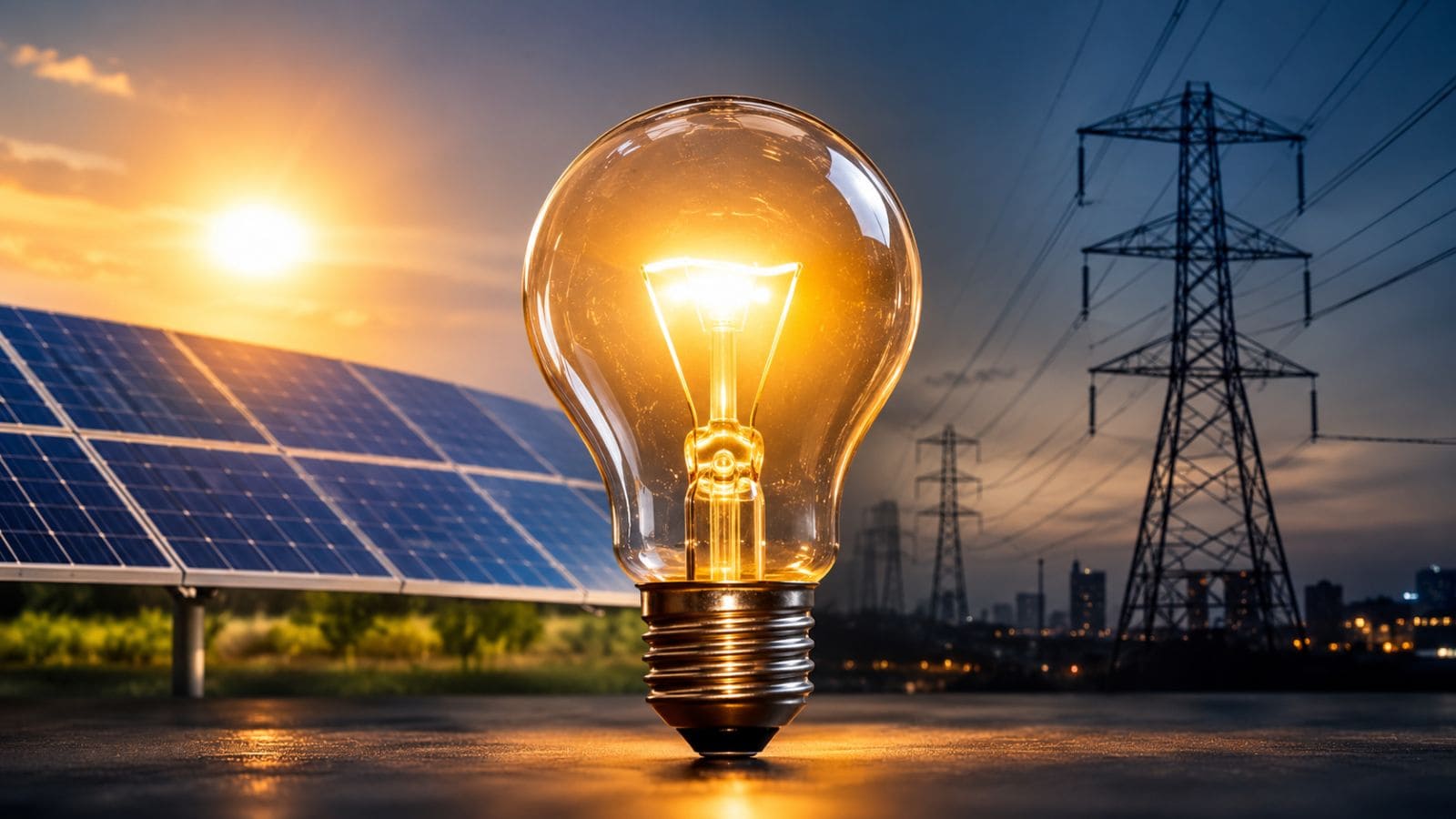
Pakistan’s rapid shift toward rooftop solar panels is systematically dismantling its national electric grid from the inside out. While international observers celebrate the country’s massive import of Chinese photovoltaic modules as a grassroots green revolution, the reality on the ground is a financial and technical death spiral. Wealthy residential consumers and industrial powerhouses are abandoning the state-run distribution network in droves. Left behind are the poorest citizens and a bankrupt utility infrastructure saddled with billions of dollars in fixed capacity payments that no longer have a viable customer base to pay them.
The numbers tell a stark story. Over the past few years, Pakistan has emerged as one of the world's largest importers of solar equipment, bringing in gigawatts of capacity in a remarkably short window. This was not driven by state mandates or climate subsidies. It was driven by survival.
The Anatomy of a Grid Defection
To understand why the Pakistan solar boom happened so violently, you have to look at the tariff structure. For decades, Islamabad used electricity billing as a blunt instrument for fiscal policy and social cross-subsidization. Industrial users and high-consumption residential households were charged punitive rates to subsidize agricultural tube wells and low-income lifeline users.
Then came the macroeconomic crunch. Currency devaluation, soaring global fuel prices, and strict International Monetary Fund conditions forced the government to hike base tariffs repeatedly. Electricity bills doubled, then tripled. Suddenly, a middle-class family in Lahore or Karachi was paying more for power than for rent or groceries.
Enter cheap Chinese solar panels. As global manufacturing overcapacity pushed module prices to historic lows, the return on investment for a rooftop solar system in Pakistan shrank from seven years to less than two. Businesses and affluent homeowners did the math. They did not wait for government approval or grid upgrades. They bought panels, bolted them to their roofs, and severed their reliance on the national utility.
This is textbook grid defection, and it is happening at a speed rarely seen in modern energy history.
The Capacity Payment Trap
In a normal power market, reduced demand from the grid would simply mean power plants burn less fuel, saving everyone money. Pakistan does not have a normal power market.
During the acute power shortages of the 2010s, the Pakistani government signed long-term contracts with Independent Power Producers, many backed by foreign debt under the China-Pakistan Economic Corridor. To attract this investment, the state guaranteed capacity payments. Under these take-or-pay agreements, the government must pay power plant owners for their fixed costs and guaranteed returns whether the electricity is actually generated or not.
Imagine a hypothetical scenario where ten neighbors agree to split the fixed monthly mortgage on a shared backup generator. One by one, the five wealthiest neighbors buy their own private generators and stop using the shared machine. The mortgage on the shared generator does not shrink. Instead, the remaining five neighbors—who could not afford private machines—must now cover the entire mortgage themselves. Their monthly bills skyrocket, pushing even the sixth and seventh neighbors to scrape together money to leave.
That is the exact utility death spiral gripping Pakistan today.
As solar adopters slash their grid consumption during daylight hours, the total volume of electricity sold by state distribution companies drops. Yet the colossal bill for capacity payments remains fixed. The regulator, the National Electric Power Regulatory Authority, is legally bound to recover these costs from the remaining kilowatt-hours sold. Consequently, grid tariffs must rise even higher to cover the shortfall. Every tariff hike makes solar panels an even more attractive investment for the next tier of consumers, accelerating the exodus.
Net Metering and the Great Wealth Transfer
The crisis is compounded by how Pakistan initially structured its net metering regulations. Designed years ago when solar adoption was negligible, the policy allowed rooftop generators to sell excess daytime electricity back to the grid at generous rates, offsetting the expensive power they consumed from the grid at night.
In practice, this turned the national grid into a free, infinitely large battery for the wealthy.
Consider the physics and economics of this arrangement. At noon, when solar panels across Punjab and Sindh are pumping out maximum power, grid demand is relatively moderate. The utility is forced to absorb this excess solar power, often curtailing cheaper base-load plants while still paying their capacity charges. Then, at 7 PM, the sun sets. Millions of air conditioners turn on simultaneously. Solar production drops to zero, and those exact same solar-equipped homes draw massive amounts of power from the grid, relying on expensive imported furnace oil or liquefied natural gas plants to meet the evening peak.
Because of net metering credits accumulated during the day, these households pay almost nothing for that expensive evening power. Meanwhile, low-income renters and residents in dense urban slums—who lack the roof space or upfront capital for solar—are forced to pay full, inflated tariffs to keep the system afloat. What was pitched as a clean energy transition has morphed into a massive regressive wealth transfer from the poor to the rich.
Technical Instability on the Wires
Beyond the balance sheets, the physical infrastructure is buckling. Pakistan's transmission and distribution network was engineered for one-way power flow—from massive centralized thermal and hydro plants down to passive consumers. It was never designed to handle decentralized, intermittent generation pouring backward into local transformers.
Voltage Fluctuations and Reverse Power Flow
In affluent neighborhoods with high solar penetration, local distribution feeders experience severe reverse power flow during sunny afternoons. When neighborhood generation exceeds neighborhood consumption, electricity pushes backward through step-down transformers toward the high-voltage grid.
This causes localized voltage spikes. High voltage degrades consumer appliances, trips sensitive industrial machinery, and accelerates the thermal aging of distribution transformers that are already poorly maintained. Utility engineers in cities like Faisalabad and Multan are fighting a daily battle against grid frequency instability.
The Duck Curve Problem
Grid operators globally deal with the duck curve—the sharp drop in net load during midday followed by a steep ramp-up in demand at sunset. California spent billions of dollars and over a decade building grid-scale battery storage and flexible gas peakers to manage this transition.
Pakistan is experiencing one of the steepest duck curves in the world without any of the shock absorbers. Dispatchers at the National Power Control Centre must violently throttle down thermal power plants every morning, only to scramble to bring them back online every evening. Thermal plants are not built to cycle like sports cars. Constant ramping causes mechanical stress, increases maintenance costs, and severely degrades fuel efficiency, adding yet another hidden cost to the system.
The Informal Economy Blind Spot
Official statistics vastly undercount the true scale of the disruption. While the government tracks registered net-metering connections, a massive shadow market of off-grid and hybrid solar installations operates entirely beneath the regulatory radar.
Walk through any electronics market in Rawalpindi or Peshawar, and you will see inverters and lithium-ion batteries stacked to the ceiling. Because applying for a net-metering license involves bureaucratic delays and bribes, thousands of consumers simply install hybrid systems configured for zero export. They use solar to run their homes during the day, charge batteries for the evening, and keep the grid strictly as an emergency backup.
For the state utilities, this invisible load destruction is terrifying. Planners cannot forecast demand accurately when gigawatts of behind-the-meter generation can appear or disappear behind cloud cover without warning. Furthermore, the rapid drop in battery prices means the final barrier to total grid independence is crumbling. Once affluent consumers can afford enough battery storage to survive the night, they will not just reduce their grid usage—they will disconnect their meters entirely.
Policy Paralysis and Flawed Fixes
Confronted with an existential threat to state finances, Islamabad’s response has been erratic and reactionary. The government has repeatedly floated proposals to slash buyback rates for net metering, replace net metering with gross billing, or impose fixed capacity charges on solar owners based on the size of their inverters.
Every time these rumors leak, public backlash is immediate and fierce. Middle-class consumers, already battered by inflation and heavy taxation, view attacks on solar incentives as the state punishing them for solving a problem the government created. After enduring decades of load-shedding, voltage drops, and arbitrary billing, citizens have zero trust in the state's ability to manage the power sector.
Even if the government successfully slashes net-metering buyback rates, it will likely backfire. Penalizing grid exports simply incentivizes consumers to buy more batteries and go completely off-grid. The utility loses the revenue either way, while forfeiting any visibility or control over the distributed energy resources operating within its territory.
The Industrial Exodus
The residential sector grabs the headlines, but the industrial defection is what truly threatens the nation's economic foundation. Textile mills, cement factories, and steel manufacturers have historically been the cash cows of Pakistan’s power sector. They consume power steadily, operate at high voltages with lower distribution losses, and pay their bills reliably.
Now, major industrial groups are building massive captive solar and wind farms. When a single textile conglomerate shifts 30 megawatts of load off the national grid, a distribution company loses millions of rupees in monthly revenue overnight.
The government recently attempted to stem this tide by cutting industrial grid tariffs slightly while simultaneously hiking taxes on captive gas generation, hoping to force factories back onto the national wires. It is a band-aid on a severed artery. Industrialists do not trust that tariff reductions will hold once the next fiscal crisis hits. For an exporter competing on razor-thin margins against rivals in Bangladesh and Vietnam, locking in predictable, zero-fuel-cost solar power is an existential necessity, regardless of what Islamabad decrees.
Where the Wires Break Next
There is no easy off-ramp from this crisis. Renegotiating the sovereign debt and capacity contracts tied to legacy power plants is a diplomatic and legal minefield, largely involving state-backed Chinese lenders who have little appetite for taking haircuts on guaranteed returns.
At the same time, the physical grid desperately needs billions of dollars in smart-grid upgrades, automated voltage regulators, and utility-scale battery storage just to handle the solar panels already installed. Pakistan does not have the capital to fund these upgrades, and international lenders are hesitant to pour money into a distribution sector plagued by massive line losses and rampant electricity theft.
The country is heading toward a bifurcated energy future. On one side sits a resilient, privately funded, solar-and-battery-powered economy serving the wealthy and major industries. On the other sits a hollowed-out, bankrupt public grid delivering increasingly expensive, unreliable power to those who cannot afford to leave.
Until Islamabad stops treating electricity tariffs as a substitute for tax collection and fundamentally restructures its legacy power contracts, the solar panels shining on rooftops across Pakistan will remain monuments to state failure rather than beacons of a clean energy future.