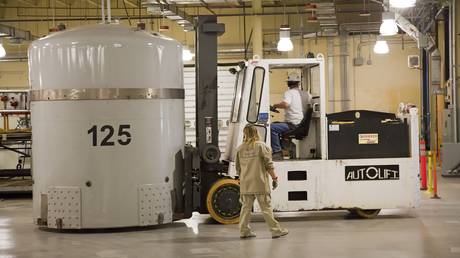
The United States government is preparing to hand over up to 20 metric tons of weapons-grade plutonium from its Cold War-era stockpile to five private nuclear energy companies. Driven by an executive mandate to secure domestic power for artificial intelligence data centers, the Department of Energy entered advanced negotiations with commercial startups to convert this lethal military material into civilian reactor fuel. Critics warn the unprecedented plan creates severe nuclear proliferation risks, provides massive corporate subsidies, and undermines decades of bipartisan nonproliferation policy. This historic shift fundamentally alters the boundary between national security and private commerce.
For half a century, American policy maintained a strict wall between military nuclear assets and commercial power generation. The rationale was simple. Weapons-usable plutonium, if intercepted or mishandled, represents the ultimate global security threat. Yet under the Surplus Plutonium Utilization Program, the Department of Energy (DOE) is altering that stance.
The selected companies—Oklo, Exodys Energy, SHINE Technologies, Standard Nuclear, and Flibe Energy—are positioned to receive a raw material capable of fueling thousands of nuclear warheads. While the administration frames the initiative as an innovative solution to the nation's energy bottleneck, a deeper look reveals a high-stakes gamble involving national security assets, Silicon Valley power demands, and corporate interests.
The Choke Point Driving the Policy Shift
The sudden urgency to unlock federal weapons storage facilities stems from a severe fuel shortage facing the next generation of nuclear power plants. Small modular reactors (SMRs) are widely touted as the future of clean energy, particularly for power-hungry tech infrastructure. However, these advanced reactors cannot run on the low-enriched uranium used by traditional commercial reactors. They require specialized, highly concentrated fuels.
Historically, Russia has been the primary global supplier of high-assay, low-enriched uranium. With a complete U.S. ban on Russian uranium imports taking effect in 2028, domestic advanced reactor developers face an existential supply crunch. The industry needs a bridge fuel immediately, or billions of dollars in venture capital will evaporate.
Enter the nation's military surplus. The DOE holds more than 50 tons of surplus plutonium at heavily fortified sites in South Carolina, Texas, and New Mexico. By shifting this material from the liability ledger to the asset ledger, the administration aims to solve two problems at once. It bypasses the uranium enrichment bottleneck and provides nuclear startups with free, highly potent fuel.
The True Cost of Free Fissile Material
While the DOE highlights that private industry will shoulder the costs of transporting, processing, and fabricating the plutonium, independent analysts question the financial logic. History shows that processing weapons-grade plutonium into commercial fuel is an industrial nightmare.
During the George W. Bush and Obama administrations, the federal government attempted to build the Mixed Oxide (MOX) Fuel Fabrication Facility at the Savannah River Site in South Carolina. The project was designed to convert 34 metric tons of weapons-grade plutonium into commercial reactor fuel under a nonproliferation agreement with Russia.
The project collapsed. It turned into one of the worst fiscal disasters in DOE history. Beset by technical failures and management incompetence, the estimated lifecycle cost of the MOX facility skyrocketed from $5 billion to nearly $50 billion. The project was terminated, having burned through billions of taxpayer dollars with virtually nothing to show for it.
Following that failure, the government opted for a "dilute and dispose" strategy. This process involves blending the plutonium with non-fissile materials and burying it deep underground at the Waste Isolation Pilot Plant in New Mexico. That disposal plan carried an estimated cost of $20 billion.
The current administration's executive order halted the disposal program. Shifting the burden to startups like Oklo—which has partnered with European nuclear developer newcleo to build fuel-fabrication infrastructure—is framed as a cost-saving measure for the taxpayer. However, critics point out that the underlying physics and chemistry have not changed. Separating and processing plutonium remains vastly more expensive, toxic, and complex than manufacturing conventional uranium fuel. If these startups underestimate the industrial hurdles, the federal government may face immense pressure to bail out stalled projects containing highly dangerous materials.
The Proliferation Loophole
The most alarming aspect of the program is not the financial risk, but the geopolitical precedent. When the United States commercializes its military plutonium stockpile, it loses the moral and diplomatic authority to discourage other nations from doing the same.
Plutonium does not exist in significant quantities in nature; it is a byproduct of uranium irradiation in nuclear reactors. For decades, Washington argued against the commercial reprocessing of spent fuel because the infrastructure required to extract plutonium for civilian reactors is virtually identical to the infrastructure used to harvest material for an atomic bomb.
If American companies begin transporting weapons-grade plutonium on public infrastructure and processing it in private facilities, the international nonproliferation framework weakens. Nations currently under scrutiny for their nuclear ambitions can point directly to the American model. They can argue that their own domestic plutonium processing programs are purely civilian, intended to feed advanced commercial reactors rather than build weapons stockpiles.
Furthermore, moving material from military custody into the commercial supply chain creates vulnerability. While the DOE mandates strict security requirements, private transport and civilian processing facilities do not match the defensive posture of military installations. The material earmarked for this program includes plutonium extracted from dismantled warhead cores, known as pits. Handing over the literal core components of the American nuclear deterrent to private corporate entities represents a profound shift in national security policy.
Corporate Ties and AI Demands
The political momentum behind this policy is inextricably linked to the rapid expansion of artificial intelligence. Tech giants require staggering amounts of continuous, carbon-free electricity to power their next-generation data centers. Traditional renewable sources like wind and solar are intermittent, making advanced nuclear power the preferred solution for Silicon Valley.
The intersection of tech capital, nuclear startups, and federal policy is tight. Current Energy Secretary Chris Wright served on Oklo’s board of directors prior to his cabinet appointment. While the administration defends the program as a broader push for American energy independence, the alignment of regulatory approvals with corporate timelines raises significant conflict-of-interest questions.
The administration has designated AI data centers as critical defense facilities and the reactors powering them as defense critical electric infrastructure. This designation allows the government to utilize national security authorities to streamline environmental reviews and reduce regulatory delays. This maneuver effectively uses the Pentagon's urgency to accelerate the commercial deployment of untested reactor designs.
An Interdependent Future
The plan is moving from executive directive to operational reality. The five selected companies are entering advanced negotiations to iron out the security, logistics, and legal liabilities of taking possession of the material.
This program is not a simple environmental recycling initiative. It is a fundamental reorganization of the American nuclear enterprise that prioritizes commercial speed and tech-sector dominance over long-standing international security norms. By fueling private ambitions with military assets, the government tethers national security directly to the financial success of private startups.