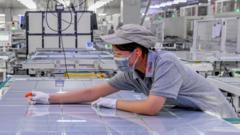
President Donald Trump signed a proclamation implementing a 15% tariff alongside rigid minimum import prices on polysilicon derivatives and raw material imports, explicitly targeting China's dominance over the base building blocks of semiconductors and solar panels. Operating under Section 232 of the Trade Expansion Act, the White House aims to protect the fragile remnants of domestic manufacturing—specifically pointing to a sector where the United States maintains only two active production plants.
Yet, beneath the banner of national security and economic independence, this policy collides with an unforgiving industrial reality. The American technology sector relies heavily on a globalized web of high-purity inputs that cannot be substituted overnight. A defensive trade barrier changes the cost structure of computing hardware and energy infrastructure simultaneously.
The Anatomy of a Chokepoint
Polysilicon is the ultra-pure silicon refined from silica sand that forms the absolute foundation of both microelectronics and photovoltaic cells. Without it, advanced logic chips do not get fabricated, and silicon wafers remain unformed. For decades, manufacturing capacity drifted eastward, driven by lower energy costs, specialized state subsidies, and scale efficiencies concentrated across Asia.
The United States enters this trade conflict with severely depleted domestic infrastructure. Only two primary entities manufacture polysilicon on American soil: Hemlock Semiconductor in Michigan—a joint venture involving Corning and Japan's Shin-Etsu Handotai—and a facility in Tennessee operated by Munich-based Wacker Chemie.
Expecting these two operations to instantly absorb the enormous input demands of America's multi-billion-dollar semiconductor fabs and renewable energy developers defies basic industrial mathematics. Production plants of this scale require years of environmental permitting, specialized chemical engineering talent, and billions in capital expenditure. A tariff does not build a cleanroom or distill hyper-pure material; it merely shifts the immediate financial penalty onto the downstream firms forced to buy foreign stock anyway.
The Hybrid Weaponization of Price Floors
What makes this trade intervention distinct is its reliance on a hybrid system. The administration did not stop at a flat 15% tariff on derivatives like silicon wafers, ingots, and solar cells. It also imposed mandatory price floors:
- $21 per kilogram for raw polysilicon.
- $100 per kilogram for polysilicon ingots and wafers.
This dual-mechanism approach is designed to prevent foreign competitors from bypassing standard percentage tariffs through undercutting or margin manipulation. By establishing a fixed price baseline, imports falling below the threshold are effectively locked out.
However, price floors create artificial market rigidity. When global supply chains experience fluctuations, a statutory floor prevents the market from clearing naturally. Downstream chip designers and hardware assemblers absorb the difference, squeezing operational margins at a time when competition in advanced computing components is escalating rapidly.
The Collateral Damage on Dual Industries
Semiconductors and solar infrastructure are inextricably linked at the raw material stage, yet they face wildly divergent political environments. While the current administration champions aggressive reshoring for high-end microelectronics to secure leadership in artificial intelligence, its simultaneous skepticism toward renewable energy subsidies creates a severe paradox.
Solar developers are caught in the crossfire. They face the withdrawal or reduction of federal clean energy support while simultaneously absorbing higher baseline material costs mandated by the new trade restrictions.
For semiconductor fabricators, the immediate impact may be less about direct cost and more about supply chain friction. Modern chip manufacturing demands ultra-high consistency. If domestic suppliers cannot scale output to meet demand parity, chipmakers face difficult choices regarding inventory hoarding, procurement delays, or seeking exemptions that draw intense regulatory scrutiny.
The Global Rebound Effect
Trade barriers rarely exist in a vacuum. Major trading partners, including South Korea and various European stakeholders with deep investments in the American technology ecosystem, are auditing their exposure. South Korean firms, heavily invested in both semiconductor fabrication and solar supply chains, find themselves navigating a narrowing corridor where compliance with U.S. domestic content rules requires restructuring longstanding procurement networks.
Meanwhile, excess polysilicon and wafer volume displaced from the American market will not simply vanish. It will flow toward alternative industrial hubs across Asia and developing markets, potentially depressing prices elsewhere and giving international competitors an advantage in regions unprotected by similar trade walls.
Protectionism without immediate domestic capacity scaling risks isolating domestic manufacturers behind an expensive wall of their own making. The policy forces a confrontation with an uncomfortable truth: securing the future of American computing and clean energy requires more than penalizing imports. It demands the unglamorous, capital-intensive labor of building actual industrial capacity from the ground up