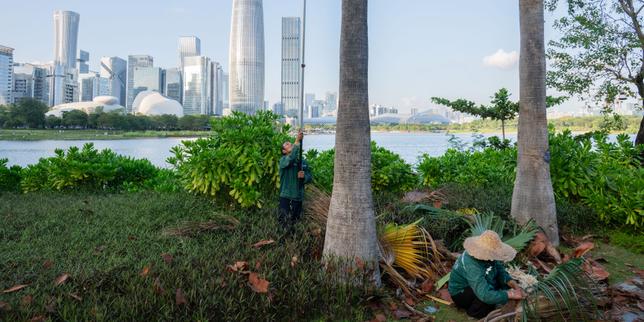
Shenzhen’s rise from a sleepy border town of 30,000 people in 1979 to a $500 billion tech powerhouse was never just a story of free-market magic. It was a calculated, state-backed industrial experiment designed to absorb foreign capital, copy Western supply chains, and eventually out-engineer the very companies that built its factories. Today, the standard media narrative—one of breathless awe at neon skyscrapers and instant urbanization—misses the real story happening on the ground. Behind the gleaming glass towers of Nanshan District, China’s showcase metropolis is fighting a brutal war on two fronts: a structural slowdown in domestic demand and an aggressive geopolitical decoupling that is stripping away its historical advantages.
Walk through the Huaqiangbei electronics market today and you will still see the raw kinetic energy that made this city famous. Bins of microchips, ribbon cables, and custom sensors sit under harsh fluorescent lights. Yet the crowd has changed. Ten years ago, the aisles were jammed with hardware founders from Silicon Valley and Munich hunting for cheap prototyping partners. Now, those foreign buyers are increasingly routing their orders to Vietnam, India, and Mexico.
The city has changed, certainly. Every local resident will tell you that. Forty years ago, water buffaloes grazed where the Ping An Finance Centre now pierces the clouds at nearly 600 meters. Roads were mud tracks. Electricity was erratic.
To look at Shenzhen merely as a miracle of speed is to misunderstand how power and capital actually operate in southern China. The transformation was deliberate, ruthless, and expensive.
How the Special Economic Zone Really Worked
When Deng Xiaoping designated Shenzhen as China’s first Special Economic Zone (SEZ) in 1980, Beijing did not simply step back and let capitalism bloom. The central government built a walled garden with specific rules. Foreign companies were invited in with tax holidays, cheap land leases, and access to an almost bottomless pool of migrant labor from China’s interior provinces.
In exchange, Beijing demanded something far more valuable than export revenue. It wanted technology transfer and manufacturing know-how.
The arrangement worked brilliantly for three decades. Foxconn built massive campuses like Longhua, employing hundreds of thousands of workers to assemble iPhones and PlayStations. Local entrepreneurs watched how these global supply chains operated, learned the tolerances required for precision tooling, and started their own component shops down the street.
By the 2010s, Shenzhen had achieved something no other city on earth could match. An engineer could sketch a circuit board at breakfast, source the capacitors by lunch, have a custom injection-molded plastic casing made by dinner, and hold a working prototype before midnight. Hardware startups called it the "Shenzhen speed."
That ecosystem gave birth to genuine global titans. Tencent turned a desktop messaging clone into WeChat, the operating system of daily Chinese life. Huawei moved from selling rural telephone switches to dominating global 5G telecommunications infrastructure. BYD transitioned from making rechargeable cellphone batteries to overtaking Tesla in global electric vehicle volume. DJI captured more than 70 percent of the world’s commercial drone market.
None of this happened by accident. Municipal planners funneled billions of yuan in state-directed subsidies, subsidized R&D grants, and preferential land deals to sectors designated as strategic priorities. When a local champion stumbled, state-owned investment arms stepped in with liquidity.
The Myth of Pure Private Enterprise
Western observers often describe Shenzhen as China’s most capitalist city, a freewheeling outlier distinct from the state-heavy economy of Beijing or Shanghai. That framing is dangerously incomplete.
While private firms generate the vast majority of Shenzhen’s GDP and tax revenue, they operate inside a tightly managed political architecture. Every major tech firm in the city hosts internal Chinese Communist Party committees. Regulatory crackdowns—like the sweeping antitrust and data-security campaigns that wiped hundreds of billions off Tencent’s market valuation starting in late 2020—proved beyond doubt who holds ultimate authority.
Consider how the city handled its transition to electric public transit. In 2017, Shenzhen became the first major city in the world to electrify 100 percent of its public bus fleet—more than 16,000 vehicles—followed shortly by its entire taxi fleet.
Journalists praised the environmental vision. Few examined the balance sheets. The rollout required massive municipal subsidies to cover the upfront cost of BYD vehicles and an aggressive, state-mandated buildout of charging depots on prime urban real estate. Private ride-hailing drivers were essentially forced through licensing rules to switch to electric models, absorbing higher vehicle costs while platform commissions squeezed their margins.
It worked as an industrial policy tool. It gave BYD a guaranteed domestic testing ground and massive scale before the company ever shipped a single car to Europe or Southeast Asia. As a model of pure market efficiency, however, it was pure state capitalism.
The Real Estate Hangover Nobody Wants to Measure
For years, Shenzhen’s municipal government funded its infrastructure binge and corporate subsidies through a familiar Chinese mechanism: land finance. Because the state owns all urban land, the city leased parcels to property developers at astronomical prices, using the proceeds to build subway lines, parks, and science incubators.
That engine has stalled.
Shenzhen boasts some of the most unaffordable housing on the planet relative to local incomes. At the peak of the boom, price-to-income ratios in districts like Nanshan and Futian surpassed 40-to-1, making London and New York look cheap by comparison. A young software engineer earning 30,000 yuan a month could barely afford a down payment on a cramped 50-square-meter apartment an hour outside the city center.
When Beijing moved to pop the national property bubble in 2021, the shockwaves hit Shenzhen hard. Home prices in several neighborhoods dropped by 20 to 30 percent from their peaks. Transaction volumes dried up. Land auction revenues plunged, leaving municipal planners with far less cash to throw at new industrial initiatives.
Even the city’s crown-jewel developers buckled. China Vanke, headquartered in Shenzhen and long considered the country’s most prudent, well-managed property giant, required emergency liquidity support and state-backed intervention to stave off default. Evergrande, before its spectacular collapse, also operated out of Shenzhen, leaving behind half-finished towers and furious retail investors.
The social contract that held the city together—work grueling hours in exchange for rising asset values and upward mobility—began to fray.
The Human Cost of 996 Culture
Ask a veteran tech worker in Shenzhen about the city’s transformation, and the conversation quickly turns from admiration to exhaustion.
Shenzhen was built by migrants—people who left farms and smaller cities in Hunan, Sichuan, and Jiangxi chasing a better life. The city’s official slogan, "Once you come, you are a Shenzhener," promised a meritocracy free from the rigid family connections required in older Chinese cities.
In practice, that meritocracy demanded total physical and mental submission. The notorious 996 work schedule—working from 9 a.m. to 9 p.m., six days a week—was normalized across Shenzhen’s tech campuses long before it became an international headline. Companies tracked bathroom breaks, monitored messaging apps, and quietly phased out engineers once they hit age 35, replacing them with cheaper, younger graduates willing to sleep under their desks.
Labor strikes in the manufacturing belt of Bao’an and Longgang tell the other side of the story. As factories automated or relocated to lower-cost regions, veteran assembly-line workers found themselves laid off without the full social insurance and housing fund contributions their employers were legally obligated to pay.
A generation of migrant workers gave their youth to build Shenzhen’s export machine. Many are now returning to their home provinces with chronic back pain, meager savings, and no hukou—the household registration permit needed to access top-tier public schools and healthcare in the city they built.
Supply Chain Flight and the Geopolitical Squeeze
The biggest threat to Shenzhen’s future does not come from inside China. It comes from Washington, Brussels, and Tokyo.
For forty years, Shenzhen thrived on seamless integration with Western markets. American chipmakers supplied the silicon; European firms supplied the precision machinery; Western consumers bought the finished goods. That era is over.
Export controls imposed by the United States and its allies have cut Shenzhen’s flagship companies off from advanced semiconductors and lithography equipment. Huawei, placed on the US Entity List in 2019, saw its global smartphone business gutted overnight before mounting a costly, state-backed comeback using domestic chips fabricated by SMIC.
Western multinational corporations, spooked by tariff wars, pandemic lockdowns, and rising political risk, have adopted a "China Plus One" procurement strategy. Apple has pushed suppliers to expand iPhone assembly in Tamil Nadu, India. Laptop and server manufacturers have poured billions into northern Vietnam, building industrial parks outside Hanoi that look remarkably like Shenzhen did in the late 1990s.
Shenzhen still holds a massive lead in component depth. Many factories in Vietnam still import 60 to 70 percent of their sub-assemblies, molds, and raw materials directly from Guangdong province via cross-border trucking routes. You cannot replicate four decades of supplier density overnight.
Yet the direction of travel is unmistakable. High-margin assembly and new product introductions are slowly diversifying away from southern China. Every factory that moves its final assembly line to Haiphong or Chennai takes jobs, engineering talent, and future R&D spillovers with it.
How Shenzhen Is Trying to Reinvent Itself Again
Faced with rising labor costs, a property slump, and Western containment, Shenzhen’s leadership is attempting a third major reinvention. Having moved from cheap textiles in the 1980s to consumer electronics in the 2000s, the city is now betting everything on hard tech, artificial intelligence, and green energy.
Walk through the Pingshan district in eastern Shenzhen and you will see the new blueprint. Massive automated factories churn out electric vehicles, lithium-iron-phosphate battery packs, and industrial robotics with minimal human intervention. In the Hetao Shenzhen-Hong Kong Science and Technology Innovation Cooperation Zone, planners are trying to merge Hong Kong’s university research labs and international legal framework with Shenzhen’s rapid prototyping factories just across the Shenzhen River.
The city is also pushing its domestic champions to become global multinationals in their own right, bypassing Western trade barriers by building factories abroad. BYD is constructing manufacturing plants in Hungary, Brazil, and Thailand. Shenzhen battery-material suppliers are setting up operations in Morocco and South Korea to qualify for Western electric vehicle tax credits.
Whether this pivot succeeds depends on a brutal equation. China’s domestic consumer market remains sluggish, weighed down by weak household confidence and youth unemployment. To keep its factories running at full capacity, Shenzhen’s companies are flooding global markets with discounted electric cars, solar panels, and industrial hardware.
That export surge is already triggering a fierce backlash. The European Union has slapped countervailing duties on Chinese electric vehicles. The United States has imposed 100 percent tariffs. Emerging economies from Brazil to Indonesia are raising trade barriers to protect their own nascent industries from being wiped out by cheap goods shipped out of Yantian Port.
What the Rest of the World Gets Wrong About the City
Outsiders tend to view Shenzhen through one of two distorted lenses. Either it is an unstoppable futuristic utopia that proves authoritarian state planning beats Western democracy, or it is a brittle Potemkin village on the verge of imminent collapse.
Both views are wrong.
Shenzhen is a ruthless, hyper-competitive industrial machine staffed by some of the hardest-working engineers and entrepreneurs on earth. Its ability to iterate on physical products—taking a concept from a CAD file to mass production—remains unmatched anywhere in the world. Dismissing its technological capabilities is a mistake that has already cost several Western legacy automakers and hardware firms billions in lost market share.
At the same time, the city’s vulnerabilities are structural and worsening. You cannot subsidize your way out of demographic decline, nor can you force foreign governments to keep their markets open when your industrial policy threatens their core manufacturing base.
If you want to understand where global manufacturing and tech competition are headed over the next decade, ignore the tourist videos of drone light shows over Shenzhen Bay. Watch the freight volumes moving through Yantian Port, track the factory construction permits filed by Shenzhen companies in Southeast Asia and Eastern Europe, and pay attention to how long China’s domestic taxpayers can afford to subsidize an export engine that the rest of the world is actively trying to block.