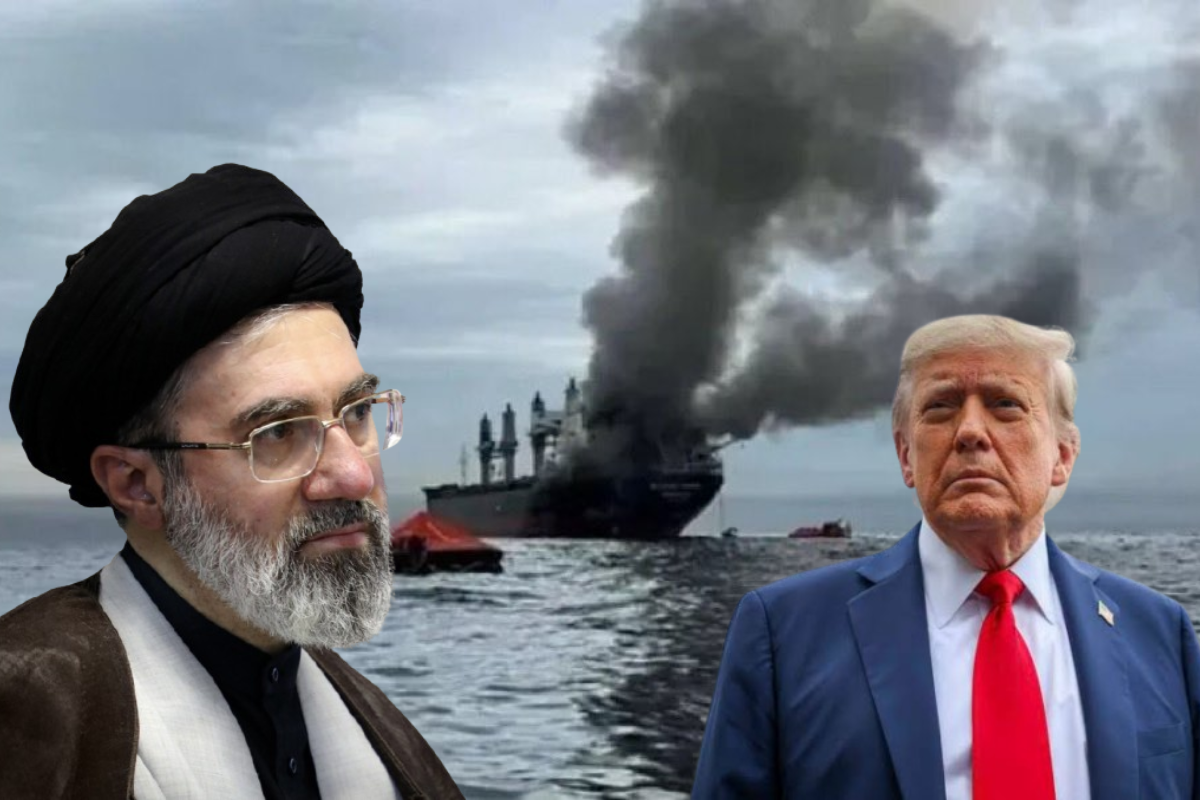
The Strait of Hormuz is burning, and the global energy supply is gasping for air. A commercial oil supertanker caught fire after striking two naval mines along a southern transit corridor, turning a long-simmering geopolitical standoff into an active shipping nightmare.
Tehran’s Islamic Revolutionary Guard Corps quickly claimed the vessel was punished for taking what state media labeled an "illegal" route. This explosion was not an isolated accident of the sea. It is the bloody manifestation of an escalating kinetic tit-for-tat between Washington and Iran that threatens to paralyze the world's most critical petroleum bottleneck.
The Anatomy of an Escalation
To understand why a supertanker is currently immobilized and ablaze near the Omani coast, we have to look at the clock. Just hours before the explosion, United States Central Command launched precision airstrikes against two IRGC rocket launchers stationed on Larak Island. American defense officials confirmed those launchers were actively being prepared to seed fresh explosive mines directly into the shipping lanes.
That preemptive American strike broke a fragile, tense baseline. It marked the first direct kinetic hit by the US on sovereign Iranian territory in months. Tehran did not absorb the blow quietly. Iranian forces reportedly retaliated with a barrage of drones targeting American military installations across the region, including assets near the United Arab Emirates and Jordan.
Amid this smoke and fire, commercial shipping is caught directly in the crosshairs. The Strait of Hormuz handles roughly a fifth of the world's petroleum consumption. When navigation through this narrow corridor becomes a game of Russian roulette with naval mines, the global economy feels the shockwave instantly.
The Chokepoint Control Strategy
The modern history of the Gulf is written in maritime coercion. For years, Tehran has viewed the narrow passage as a geopolitical lever. Controlling the strait means controlling the flow of oil, and controlling the flow of oil translates to supreme regional leverage.
Before the latest detonations, intelligence reports indicated that Iran was attempting to force all commercial traffic to detour near Larak Island for mandatory inspections. More aggressively, maritime security analysts have tracked attempts by Iranian authorities to levy exorbitant transit fees—sometimes reaching two million dollars per vessel—guaranteeing safe passage through waters that should remain open under international law.
When commercial entities or foreign navies push back against these unauthorized tolls, the environment turns hostile. The deployment of sea mines in international shipping lanes serves a dual purpose. It disrupts transit entirely, and it forces a hyper-expensive, high-risk clearance operation for the US Navy and its allies.
Market Reactions and Energy Vulnerability
Global commodities markets react to the smell of crude smoke faster than diplomats can draft press releases. Brent crude futures ticked upward immediately following the news of the tanker explosion and the regional drone strikes, hovering near ninety dollars a barrel.
Every time an explosion rocks the Gulf, shipping insurance rates spike into the stratosphere. Tanker owners operating in the Persian Gulf now face prohibitive war-risk premiums. Some major shipping lines are choosing to pause operations entirely rather than risk total hull loss and crew fatalities. This creates an artificial supply squeeze, even if oil production facilities inland remain untouched.
A hypothetical scenario illustrates the fragility: if a single ultra-large crude carrier sinks across the deepest channel of the strait, it could physically block the passage for weeks. Salvage operations under active drone and missile threats are nearly impossible. The global supply chain would experience an immediate hemorrhage, driving retail fuel prices to levels not seen during previous energy crises.
The Limits of American Deterrence
Washington faces a brutal strategic dilemma. The White House has repeatedly warned that any attempt to close the strait or target commercial shipping will be met with overwhelming force. Yet, massive military superiority does not easily translate to defensive security for hundreds of independent commercial vessels moving through a narrow twenty-one-mile-wide channel.
You cannot park a warship next to every oil tanker. The sheer volume of maritime traffic makes 100 percent escort coverage an impossible logistical fantasy. When the US military claims it has cleared a shipping lane of explosive devices, covert actors can deploy new, composite-material mines under the cover of night using small, fast attack craft.
The strategy from Washington relies on heavy deterrence—punishing strikes against launcher sites and coastal radar networks. But deterrence only works if the adversary values infrastructure preservation over political survival. For the IRGC, projecting power across the strait is an existential priority.
The Ground Reality for Crews
Behind the macroeconomic data and political posturing lie the human beings steering these floating leviathans. Crew members aboard modern supertankers are civilian mariners navigating a war zone. They wake up to the drone of overhead aircraft and the quiet dread that the next radar blip might be a floating contact wired with high explosives.
When a ship takes a direct hit from a sea mine, the structural integrity of a hull carrying millions of gallons of volatile hydrocarbons is compromised in milliseconds. Firefighting at sea, especially under the threat of secondary strikes, requires extraordinary risk. The silence from state media regarding crew casualties in this latest incident only deepens the anxiety rippling through maritime unions worldwide.
The confrontation in the Persian Gulf has evolved past a war of words. With naval mines actively detonating beneath commercial hulls and regional bases absorbing drone attacks, the margin for error has vanished entirely. The Strait of Hormuz remains open on paper, but in reality, every captain entering the corridor is rolling the dice against an unseen explosive tide.



