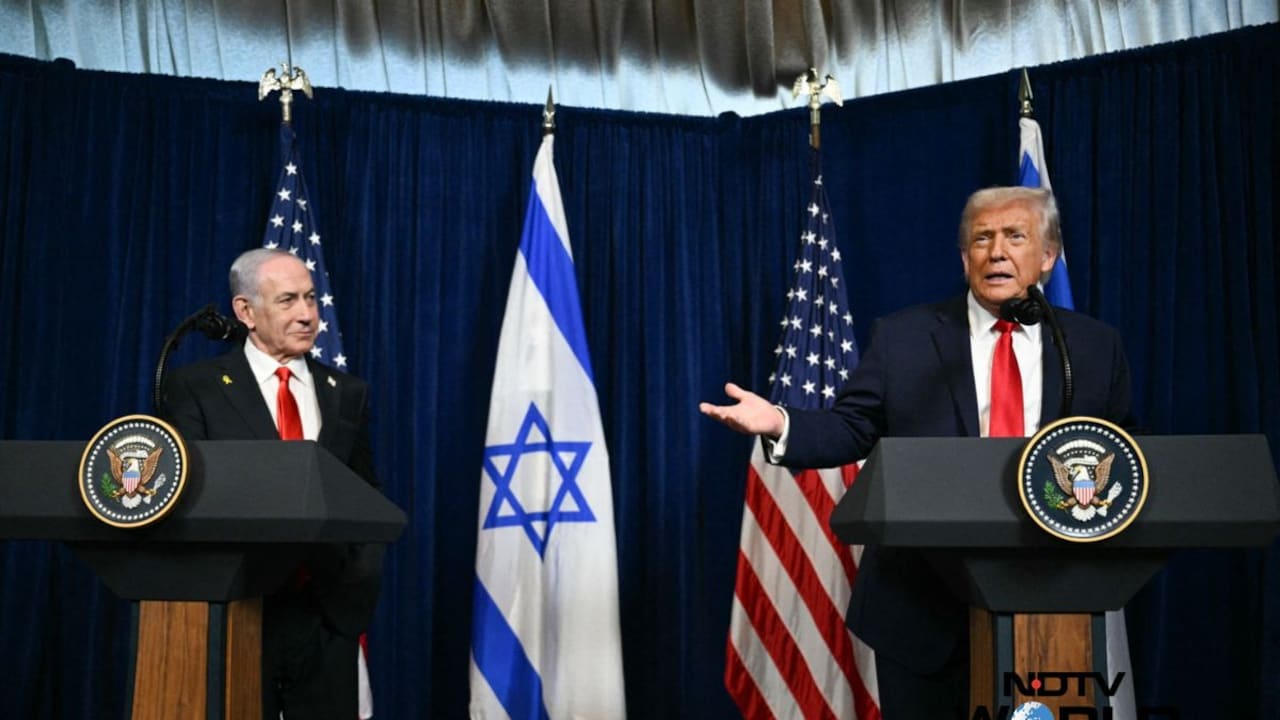
Donald Trump’s public declaration that the United States and Israel "have to finish a job" alongside Benjamin Netanyahu marks a decisive shift from containment to open-ended military alignment against Tehran. Rather than pressing for a rapid ceasefire or imposing diplomatic guardrails, the White House has effectively handed Jerusalem a blank check to prosecute its campaign against Iranian infrastructure and proxy networks. For Washington, this posture reflects a calculated gamble that overwhelming force will permanently degrade Tehran's regional reach, even as it risks pulling American forces deeper into a protracted multi-front war with severe economic consequences.
The rhetoric is unmistakable. When a sitting American president adopts the language of total mission completion during an active regional conflagration, diplomatic off-ramps disappear overnight. For decades, successive administrations in Washington maintained a delicate balancing act—arming Israel to the teeth while quietly using backchannels to restrain its most aggressive military impulses. That era of calibrated friction is over.
The Anatomy of a Blank Check
To understand why Trump has abandoned traditional diplomatic hedging, you have to look at the intersection of domestic political calculus and long-standing strategic grievances. In Washington, the prevailing doctrine among Trump’s inner circle is that previous administrations failed because they prioritized de-escalation over decisive victory. From their perspective, half-measures only allowed Iran to rebuild its ballistic missile stockpiles, harden its nuclear facilities, and fund regional militias from Lebanon to Yemen.
By framing the conflict as an unfinished job, Trump is tapping into a specific brand of deterrence theory. The logic is straightforward. If adversaries believe Washington fears escalation, they will push boundaries endlessly. If they believe Washington and Jerusalem are operating as a single, unrestrained unit, the cost of aggression becomes existential.
Yet this approach ignores a fundamental reality of modern asymmetric warfare. You cannot easily bomb an ideology or a decentralized network of proxy forces into permanent submission.
The Strategic Mismatch
Israel and the United States do not share identical threat assessments, despite the unified front projected at press conferences. For Netanyahu, neutralizing Iran’s nuclear threshold and dismantling Hezbollah’s rocket arsenal are immediate, existential imperatives necessary to restore Israeli deterrence after years of border attrition. His political survival is also inextricably tied to projecting uncompromising strength.
For the United States, the calculus is broader and far more precarious. Washington has to worry about global energy chokepoints, specifically the Strait of Hormuz, through which roughly a fifth of the world's petroleum passes. A prolonged war that cripples Iranian oil exports or triggers retaliatory strikes on Gulf Arab infrastructure sends shockwaves directly to American gas pumps and global financial markets.
Furthermore, American military assets in the Middle East—from airbases in Qatar and the United Arab Emirates to naval destroyers in the Red Sea—become primary targets the moment Tehran decides it has nothing left to lose. Trump’s backing of Netanyahu removes the primary restraining mechanism that previously kept these divergent interests from colliding.
How the Diplomatic Guardrails Collapsed
Historically, even the most staunchly pro-Israel presidents recognized the utility of daylight between Washington and Jerusalem. During the 1973 Yom Kippur War, Richard Nixon authorized a massive airlift to save Israel from defeat, yet simultaneously used intense diplomatic pressure to halt the Israeli advance and prevent a direct superpower clash with the Soviet Union. In 1981, Ronald Reagan temporarily suspended fighter jet deliveries after Israel bombed Iraq's Osirak nuclear reactor.
Those friction points were not signs of weakness. They were essential pressure valves that allowed the United States to act as both Israel’s ultimate guarantor and the region’s indispensable diplomatic broker.
Today, that leverage has been voluntarily surrendered. When the White House publicly endorses the concept of finishing the job, it signals to regional mediators in Cairo, Doha, and Riyadh that Washington is no longer in the business of brokering compromises. Arab capitals, many of which spent years quietly normalizing ties with Israel under the Abraham Accords to form a united front against Iran, are now caught in an impossible bind. Publicly supporting an open-ended US-Israeli military campaign risks domestic unrest, while opposing it invites retaliation from Washington.
The Erosion of Escalation Dominance
Military planners rely on a concept known as escalation dominance—the ability to control the tempo and intensity of a conflict so that the adversary always faces worse options at every rung of the ladder. Trump’s rhetoric assumes that unconditional US backing guarantees escalation dominance.
In practice, it often produces the exact opposite effect. When an adversary is cornered and convinced that diplomatic survival is off the table, rational deterrence breaks down. Tehran’s leadership operates on a calculus of regime survival. If they conclude that Washington and Jerusalem are aiming for the total collapse of their governance structure rather than a negotiated settlement, their incentive to exercise restraint evaporates.
Consider a hypothetical scenario involving naval interdiction. Under traditional containment, Iran might harass commercial shipping in the Persian Gulf to signal displeasure, stopping short of sinking vessels to avoid a full-scale American naval response. Under a "finish the job" doctrine, where Tehran believes a massive strike is inevitable regardless of its behavior, the regime has every incentive to mine the Strait of Hormuz immediately, maximizing global economic pain before its naval capabilities are destroyed.
The Economic and Military Toll Nobody Wants to Price In
Public statements about finishing a job rarely include an itemized receipt. The financial and material costs of sustaining high-intensity operations in the Middle East are staggering, and they arrive at a moment when the Pentagon is already stretched thin.
Modern air defense is an expensive game of attrition. Firing multi-million-dollar interceptor missiles to shoot down drones and ballistic missiles that cost a fraction of that price drains stockpiles rapidly. Every carrier strike group deployed to the Eastern Mediterranean or the Persian Gulf represents billions of dollars in operational costs and delays critical maintenance schedules.
More importantly, every precision-guided munition shipped to the Middle East is one less munition available for deterrence in the Indo-Pacific. Defense analysts in Washington have spent the better part of a decade warning that the US defense industrial base cannot simultaneously supply high-intensity conflicts in Europe, the Middle East, and a potential crisis over Taiwan. Trump’s unconditional backing of Netanyahu’s war effort directly tests the breaking point of American manufacturing capacity.
The Energy Shock Factor
Markets hate uncertainty, and an open-ended war in the world's most critical energy basin is the ultimate uncertainty generator. Even if Iranian crude is largely sanctioned, a wider conflict threatens production facilities in neighboring states that have spent billions trying to insulate themselves from regional fires.
If oil prices spike and remain elevated, central banks face renewed inflationary pressures, complicating interest rate trajectories and slowing global growth. For a White House that campaigned heavily on economic stability and lowering costs for working families, an energy-driven inflation surge is a political vulnerability that no amount of tough foreign policy rhetoric can offset.
The Illusion of the Clean Ending
The phrase "finish a job" implies a neat, recognizable conclusion—a moment when the objectives are met, the troops come home, and stability returns. Modern Middle Eastern history offers zero evidence that such clean endings exist.
In 2003, the toppling of Saddam Hussein was framed as a decisive stroke that would reshape the region for the better. Instead, it dismantled the regional balance of power, unleashed decades of sectarian insurgency, and ironically paved the way for Iran to expand its influence across Iraq, Syria, and Lebanon. In 2011, the intervention in Libya achieved its immediate military objective of removing Muammar Gaddafi, leaving behind a fractured state that destabilized the entire Sahel region.
Military force is an exceptional tool for destroying physical infrastructure, degrading command structures, and eliminating specific leaders. It is a notoriously poor instrument for building durable political settlements. Even if joint US-Israeli operations succeed in setting Iran’s nuclear program back by years and crippling its conventional military, the underlying political grievances and regional rivalries remain intact.
What Happens in the Vacuum
If Tehran’s regional proxy network is severely degraded, power vacuums will emerge across Lebanon, Syria, Iraq, and Yemen. History shows that vacuums in the Middle East are rarely filled by peaceful, democratic institutions. They are filled by rival militias, criminal networks, and extremist factions competing for territory and resources.
Israel’s leadership knows this well. Having occupied southern Lebanon for eighteen years until 2000, the Israeli military understands the difference between winning conventional battles and managing the grinding reality of post-conflict occupation and insurgency. Yet political imperatives in both Washington and Jerusalem currently favor maximalist military goals over the messy, unglamorous work of post-war governance planning.
The Intelligence Blind Spot
Relying entirely on military escalation also exposes a persistent blind spot in Western intelligence assessments—the tendency to underestimate how quickly adversaries adapt under extreme pressure. Years of sanctions and covert sabotage forced Iran to develop a decentralized, resilient military-industrial complex capable of producing drones, missiles, and cyber capabilities domestically.
When backed into a corner, authoritarian regimes rarely surrender; they radicalize further. Hardliners within Tehran’s security apparatus use external existential threats to purge domestic moderates, crush internal dissent, and justify accelerated efforts to acquire an ultimate deterrent. In trying to finish the job militarily, Washington and Jerusalem risk validating the exact argument Iran’s most extreme factions have made for decades—that only a nuclear weapon can guarantee the regime's survival.
The alliance between Trump and Netanyahu is built on a shared conviction that overwhelming force is the only language their adversaries respect, yet force without a viable diplomatic endgame is merely an expensive delay of the next crisis.