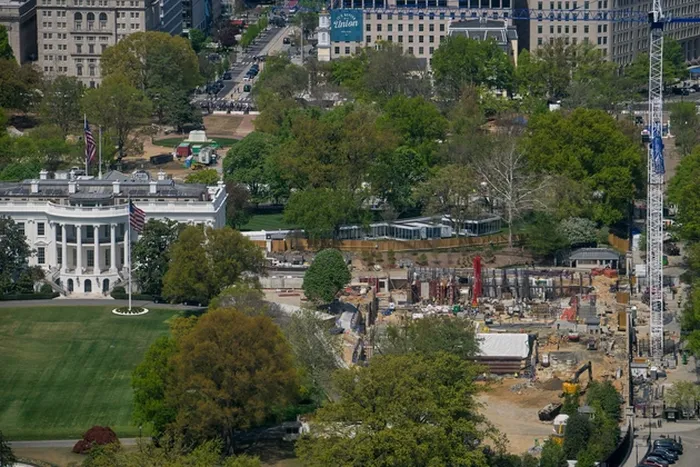
The federal judiciary is currently grappling with a high-stakes standoff over the White House state ballroom, a $400 million, 90,000-square-foot expansion that has effectively transformed the executive grounds into a contested construction site. As of April 2026, a U.S. appeals court has allowed work to continue temporarily, putting a lower court’s injunction on hold while legal arguments proceed. At the heart of this conflict sits a fundamental disagreement over presidential authority, congressional oversight, and the true definition of national security.
President Trump argues the project is a vital necessity, framing the ballroom not merely as an entertainment venue for VIPs, but as a critical addition to the White House security infrastructure. His administration insists the structure—boasting bulletproof glass and advanced defensive capabilities—is essential to protect the executive residence from modern threats. Yet, critics, led by the National Trust for Historic Preservation, view the project as a bypass of the regulatory and legislative scrutiny mandated for federal property.
U.S. District Judge Richard Leon, who originally ordered a halt to the above-ground construction in March 2026, has consistently rejected the administration's expansive reading of executive power. His rulings underscore a pointed refusal to accept that national security claims function as a blank check for construction projects that lack explicit congressional authorization. The administration’s attempt to characterize the ballroom’s assembly as inseparable from vital subterranean bunker work has drawn sharp rebukes from the bench, with the court characterizing the government's interpretations as disingenuous.
The legal strategy deployed by the administration relies heavily on the assertion that this construction qualifies as a security priority exempt from standard federal permitting processes. This stance has forced the courts into an uncomfortable position: acting as de facto arbiters of construction necessity. Judge Leon has expressed clear frustration at being drawn into the role of a project manager, particularly as he is tasked with distinguishing between critical security work—which remains permitted—and the aesthetic or functional ballroom elements that remain stalled.
Beyond the courtroom, the project has faced intense scrutiny regarding its origins and execution. The demolition of the historic East Wing in October 2025 ignited the initial firestorm of protest, raising questions about the preservation of national landmarks. While the administration points to private funding as a primary justification for expedited action, the legal reality remains that the White House is not private property. Even projects backed by external donors are subject to the National Environmental Policy Act and other federal statutes, a fact that has been central to the ongoing litigation.
The financial and logistical scale of the project further complicates the situation. With the cost estimate climbing from an initial $200 million to $400 million, the ballroom has become a massive industrial undertaking located on the most sensitive real estate in the United States. Observers note that the inclusion of an underground facility, reportedly a bunker, adds a layer of complexity to the legal proceedings. By tying the ballroom to this subterranean defense infrastructure, the administration has attempted to insulate the entire project from legislative interference.
The appeals court’s decision to schedule a hearing for June 5, 2026, ensures that this dispute will linger in the spotlight for months. For now, the machinery remains in motion, but the legal framework holding the project together is under constant pressure. The clash is emblematic of a larger struggle regarding the limits of executive influence over federal spaces. As the case moves forward, the primary question for the judiciary is whether the executive branch can override established institutional procedures by asserting a security necessity that external experts have yet to verify in a public forum.
The outcome of this case will likely set a lasting precedent for future executive actions involving federal architecture. Regardless of the final judicial decision, the controversy has already altered the visual and functional integrity of the White House. The ongoing debate forces a necessary reckoning with the balance of power between the branches of government, testing whether the traditional safeguards of American democracy can withstand the demands of a project that operates outside the conventional, and often slow, legislative process.
The administration continues to push toward a rapid completion, banking on the momentum of construction to eventually render the legal challenges moot. Whether the court will ultimately insist on a halt until proper authorization is secured or allow the project to reach its conclusion remains the defining uncertainty of this institutional conflict.