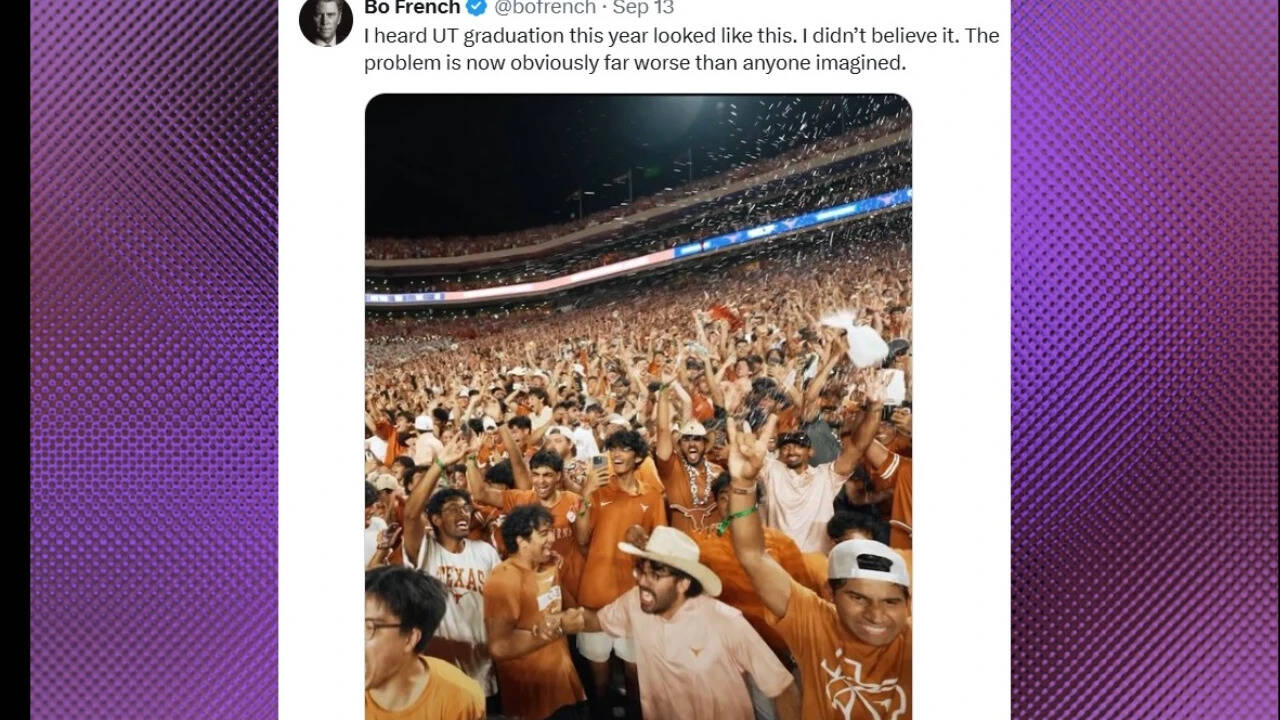
Public universities operate under an asymmetric governance constraint when political controversies intersect with campus demographics: student bodies demand targeted moral condemnation from institutional leadership, while state-level legal frameworks and fiduciary boards require viewpoint-neutral restraint. The dispute involving University of Texas students seeking formal condemnation of remarks targeting Indian-origin students—and the university's refusal to issue a targeted rebuke aimed solely at a political figure like Bo French—illustrates the structural collision between campus advocacy and institutional neutrality doctrines. Rather than functioning as an isolated communication failure, the episode exposes the exact mechanics of how public higher education institutions navigate First Amendment obligations, board-level political oversight, and internal stakeholder pressure.
The Structural Asymmetry of Campus Speech Governance
To understand why a university administration declines to condemn specific external or political rhetoric even when student organizations mobilize around it, one must map the competing incentive structures governing public institutions. Unlike private corporations or private universities, a flagship public system such as the University of Texas operates as an arm of the state. Its leadership does not possess unilateral discretion to adopt partisan or quasi-partisan positions on political actors.
The governance friction breaks down into three distinct operational layers:
- Constitutional and Statutory Boundaries: Public universities are bound by the First Amendment and state-level free speech statutes. While the First Amendment does not prohibit an institution from speaking on its own behalf—a doctrine known as government speech—state legislatures and governing boards increasingly restrict administrators from issuing official statements on political controversies unless those statements directly implicate core academic operations.
- Fiduciary and Political Oversight: University presidents and chancellors report to Boards of Regents appointed by state executives and confirmed by state legislatures. When an external controversy involves a prominent political figure or party official, issuing a targeted institutional condemnation creates immediate friction with the political apparatus that controls university appropriations, tuition caps, and executive appointments.
- Internal Stakeholder Expectations: Student governments, cultural associations, and faculty senates evaluate leadership through a lens of representational care. For Indian-origin students and allied campus groups, rhetoric perceived as targeting their demographic is not experienced as an abstract political debate; it is experienced as a direct challenge to their standing within the academic community.
When these three layers collide, the administration's refusal to name or single out an individual political actor is rarely an endorsement of the underlying remarks. Instead, it reflects an institutional risk-minimization strategy designed to avoid establishing a precedent of selective political commentary.
Deconstructing the Institutional Neutrality Doctrine
The core mechanism behind the university's posture—treating the issue as broader than a single individual rather than issuing a targeted rebuke of Bo French—is rooted in the principle of institutional neutrality, most famously codified in the 1967 Kalven Committee Report at the University of Chicago.
Under a strict Kalven framework, the university is the home and sponsor of critics, not itself a critic. The operational logic rests on a simple premise: if an institution begins issuing official moral verdicts on external political figures, every subsequent silence becomes an implicit endorsement. Over time, the university transforms from a neutral forum for inquiry into a political actor whose credibility is contested by whichever faction disagrees with its latest statement.
The Precedent Trap in Administrative Communications
Administrators managing public communications face a binary trap once they abandon strict neutrality:
- Selective Intervention: If the university explicitly condemns one political figure's rhetoric regarding Indian-origin students, it establishes an operational standard requiring it to evaluate and condemn every subsequent controversial statement made by politicians, commentators, or donors affecting any other demographic or ideological group.
- Definitional Drift: Because political discourse constantly generates contentious claims across immigration, foreign policy, affirmative action, and religious expression, defining the exact threshold that triggers an official administrative rebuke becomes subjective. That subjectivity invites legal challenges alleging viewpoint discrimination and legislative scrutiny alleging ideological bias.
By framing the situation as an issue extending beyond one individual, university leadership attempts to retreat from the selective intervention trap. General affirmations of campus inclusion or broad references to existing non-discrimination policies allow administrators to signal baseline support for affected students without formally adjudicating the conduct of a specific political official.
Stakeholder Divergence and the Perception Gap
While institutional neutrality solves a governance problem for administrators, it simultaneously generates a severe legitimacy deficit among the students requesting action. This divergence occurs because students and administrators use incompatible metrics to evaluate institutional responsibility.
For student advocates, the primary metric is symbolic solidarity. In campus organizing, an official statement from the president's office functions as institutional validation. When students mobilize to request a condemnation of rhetoric targeting Indian-origin peers, they are asking the university to draw a clear boundary separating acceptable political discourse from rhetoric they view as demeaning to a major segment of the student body. Indian-origin students represent one of the largest and most academically visible international and domestic demographic cohorts at major research universities like UT Austin, contributing heavily to engineering, computer science, business, and graduate research programs. From the students' perspective, failing to explicitly rebuke rhetoric targeting their community signals institutional indifference.
For university executives, the primary metric is operational durability. Administrators evaluate every public statement against its downstream consequences on state funding, legislative relations, and legal exposure. In states like Texas, where higher education governance has undergone substantial statutory restructuring—including legislation eliminating Diversity, Equity, and Inclusion (DEI) offices and mandating strict adherence to institutional neutrality—issuing a statement perceived as entering a partisan dispute carries immediate institutional costs.
Why General Statements Fail to Satisfy Campus Demands
When a university responds to a demand for targeted condemnation by broadening the scope—asserting that the issue is not merely about one individual or reiterating generic campus values—the response typically fails to resolve the underlying tension for three reasons:
- Asymmetry of Specificity: The grievance raised by students is specific, naming a particular individual and specific remarks. A generalized institutional response leaves the specific grievance unaddressed, creating the impression of evasion.
- Lack of Enforcement Mechanism: Reaffirming general campus values does not alter the external political environment or restrict the speech of outside actors. Students seeking tangible institutional backing view non-specific statements as purely performative.
- Attribution Ambiguity: By suggesting the issue is broader than one individual, the institution diffuses responsibility. While technically accurate—rhetoric surrounding immigration, visas, and demographic shifts is systemic rather than confined to a single voice—diffusion blunts the accountability that student organizers are attempting to establish.
The Legal and Regulatory Constraints on Public Universities
To evaluate whether the university had viable alternatives, one must examine the legal architecture governing speech at public institutions in Texas. First Amendment jurisprudence draws a sharp distinction between speech occurring within the university's disciplinary jurisdiction and speech occurring in the broader public square.
- Absence of Disciplinary Jurisdiction: External political figures, party chairs, and off-campus commentators are not subject to the university's student code of conduct or faculty handbook. The university possesses zero regulatory authority over their speech. Any institutional response is therefore purely expressive rather than disciplinary.
- Protection of Political Speech: Under established Supreme Court precedent, political commentary—even when sharp, sweeping, or offensive to specific groups—receives the highest tier of First Amendment protection unless it crosses the narrow legal thresholds of incitement to imminent lawless action, true threats, or targeted harassment that denies access to educational opportunities.
- State-Level Statutory Mandates: Recent higher education legislation in Texas explicitly restricts public universities from maintaining offices or programs that promote differential treatment or ideological advocacy, while reinforcing free expression protections on campus. Administrators operating under these statutes face direct compliance audits from governing boards.
Within this regulatory environment, an administration that singles out a political figure for official condemnation risks violating board directives on institutional neutrality without gaining any practical tool to protect students from off-campus rhetoric.
Cause-and-Effect Mechanics of Campus Speech Controversies
The progression from external political commentary to internal campus friction follows a predictable sequence. Mapping this sequence clarifies why institutional responses repeatedly stall at the same bottleneck:
- Trigger Event: An external political actor makes statements critiquing immigration pathways, visa programs, or demographic changes in a manner that students of Indian origin experience as stigmatizing or hostile.
- Campus Mobilization: Student organizations draft resolutions or open letters demanding that university leadership publicly condemn the individual and affirm the belonging of the affected demographic.
- Administrative Triage: University legal counsel, government relations officers, and communications teams assess the request against board policies, state statutes, and political risk.
- The Broadening Pivot: Rather than naming the political actor, the administration reframes the issue as a broader societal or campus-wide matter, relying on pre-approved language regarding academic freedom, respectful discourse, or general student support.
- Escalation of Dissatisfaction: Student leaders interpret the refusal to name the individual as a failure of moral leadership, shifting their critique from the external political actor to the university administration itself.
Notice the structural shift in the final stage: the university's attempt to stay out of a political controversy inadvertently converts the administration into the primary target of student criticism. By declining to absorb the external political risk of naming an outside figure, the university absorbs internal reputational risk with its own student body.
Limitations of Institutional Neutrality in High-Friction Environments
While institutional neutrality provides a coherent rulebook for avoiding partisan entanglement, the doctrine has clear operational limitations when applied to demographic controversies:
- It Cannot Neutralize Perceived Harm: Declaring institutional neutrality does not diminish the social or psychological impact of hostile political rhetoric on students who feel singled out by their national origin or heritage.
- It Relies on Consistent Application: Institutional neutrality only retains moral authority if applied uniformly across all political controversies, regardless of which ideological faction is exerting pressure. Any perceived inconsistency—such as commenting on certain geopolitical events while remaining silent on domestic political rhetoric—destroys the credibility of the doctrine.
- It Creates a Communication Vacuum: When official channels restrict themselves to legalistic or overly broad statements, social media narratives and external commentary fill the void, often polarizing the campus further.
Strategic Framework for Navigating Campus Speech Disputes
For university administrators, student leaders, and policy analysts operating inside public higher education systems, resolving the friction between neutrality mandates and student advocacy requires shifting from symbolic statements to structural mechanisms.
For University Administrations
Administrators cannot rely on ad hoc explanations when declining to condemn external figures. Leadership must establish and publish an explicit, transparent communication protocol before controversies arise. This protocol should clearly define the narrow criteria under which the university issues official statements—specifically limiting them to direct threats to campus safety, legal compliance, or core academic operations—while explicitly stating that the institution does not adjudicate external political speech. Simultaneously, universities should redirect resources from reactive public relations statements toward tangible student support infrastructure, including international student legal clinics, career services for visa-holding graduates, and open forums where students can exercise their own speech rights without requiring administrative endorsement.
For Student Organizations
Demanding that a public university president issue a targeted condemnation of a political official is a low-leverage tactic in states governed by strict neutrality mandates; the institutional incentives virtually guarantee a diluted or generalized response. Student coalitions achieve far greater strategic impact by leveraging the university's commitment to free expression directly. Rather than asking the administration to speak on their behalf, student organizations should utilize university facilities, academic departments, and student government platforms to host public panels, publish detailed policy rebuttals, and engage directly with media and lawmakers. Under First Amendment doctrine, a public university that refuses to speak for students is legally obligated to protect the space for students to speak for themselves.