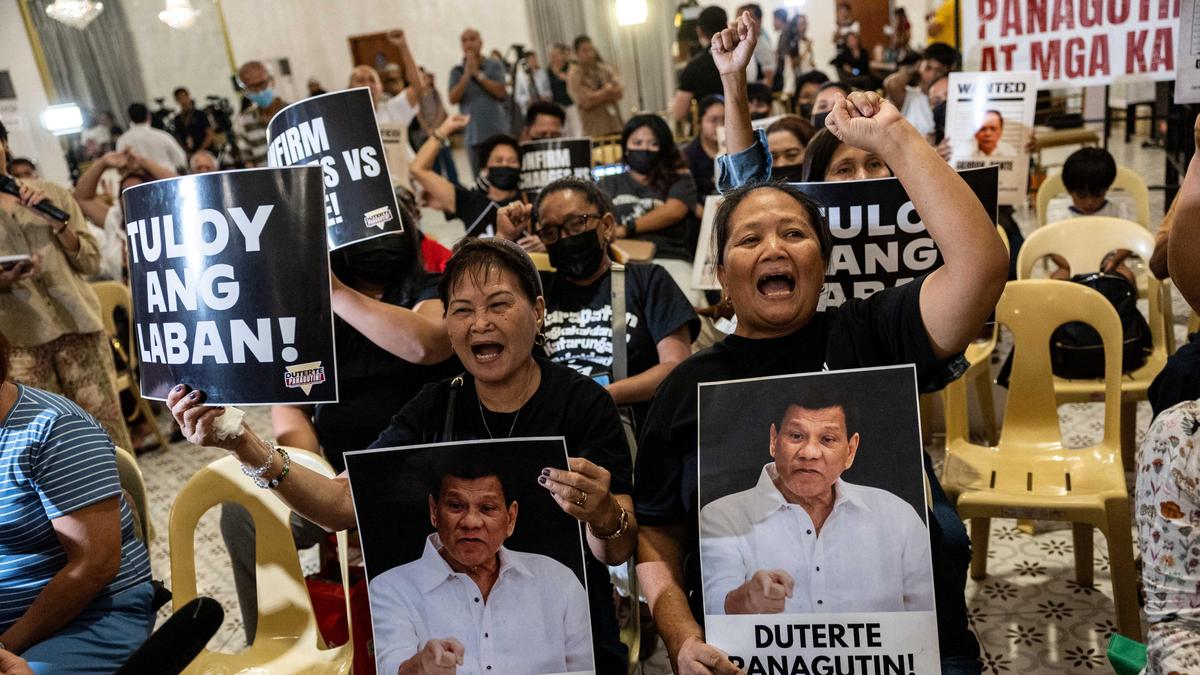
The International Criminal Court has moved to confirm charges against former Philippine President Rodrigo Duterte, signaling a definitive end to the legal immunity he enjoyed during his six-year term. This decision pushes the "War on Drugs" into a Hague courtroom, where judges will scrutinize a domestic policy that resulted in thousands of extrajudicial killings. While Duterte long maintained that international bodies had no jurisdiction over his sovereign actions, the ICC’s persistence demonstrates that withdrawing from the Rome Statute does not retroactively erase accountability for crimes committed while a country was a member.
The confirmation of these charges is not merely a procedural step. It is a seismic shift in how the international community handles populist leaders who use state machinery to bypass the rule of law. For years, the narrative from Manila was that the killings were the result of "legitimate police operations" where suspects resisted arrest. However, the evidence compiled by investigators paints a darker picture of systemic executions, state-sponsored death squads, and a climate of fear that permeated the country’s poorest urban centers. If you liked this post, you might want to check out: this related article.
The Jurisdictional Trap Duterte Could Not Escape
One of the most significant aspects of this case is the failure of Duterte’s primary legal defense. In 2018, as the ICC began its preliminary examination, Duterte ordered the Philippines to withdraw from the court. He calculated that by leaving the Rome Statute, he could effectively shut the door on any international investigation. He was wrong.
Under international law, the ICC retains jurisdiction over any crimes committed on a state’s territory while that state was a party to the treaty. The "War on Drugs" began in mid-2016, and the Philippines remained a member until March 2019. This three-year window provides the court with a massive cache of evidence, covering the most violent period of the crackdown. The judges have made it clear that a "get out of jail free" card cannot be printed simply by tearing up a membership agreement after the fact. For another look on this story, see the recent coverage from BBC News.
This creates a blueprint for future prosecutions of leaders who believe they can opt-out of global justice. The court is effectively stating that the law is a net, not a door. Once you are inside, your actions are recorded, and the exit doesn't lead to an Alibi.
Systematic Violence vs Random Police Excess
The defense has consistently argued that any "excesses" were the work of rogue officers acting without orders. This is a common tactic in human rights litigation, designed to insulate the top leadership from the actions of the rank and file. However, the ICC's focus is on the concept of "State Policy."
To prove crimes against humanity, the prosecution doesn't just need to show that people died. They must prove that the killings were part of a widespread or systematic attack against a civilian population. The sheer volume of the "nanlaban" cases—where police claim a suspect fought back—suggests a pattern that is too consistent to be accidental. In these scenarios, the victims were almost always found with a single handgun and a small amount of narcotics, often killed in circumstances that forensic experts found inconsistent with a shootout.
The Rhetoric of Incitement
A critical component of the investigative file is Duterte’s own public record. Throughout his presidency, he frequently told police officers he would "shield" them from prosecution if they killed drug suspects. He famously compared himself to Hitler, stating he would be "happy to slaughter" three million addicts. In a court of law, these aren't just colorful metaphors. They are evidence of intent and a directive from the Commander-in-Chief.
When a leader tells his armed forces that the law is an obstacle and that killing is a service to the nation, the line between "rogue police" and "state-directed violence" evaporates. The ICC judges are looking at whether the Davao Death Squad model—a paramilitary group Duterte allegedly controlled while mayor—was scaled up to a national level once he moved into Malacañang Palace.
The Domestic Failure of the Complementarity Principle
The ICC is a court of last resort. Under the principle of "complementarity," it can only step in if the domestic legal system is unwilling or unable to prosecute the crimes itself. This has been the battleground for the Philippine government’s lawyers, who argue that the country’s courts are functioning and independent.
The reality on the ground tells a different story. Out of the thousands of deaths recorded by the government—and the tens of thousands estimated by human rights groups—only a handful of cases have resulted in convictions of police officers. These convictions, such as the high-profile case of Kian delos Santos, were only achieved because of undeniable CCTV footage and massive public outcry.
The ICC’s confirmation of charges suggests that the judges viewed the Philippine government’s "internal reviews" as a facade. If a domestic system only investigates a fraction of 1% of the deaths, it is effectively "unwilling" to provide justice. The court is essentially calling out the bluff of the Manila legal establishment.
Geopolitical Fallout and the Marcos Dilemma
The move to trial places current President Ferdinand Marcos Jr. in a precarious position. When he took office, he inherited the Duterte legacy as part of a political alliance. However, as the ICC pressure mounts, that alliance is fracturing.
Marcos must choose between protecting his predecessor and maintaining the Philippines' standing in the international community. If he refuses to cooperate with the ICC, he risks being seen as a protector of human rights abusers, which could impact trade agreements and military aid from Western allies. If he allows ICC investigators into the country, or facilitates an arrest, he risks a civil war within his own political base.
The international community is watching closely. This isn't just about the Philippines; it’s about whether the post-WWII international order has the teeth to hold a popular, democratically elected leader accountable. For many nations in the Global South, the ICC has been criticized for focusing primarily on African leaders. The Duterte trial changes that narrative, bringing the court into the heart of Southeast Asian politics.
The Forensic Evidence and the Role of Whistleblowers
Beyond the political theater, the trial will hinge on concrete evidence. Investigators have spent years interviewing former police officers and members of the alleged death squads who have since fled the country. These whistleblowers are the "smoking guns" of the prosecution.
They provide the link between the verbal orders given in private meetings and the bodies found on the streets of Manila. Their testimony describes a system of "quotas" and "rewards," where officers were paid for every "drug personality" they neutralized. This commercialization of state violence is a key factor in proving that the deaths were not a byproduct of a war on drugs, but the primary objective.
Digital forensics will also play a role. Deleted communications, leaked memos, and financial trails showing the flow of money from the Office of the President to specific police units are being integrated into the prosecution’s case. The paper trail in a modern bureaucracy is incredibly difficult to erase entirely, even for a president.
Challenging the "Populist Mandate" Defense
Duterte’s supporters often point to his high approval ratings as a justification for his methods. The argument is that the people wanted a "clean" country and gave him a mandate to achieve it by any means necessary.
The ICC, however, does not recognize a "popularity defense." Human rights are inherent and cannot be voted away by a majority. If a majority votes to execute a minority without trial, it remains a crime under international law. This trial will serve as a stark reminder that sovereignty is not a shield for atrocities, and that "the will of the people" stops at the edge of a mass grave.
The legal proceedings in The Hague will be long and arduous. Duterte has already indicated he will not recognize the court's authority, potentially setting up a trial in absentia or a standoff over extradition. But the confirmation of charges ensures that the former president can no longer travel freely to most countries without the risk of being detained. His world has just become much smaller.
The Impact on Global Drug Policy
Finally, this trial puts the global "War on Drugs" itself on the stand. For decades, the prohibitionist model has encouraged aggressive policing, but the Duterte era took this to its logical, violent extreme. By labeling the casualties of this policy as victims of crimes against humanity, the ICC is effectively delegitimizing the use of lethal force as a standard tool of narcotics control.
Other nations watching this case will have to reconsider their own internal security strategies. If the "Manila Model" results in an ICC trial, the cost of populist "tough on crime" stances has just skyrocketed. The era of the "untouchable" strongman is facing its most significant legal challenge in a generation.
The court has signaled that the time for preliminary debate is over. The focus now shifts to the specifics of the indictments, the protection of witnesses, and the logistical nightmare of bringing a former head of state to the dock. Whether or not Duterte ever sits in a cell in Scheveningen, the confirmation of these charges is a permanent stain on his legacy and a warning to those who would follow his lead.
Evidence of the state's involvement is no longer a matter of activist speculation; it is now the formal basis of an international criminal trial.