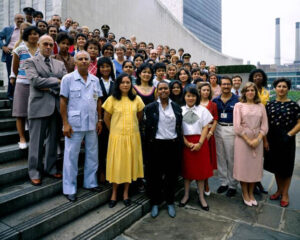
The badge hangs heavy around your neck by mid-afternoon. It is a thin piece of laminated plastic, blue and white, slapping against your sternum with every hurried step down the carpeted corridors of the Secretariat building in New York. Around you, the air smells of burned espresso, expensive wool coats, and the faint, metallic tang of central air conditioning working overtime to cool rooms packed with the world's diplomats.
When people picture the United Nations, they picture the General Assembly hall. They see the green marble podium, the rows of nameplates, the ambassadors speaking into slender microphones while translators tucked behind soundproof glass turn fury into measured French, Arabic, or Mandarin. They think reform means changing who holds the veto on the Security Council. They argue over permanent seats for Brazil, India, or the African Union.
They are looking at the stage. They are missing the stagehands who built the set, wrote the script, and control the lighting.
To understand why the world's premier diplomatic body feels perpetually slow, detached, and oddly brittle in the face of modern crises, you have to stop staring at the ambassadors. You have to look at the people wearing those blue-and-white badges. You have to examine the quiet, fiercely guarded machinery of United Nations staff representation.
The Myth of the Neutral Machine
Every international civil servant takes an oath. Standing before a supervisor on their first day, they pledge not to seek or accept instructions from any government or authority external to the organization. On paper, the UN Secretariat is a pristine, borderless engine of pure neutrality.
In practice, human beings do not erase their upbringing, their instincts, or their blind spots when they sign an employment contract.
Consider a hypothetical scenario—one that mirrors thousands of quiet Tuesday mornings across UN headquarters in New York, Geneva, and Nairobi. Let us introduce Elena, a mid-level policy officer drafted to write the foundational framework for a new climate resilience fund aimed at coastal communities in the Global South. Elena is brilliant, earnest, and exhausted. She grew up in a wealthy European capital, earned two master's degrees from prestigious Western universities, and completed three unpaid internships in Geneva before landing her first consultancy.
Now, picture Tariq. Tariq is an agricultural economist from a flood-prone delta in South Asia. He has spent twelve years watching saltwater ruin rice paddies. He knows exactly how local village councils distribute emergency cash and why top-down infrastructure grants usually stall during monsoon season. Tariq wants to apply for Elena’s job.
He never gets the interview.
Why? Because the rules governing how the UN recruits, promotes, and retains its workforce were built for a world that no longer exists. When you examine the data published annually by the UN Secretary-General on the composition of the Secretariat, a stark pattern emerges beneath the diplomatic pleasantries. While the UN employs tens of thousands of people from nearly every nation on earth, power is not distributed evenly across the org chart. At the senior professional and director levels—the P-5, D-1, and D-2 grades where policy is actually drafted and budgets are allocated—nationals from a small cluster of wealthy Western nations remain heavily overrepresented. Meanwhile, dozens of developing countries remain chronically underrepresented, or entirely unrepresented, in the rooms where decisions take shape.
The Architecture of Exclusion
How does an institution dedicated to global equality accidentally build a tilted playing field? It does not happen through mustache-twirling villainy. It happens through bureaucracy.
Think of the UN hiring system like an old fortress whose moat has grown wider every decade, not out of malice, but out of procedural inertia.
First, there is the internship trap. For decades, the United Nations did not pay its interns. Even today, despite incremental reforms and modest stipends in certain agencies, securing an entry-level foothold in New York or Geneva requires surviving months—sometimes years—in some of the most expensive real estate markets on the planet. Who can afford to work for free in Manhattan while paying $2,400 a month for a closet-sized sublet? Not Tariq. The unpaid internship acted as an invisible wealth filter, quietly pre-selecting a generation of future UN managers from affluent families in North America and Western Europe.
Then comes the language barrier. The UN officially recognizes six languages, yet the working reality of the Secretariat operates overwhelmingly in English and, to a lesser extent, French. When a job posting requires "native-level drafting ability" in English, a brilliant humanitarian logistician from Chad, Bolivia, or Indonesia immediately loses half a step to a mediocre candidate from London or Toronto. Nuance gets lost. Idioms trip up non-native speakers during competency-based interviews, which reward a very specific, Western style of self-promotional storytelling. In many cultures, boasting about individual triumph over a team effort is considered bad manners; in a UN interview panel, failing to say "I" instead of "we" can cost you the score you need to pass.
And then there is the shadow economy of funding.
To understand this, you have to follow the money. Regular budget posts—the core jobs funded by mandatory dues from all 193 member states—are subject to strict geographical distribution formulas. These formulas attempt to balance population size, financial contribution, and basic membership so no single country dominates.
But the regular budget has been squeezed for years. When rich nations want the UN to tackle a new priority—cybersecurity, artificial intelligence governance, specific humanitarian corridors—they rarely increase the core budget. Instead, they write checks for "extrabudgetary" funds. And attached to those checks, sometimes explicitly and sometimes through quiet diplomatic winks, come Junior Professional Officers (JPOs) and seconded experts. Wealthy donor nations literally pay the salaries of their own young citizens to work inside the UN for two or three years. Once inside, those JPOs learn the arcane acronym language of the building, build relationships with hiring managers, and convert their temporary posts into permanent careers. Developing nations cannot afford to buy seats at the table for their youth.
The result is predictable.
What Happens When the Room Looks the Same
Does it actually matter where a bureaucrat holds a passport if they are good at spreadsheets?
Ask anyone who has sat through a crisis response meeting when a disaster hits a region nobody in the room has ever visited.
I remember watching a heated debate in a windowless conference room during a protracted food crisis in the Horn of Africa. A team of sharp, well-intentioned analysts—none of whom hailed from the region—had designed a digital voucher system meant to bypass local middlemen and deliver aid straight to mobile phones. On their laptops, the flowcharts were immaculate. The fraud-prevention algorithms were tight.
Only after the program launched did the reality on the ground shatter the model. In the targeted districts, local clan elders routinely pooled resources to cover families without network coverage, and the digital system flagged those communal transfers as money laundering, freezing accounts right before a holiday. Had even one senior planner in that room grown up navigating informal pastoralist credit networks, the flaw would have been spotted in ten minutes on a whiteboard. Instead, it took six months and millions of wasted dollars to untangle.
Representation is not a cosmetic exercise in checking demographic boxes. It is an epistemic necessity.
When the people writing the background papers, choosing which experts get invited to brief the Security Council, and framing the options for the Secretary-General all share similar educational pedigrees and cultural assumptions, blind spots harden into orthodoxy. Certain problems feel urgent; others feel theoretical. Debt restructuring for middle-income countries gets treated as a dry technicality, while regulatory frameworks favored by Silicon Valley or Brussels get fast-tracked as universal standards.
Worse still, the legitimacy of the entire organization begins to rot from the inside out.
When diplomats from the Global South walk into bilateral meetings and see that every senior official across the table looks and sounds like an official from the former colonial powers, trust evaporates before the first cup of water is poured. They stop viewing the Secretariat as an honest broker. They start treating it as an extension of Western foreign policy wearing a blue helmet. And once member states stop believing the referee is neutral, they stop obeying the rules of the game.
The Trap of Half-Measures
Over the past twenty years, successive Secretaries-General have launched glossy "Human Resources Reform" initiatives. There have been diversity task forces, mobility frameworks, and dashboards tracking gender parity.
Gender parity, to the UN’s credit, has seen genuine, hard-won progress at senior levels—proof that when leadership sets hard targets and enforces accountability, the system can bend.
Yet geographical representation remains the third rail of UN politics. Every time a reform package threatens to overhaul the recruitment pipeline, quiet resistance stiffens across the corridors. Hiring managers complain that strict geographical quotas slow down recruitment when emergencies demand speed. Powerful donor states warn that tampering with merit-based hiring will dilute competence—an argument that subtly implies talent is concentrated in a handful of northern capitals, while the rest of the world requires lowered standards to compete.
That framing is backwards.
The current system is not a pure meritocracy. A system that systematically filters out candidates from four-fifths of the planet due to unpaid internships, visa bottlenecks, and parochial interviewing rubrics is leaving vast reserves of global talent on the table. True meritocracy requires widening the net until you are actually comparing the best minds from Lagos, Jakarta, Lima, and Cairo alongside those from Paris and New York.
Rebuilding the Engine from the Inside
If we are serious about saving multilateralism from sliding into irrelevance, reforming the Security Council cannot be the starting line. Charter amendments require the ratification of two-thirds of the General Assembly and all five permanent members—a political mountain that could take decades to climb.
Staff reform, by contrast, is within reach right now. It requires political will, smart budget reallocation, and a willingness to dismantle comfortable privileges.
First, the UN must permanently end the era of unpaid entry-level labor and overhaul the JPO pipeline. Every internship across the entire UN system—not just a select few agencies—must carry a living stipend indexed to the duty station, paired with proactive visa sponsorship. Simultaneously, donor countries funding JPO programs should be required to match every national they sponsor with a funded slot for a young professional from a least-developed country. If Germany or Japan wants to train its young diplomats inside the UN, they should help train a counterpart from Malawi or Nepal alongside them.
Second, the Secretariat needs to decentralize its brain trust. Why are thousands of policy analysts clustered in Manhattan and Geneva, two of the highest-cost, most visa-restrictive cities on earth? Moving entire policy divisions, research hubs, and administrative headquarters to regional centers in Nairobi, Bangkok, Santiago, and Addis Ababa would do two things overnight. It would slash operational overhead, freeing up millions for field programs, and it would physically immerse UN decision-makers in the lived realities of the Global South. When you take the bus past informal settlements on your way to draft an urban development resolution, your perspective changes.
Third, the organization must rewire how it evaluates talent. Competency-based interviews need to be stripped of cultural bias, and blind recruitment—removing names, nationalities, and university pedigrees during initial technical assessments—should become mandatory for professional posts. Furthermore, field experience must carry far greater weight than headquarters tenure when filling senior director roles. Nobody should be writing global humanitarian policy from the thirty-eighth floor in New York without having spent significant time managing operations where the power grid flickers and the roads wash out.
The Weight of the Badge
It is tempting to dismiss internal UN staffing rules as dry administrative plumbing—the sort of thing only human resources directors and diplomatic attachés could ever care about.
That is a mistake.
The global crises defining the middle of the twenty-first century—runaway climate disruption, sovereign debt cascades, pandemic preparedness, the governance of autonomous weapons—do not respect borders. No single superpower can solve them alone, no matter how large its military or how deep its treasury. We need a referee that the entire planet trusts.
Trust cannot be mandated by a General Assembly resolution. It is built in the quiet moments: in who gets hired to draft the first paragraph of a treaty, whose instincts shape an emergency relief convoy, and whose voice is heard before the microphones are even turned on.
Late in the evening at Turtle Bay, after the delegates have gone home to their embassies and the cleaning crews begin vacuuming the empty chamber, a handful of lights stay burning on the upper floors of the Secretariat tower. Behind those windows, mid-level officers are typing the memos that will land on ambassadors' desks at dawn. Until the faces behind those glowing screens truly reflect the eight billion people outside the gates, the United Nations will remain a house divided against its own promise.


