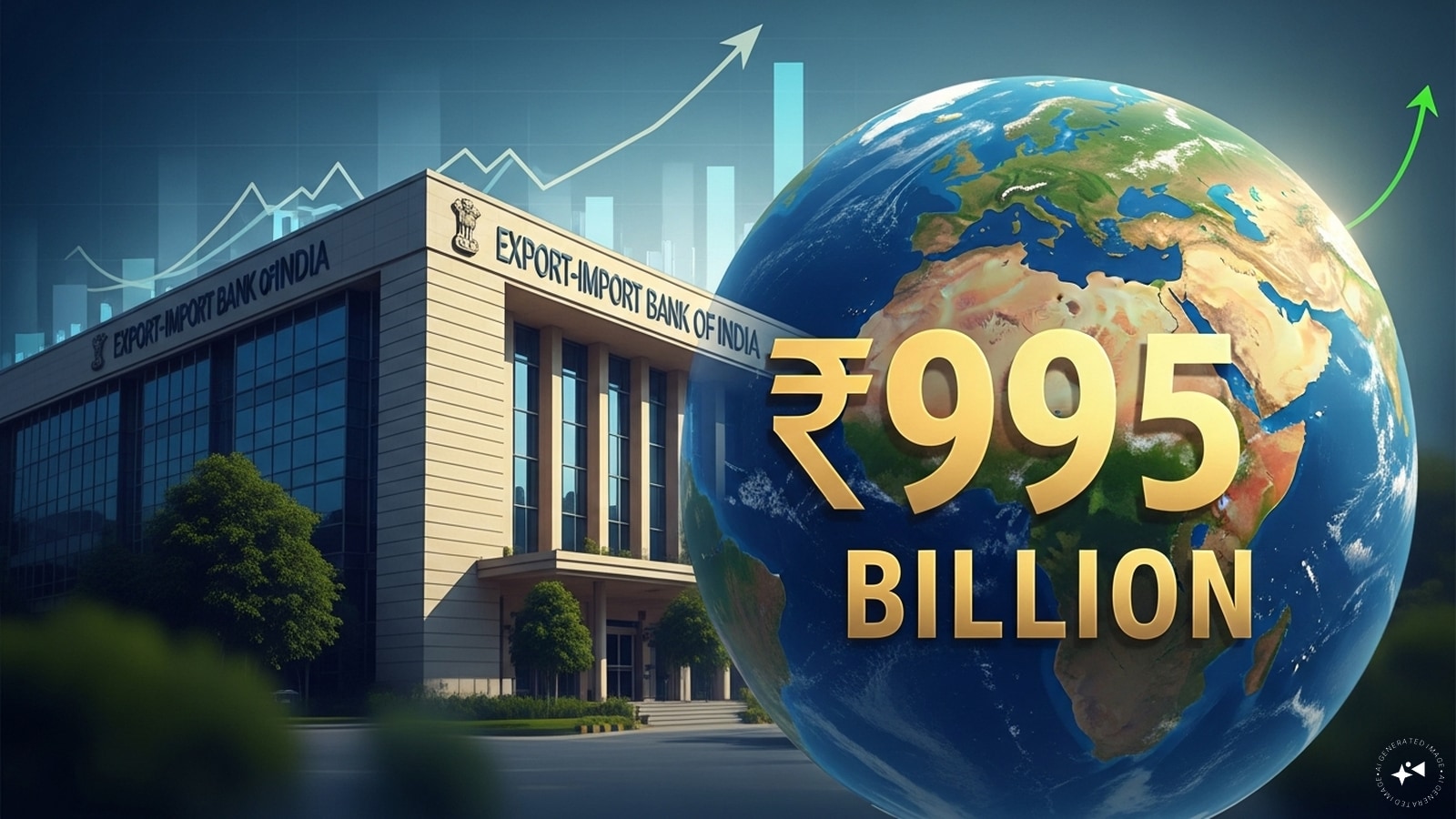
In a small, dusty workshop on the outskirts of Coimbatore, a welder named Aarav watches a blue flame dance against a sheet of steel. He is making components for a water filtration system destined for a village in Kenya. To Aarav, this is just a job. He clocks in, he welds, he earns his keep. He doesn't see the complex web of credit, risk, and sovereign ambition that allows his workshop to ship goods across an ocean. He doesn't know that his livelihood is tied to a sterile boardroom in Mumbai where the Export-Import Bank of India (EXIM) is mapping out a $10.5 billion blueprint for the 2026-27 fiscal year.
Most people hear "debt fundraise" and their eyes glaze over. It sounds like the background noise of a financial news ticker—dry, distant, and disconnected from the real world. But money is never just numbers on a screen. It is fuel. For a developing powerhouse like India, debt is the oxygen that allows its industries to breathe in the competitive atmosphere of global trade.
The Weight of Ambition
Consider the scale of what is happening. $10.5 billion. It is a staggering sum, roughly 850-900 billion rupees, depending on the day's exchange rate. This isn't just a routine top-up of the coffers. It is a massive bet on India’s ability to project its industrial might outward.
When EXIM Bank prepares to step into the global and domestic markets to borrow this capital, they aren't doing it because they are short on cash. They are doing it because the world is hungry for what India builds, and the builders need a bridge. Imagine a bridge made of paper—contracts, guarantees, and lines of credit—that stretches from the ports of Gujarat to the manufacturing hubs of Europe and the emerging markets of Africa. Without this bridge, the welder in Coimbatore is just a man with a torch and no one to sell to.
The bank's strategy is a delicate dance. They plan to tap into both the domestic bond market and international pools of liquidity. Why both? Because the world is unpredictable. By diversifying where they get their money, they ensure that if one door slams shut—perhaps due to a sudden shift in US Federal Reserve policy or a flare-up in geopolitical tensions—another remains open.
The High-Stakes Ledger
To understand why this matters, we have to look at the "Invisible Stakes." For a hypothetical exporter we’ll call Sunita, who runs a medium-sized textile firm, the EXIM Bank is the difference between a "No" and a "Yes." Sunita wants to fulfill a massive order for a retail chain in Brazil. The Brazilian buyer wants 90 days to pay. Sunita’s suppliers in India want payment upfront.
This gap is the "valley of death" for small and medium enterprises.
Sunita can’t bridge that gap on her own. Her local bank thinks Brazil is too risky. This is where the $10.5 billion fundraise enters the story. That capital allows EXIM Bank to offer Sunita the credit insurance and the working capital she needs. It absorbs the risk so she can focus on the craftsmanship. When EXIM Bank borrows billions, they are essentially buying the risk that Sunita and thousands like her cannot afford to carry.
But there is a catch. Borrowing money costs money.
The bank has to convince investors that India’s growth story is more than just a headline. They have to prove that the 10% to 12% loan growth they are targeting for the next few years is sustainable. If they over-leverage, the bridge collapses. If they don't borrow enough, the fire in workshops like Aarav's goes out.
The Global Chessboard
India’s EXIM Bank isn't operating in a vacuum. It is competing with every other major export-credit agency in the world. China's EXIM Bank, the US Export-Import Bank, and Japan’s JBIC are all vying for the same territory. This is a quiet war fought with interest rates and credit terms rather than munitions.
The decision to raise over $10 billion in FY27 is a signal to the world. It says that India is no longer content being a backup player in the global supply chain. It wants to lead. To lead, you need a war chest.
A large portion of this fundraising will likely happen through the issuance of bonds. Some will be "Green Bonds," reflecting a global shift toward sustainability. This isn't just about PR. Investors are increasingly demanding that their capital goes toward projects that don't set the planet on fire. If India can package its industrial expansion in a way that satisfies the ESG (Environmental, Social, and Governance) requirements of a pension fund in Sweden, it taps into a cheaper, more stable source of money.
The Human Cost of Calculation
It is easy to forget the humans when discussing debt-to-equity ratios and basis points. But the logic of the bank is the logic of survival. In the previous fiscal year, the bank saw its margins tighten. The cost of borrowing rose globally as central banks hiked rates to fight inflation.
For the people running EXIM Bank, the $10.5 billion target is a calculated risk against the tide of history. They are betting that by 2027, the global economy will be ready to absorb Indian exports at an unprecedented rate. If they are wrong, they are left holding a very expensive bill. If they are right, they catalyze a generation of industrial growth.
Think back to Aarav in Coimbatore. If the bank fails to raise this capital at a favorable rate, the cost of credit for his employer goes up. The water filtration project becomes too expensive. The Kenyan village continues to drink contaminated water. Aarav’s overtime pay disappears. The "dry facts" of a fundraise are, in reality, the nervous system of global development.
The bank is also looking at "Lines of Credit" (LOCs). These are essentially gift cards for foreign governments, backed by the Indian government, which can only be spent on Indian goods and services. This is soft power in its purest form. When India lends money to a nation in Southeast Asia to build a railway, it isn't just about the interest on the loan. It’s about the Indian engineers who get the jobs, the Indian steel used for the tracks, and the long-term diplomatic ties that are forged in iron and debt.
The Pressure of the 2027 Horizon
Why FY27? Why now? The timeline is crucial. The world is currently in a state of "China Plus One" repositioning. Multinationals are desperate to find manufacturing hubs that aren't tied to the volatility of Beijing’s trade relations. India is the natural successor, but it lacks the deep-pocketed infrastructure of its neighbor.
The $10.5 billion is a down payment on that future.
The bank’s leadership knows that the window of opportunity won't stay open forever. Other nations—Vietnam, Mexico, Poland—are all sprinting for the same finish line. The fundraise is an acceleration. It is the sound of a driver downshifting and hitting the gas just as they enter the straightaway.
The complexity of this operation is immense. The bank will issue bonds in various currencies—Dollars, Euros, perhaps even Yen—to hedge against currency fluctuations. They will navigate the labyrinth of international regulations. They will face the scrutiny of credit rating agencies like Moody’s and S&P, who will pore over India’s fiscal deficit and growth projections with a magnifying glass.
Beyond the Balance Sheet
We often treat "state-owned" entities as slow, lumbering giants. But EXIM Bank has to be as agile as a hedge fund. It operates at the intersection of government policy and market reality. When the government says "Make in India," the EXIM Bank is the one who has to figure out how to pay for the shipping.
There is a certain vulnerability in this. To admit you need to borrow $10.5 billion is to admit that your ambitions are currently larger than your wallet. It is a moment of profound honesty. It acknowledges that India’s dream of becoming a $5 trillion economy isn't something that will happen by magic. It will be built on a foundation of borrowed capital, repaid by the sweat of people like Aarav and the ingenuity of entrepreneurs like Sunita.
The real story isn't the figure itself. It is the momentum.
In the quiet hours of the night, when the markets are closed and the spreadsheets are saved, the stakes remain. The stakes are the millions of young Indians entering the workforce every year. They need jobs that only a robust export sector can provide. They need the $10.5 billion to turn into factories, ports, and research centers.
The fundraise is a bridge. On one side is the India of today—resilient, growing, but still hungry. On the other side is the India of the future—a global titan of trade. The $10.5 billion is the cost of the crossing.
As the sun sets over the Arabian Sea, reflecting off the glass towers of Mumbai’s financial district, the planners at EXIM Bank are already moving on to the next set of projections. They know that money is a fickle friend. It comes where it is welcomed and stays where it is well-treated. By the time FY27 rolls around, the success of this gamble won't be measured in the volume of bonds sold, but in the number of containers leaving the docks at Nhava Sheva, each one a tiny piece of a ten-billion-dollar promise being kept.
Aarav turns off his torch. The workshop goes dark. Somewhere, a ship is being loaded.