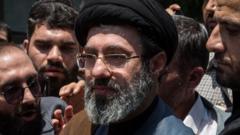
The shadow cast by Mojtaba Khamenei has finally overtaken the man himself. For two decades, the second son of Iran’s Supreme Leader operated as a ghost within the machinery of the Islamic Republic, a figure defined more by what was whispered than what was seen. Today, that shadow has solidified into a blueprint for succession. The transition is no longer a "potential scenario" debated in the ivory towers of Western think tanks. It is an active political operation being executed in real-time across the halls of the Office of the Supreme Leader and the barracks of the Islamic Revolutionary Guard Corps (IRGC).
The death of President Ebrahim Raisi in a 2024 helicopter crash did more than just create a sudden vacancy in the executive branch. It removed the only viable "clerical" alternative to a hereditary transition. Raisi was the ultimate insider, a man groomed to provide the appearance of continuity while Mojtaba managed the deep state. With Raisi gone, the pretense of a competitive selection process has withered. The question is no longer whether Mojtaba wants the seat, but whether the fragile coalition of military commanders and aging clerics can survive the friction of his ascent.
The Architect of the Deep State
Mojtaba Khamenei did not climb the traditional clerical ladder. He does not hold the prestigious title of Grand Ayatollah, nor has he spent decades issuing fatwas in the seminaries of Qom. His power is derived from the Beyt, the Supreme Leader’s administrative office, which has effectively cannibalized the functions of the formal Iranian government.
In the late 1990s and early 2000s, Mojtaba began embedding himself within the intelligence apparatus. He became the primary liaison between his father and the IRGC’s most hardline factions. This wasn't a ceremonial role. He was the tactical mind behind the suppression of the 2009 Green Movement, reportedly directing the Basij militia’s brutal response to street protests. By doing so, he proved his utility to the security state. He showed the generals that he was willing to get his hands dirty to preserve the system.
The IRGC doesn't back Mojtaba out of personal loyalty. They back him because he represents the path of least resistance for their own economic and political hegemony. The Guard now controls upwards of 30 percent of the Iranian economy, from telecommunications to construction and oil smuggling. They need a Leader who is beholden to them, or at the very least, one who understands that the military is the true spine of the nation.
The Clerical Crisis of Legitimacy
The most significant barrier to Mojtaba’s rise isn't the Iranian public, which has been largely disenfranchised by decades of economic mismanagement. The real threat comes from the Assembly of Experts, the body of 88 clerics technically charged with choosing the next leader.
Many of these men are traditionalists. They remember the 1979 Revolution as a revolt against a hereditary monarchy. To replace the Pahlavi Shah with a Khamenei Sultan is a betrayal of the very "republican" veneer that Ayatollah Khomeini used to sell the revolution to the masses. If Mojtaba is forced through, the religious legitimacy of the Velayat-e Faqih (Guardianship of the Islamic Jurist) could collapse entirely.
We are seeing a quiet but desperate rebellion in the seminaries. Senior clerics who have remained silent for years are now signaling their discomfort. They fear that a hereditary succession will turn the office of the Supreme Leader into a purely political and military position, stripped of its spiritual authority. Once the spiritual shield is gone, the regime is nothing more than a standard military dictatorship.
The Economic Price of Stability
While the elite bicker over theology and lineage, the Iranian street is suffocating. The rial is in a state of permanent collapse. Inflation is a predatory force, eating through the savings of the middle class and pushing the working poor into absolute destitution.
Mojtaba’s branding as a "strongman" who can bring order is a hard sell when the order he offers is the same one that led to the current stagnation. To solidify his rule, he will need to provide an immediate economic "win." This likely means one of two things: a massive new crackdown to silence dissent or a tactical retreat on the international stage to secure sanctions relief.
However, Mojtaba is a product of the most isolationist factions of the Iranian elite. He has spent his career building a "Resistance Economy" designed to bypass the West, not engage with it. Expecting him to pivot toward a grand bargain with Washington is a misunderstanding of his DNA. He is more likely to double down on the "Look to the East" policy, tying Iran’s future even more tightly to Chinese credit and Russian hardware.
The Hidden Vulnerabilities
No succession is guaranteed. The Iranian system is built on a delicate balance of competing power centers: the regular army, the IRGC, the various intelligence services, and the bonyads (charitable foundations that function as massive slush funds).
Mojtaba has spent years placing his allies in key positions within these organizations. But loyalty in Tehran is a liquid asset. The moment Ali Khamenei passes, the gravitational pull that keeps these factions in orbit will vanish. There is a very real possibility that once the patriarch is gone, the IRGC will decide they no longer need a cleric at the top at all.
Why deal with the headache of a "Supreme Leader" when the military can simply rule through a puppet council? Mojtaba is betting that his deep ties to the Guard will make him their choice. The Guard might decide that Mojtaba is more useful as a target for public anger than as a commander-in-chief.
The Specter of the Streets
The 2022 "Woman, Life, Freedom" protests revealed a fundamental rift that no amount of propaganda can bridge. The youth of Iran, who make up the vast majority of the population, do not see Mojtaba as a leader. They see him as the crown prince of a failing enterprise.
The regime’s response to any hint of instability during the transition will be overwhelming force. They have spent the last decade perfecting the "halal internet"—a closed-loop domestic network that can be severed from the global web at a moment's notice. They have integrated facial recognition technology into their surveillance of the mandatory hijab laws.
The Geopolitical Fallout
A Mojtaba Khamenei presidency—or "Leadership"—will solidify the "Axis of Resistance." He is a staunch supporter of Hezbollah, the Houthis, and the various militias in Iraq. Under his watch, Iran’s regional adventurism will not likely shrink; it will become more professionalized and perhaps more aggressive.
He lacks the revolutionary "prestige" of his father or Khomeini. To make up for this lack of charisma, he will rely on the projection of power. This makes the next few years particularly dangerous for the Middle East. A new leader with something to prove is often more prone to miscalculation than an old one who is comfortable in his seat.
The transition isn't just an internal Iranian matter. It is a pivot point for global energy markets and nuclear non-proliferation. If the transition is messy, the resulting power vacuum could lead to a localized civil war within the security services. If the transition is "too" successful, we will see the birth of a nuclear-armed, militarily-dominated Iran that has finally abandoned even the pretense of being a republic.
The Mechanics of the Takeover
The strategy currently in play is one of attrition. Mojtaba’s team is systematically neutralizing potential rivals by using the Guardian Council to disqualify them from elections and the judiciary to ensnare them in "corruption" investigations.
They are also reshaping the narrative. State-aligned media has begun featuring Mojtaba more frequently, albeit subtly. They are testing the waters, gauging the intensity of the blowback. The goal is to reach a point where, upon the Supreme Leader’s death, Mojtaba’s installation feels like a fait accompli—a necessary step for "national security" rather than a choice.
The international community is largely a bystander in this drama. Sanctions have already been maxed out. Diplomacy is stalled. The future of the Iranian state is being decided in windowless rooms in North Tehran and the military compounds of Isfahan.
History shows that hereditary successions in revolutionary regimes are notoriously unstable. They often lead to a "Thermidorian Reaction," where the radicalism of the first generation is replaced by the cynical pragmatism—or the total collapse—of the second. Mojtaba Khamenei is preparing to inherit a throne, but the legs of that throne are being eaten away by the very system he helped build. He may find that being the "Shadow King" was a far safer role than the one he is about to step into.
The machinery is in motion, the pieces are on the board, and the aging Supreme Leader is the only thing left holding the door open for his son. When that door closes, the true nature of the Iranian project will be revealed.
Identify the key players in the Assembly of Experts and the IRGC high command to see where the first cracks in the succession will appear.