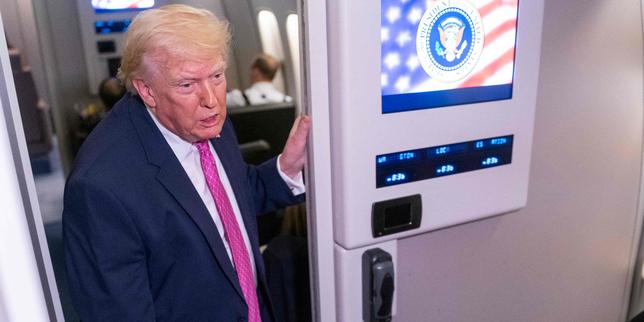
The era where a single late-night social media post from Donald Trump could send global markets into a tailspin is over. Investors have developed a profound immunity to the political theater that once dictated daily trading volumes. While the rhetoric remains as sharp as ever, the reaction from the S&P 500 and the bond market has flattened into a state of indifference. This isn't because the stakes are lower, but because the financial world has finally decoupled political noise from economic reality. The "Trump Premium" on volatility has evaporated, leaving behind a market that cares more about interest rates than insults.
The Exhaustion of Shock Value
Market participants are currently operating under a regime of "outrage fatigue." Between 2016 and 2020, the relationship between the White House and Wall Street was defined by a constant state of high alert. A tweet about trade tariffs with China could instantly wipe billions off the valuation of multinational corporations. Today, the mechanism is broken.
The institutional money—the pension funds, the sovereign wealth funds, and the algorithmic high-frequency traders—has recalibrated. They no longer trade on the intent of the speech but on the probability of the policy. Since much of the current campaign rhetoric involves sweeping promises that face massive legislative or judicial hurdles, the market simply prices them at zero.
Why the Algorithms Stopped Listening
In the early days of the Trump era, developers scrambled to build scrapers that could parse sentiment from social media in milliseconds. If the sentiment was "aggressive" and the keyword was "trade," the bots sold.
It didn't take long for the math to fail. The gap between a verbal threat and a signed executive order proved to be wide and unpredictable. Quantitative analysts realized that chasing these spikes was a losing strategy. Now, the algorithms are tuned to ignore the vociferations and focus on hard data points: consumer price index (CPI) prints, labor statistics, and Federal Reserve meeting minutes.
The Tariffs That Cried Wolf
The most consistent theme in the current political cycle is the promise of universal baseline tariffs. To a casual observer, the threat of a 10% or 60% levy on imports should be enough to send retail stocks into a freefall. Yet, the giants of the sector remain remarkably stable.
This stability is rooted in a hard-earned cynicism. Executives at major importers have spent the last eight years diversifying their supply chains. They didn't wait for the next election to move production out of high-risk jurisdictions. The "China Plus One" strategy is no longer a boardroom theory; it is a physical reality of warehouses in Vietnam, Mexico, and India. When the threat of new tariffs is leveled today, the market looks at the balance sheets of these companies and sees a level of preparation that didn't exist in 2017.
The Debt Ceiling Factor
There is also the matter of the fiscal cliff. Investors are looking at the math of the national debt and realizing that regardless of who sits in the Oval Office, the room for radical economic maneuvering is shrinking. The bond market, often called the "adult in the room," is signaling that it will not fund massive, un-offset tax cuts or trade wars without demanding a much higher yield. This creates a natural leash. The market isn't "scared" of the rhetoric because it knows the bond vigilantes are standing by to check any move that threatens the underlying stability of the dollar.
Energy Policy and the Reality of the Grid
A recurring point of friction is the "drill, baby, drill" mantra. On the surface, this should be a boon for traditional energy stocks. However, the energy sector has its own internal logic that ignores political shouting.
Oil and gas companies are currently focused on capital discipline and returning cash to shareholders through buybacks and dividends. They have zero interest in a massive, state-sponsored production glut that would crash the price of crude. Furthermore, the transition to renewable energy is being driven by private capital and state-level mandates that are largely insulated from federal interference.
The market has recognized that the president does not have a "price of oil" dial on their desk. Whether the rhetoric is pro-oil or pro-green, the massive tankers and the sprawling electrical grids move at a pace that four-year political cycles cannot easily disrupt.
The Shift to Earnings over Ideology
We are seeing a return to fundamentalism. For a brief window, it felt like the "vibe" of the administration was more important than the quarterly earnings report. That window has slammed shut.
In the current high-interest-rate environment, the cost of capital is too high to bet on political whims. If a company can't show a clear path to profitability, no amount of favorable deregulation talk will save its stock price. Investors are scrutinizing margins and cash flow with a fervor not seen since the pre-2008 era.
The Regulatory Buffer
The "Deep State," often used as a pejorative in political circles, is viewed by Wall Street as a stabilizing force of bureaucracy. Even the most aggressive attempts to dismantle regulatory agencies take years of litigation. The market knows this. When a promise is made to "fire thousands of bureaucrats," the legal departments of the S&P 500 don't panic; they prepare for a decade of court cases. This legal inertia acts as a shock absorber, preventing political volatility from turning into economic instability.
Looking for the Real Risks
If the markets are ignoring the shouting, what are they actually watching?
They are watching the independence of the Federal Reserve. Any serious threat to the autonomy of the central bank is the one "red line" that would cause a genuine market collapse. While there have been frequent verbal attacks on the Fed chair, the market assumes the institution will hold. If that assumption ever wavers—if the executive branch manages to gain a direct hand in setting interest rates—the resulting chaos would make the trade wars look like a minor correction.
The second risk is the weaponization of the dollar. If political rhetoric begins to suggest a move away from the dollar as the global reserve currency—either through aggressive sanctions or a rejection of international norms—the currency markets will react violently. This hasn't happened yet. The "shouting" remains localized to trade and immigration, areas where the market has already built up significant scar tissue.
The Strategy of Silence
Institutional investors have adopted a strategy of silence. They are no longer issuing frantic notes to clients every time a controversial statement is made on the campaign trail. Instead, the focus has shifted to "policy-agnostic" portfolios. These are investments designed to thrive whether the tax code moves up or down two percentage points.
This shift represents a maturing of the modern financial system. It is a realization that the political theater is a separate industry entirely, one that operates on the currency of attention rather than the currency of value.
Stop looking for the market's reaction in the daily tickers. You won't find it there. The real story is the silence of the big money. They have moved on from the drama, and they are betting that the structural integrity of the American economy is louder than any megaphone.
If you are waiting for the next political outburst to provide a buying opportunity or a reason to sell, you are trading on a map that is eight years out of date. The walls are up, the ears are closed, and the money is looking for the exit of a theater that has been playing the same show for too long.