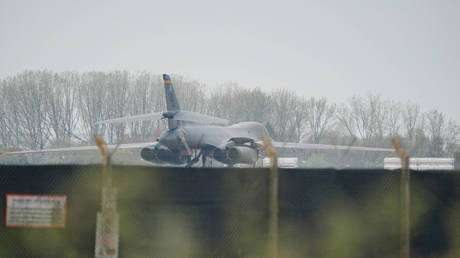
Every time an accusation of a false-flag plot hits the headlines, half the comment section treats it like a movie script and the other half treats it like settled fact. Both instincts are lazy. When Tehran points a finger at London over an airbase terror plot, the standard media reflex is simple: either declare it pure propaganda from a sanctioned regime or assume intelligence agencies are trading shadow blows in the dark.
Both takes miss the real mechanics of modern covert warfare.
I have spent years watching security teams, defense analysts, and corporate risk leads burn millions chasing ghosts because they misread how state actors actually signal intent. They read a headline about a plot at a military installation and immediately look for a smoking gun on the tarmac. Meanwhile, the actual pressure points sit in diplomatic rooms, shipping lanes, financial clearing channels, and domestic political calendars.
If you treat a false-flag accusation like a whodunit, you are asking the wrong question. The real question is not "Did London stage a plot at an airbase?" The real question is "What political, legal, or operational leverage does making—or denying—this accusation unlock right now?"
The Lazy Consensus Around False Flags
In standard reporting on state-versus-state friction, "false flag" gets tossed around like a synonym for "lie." That is sloppy. In intelligence and military doctrine, a false-flag operation means carrying out an attack or provocation while making it look like another party did it.
Historically, that requires tight operational control, plausible deniability, and a clear strategic payoff that outweighs the catastrophic risk of exposure. If an intelligence service gets caught manufacturing an attack to frame a rival, the blowback—diplomatic expulsion, loss of local assets, domestic embarrassment—can easily dwarf whatever tactical gain it chased.
Yet commentators routinely swing between two extremes whenever an airbase or military site is mentioned:
- The Dismissal Reflex: "It's Tehran talking, so ignore it completely." That misses how information operations work. Even when an accusation lacks hard public proof, the claim itself is a move on the board.
- The Conspiratorial Reflex: "Spy agencies do shady stuff all the time, so it must be true." That confuses capability with probability. Having covert tools does not mean every dramatic allegation reflects an actual plot on the ground.
Real-world strategic thinkers—from Cold War intelligence historians like Richard Betts and Robert Jervis to modern scholars of coercive diplomacy like Thomas Schelling—have long emphasized that signaling and perception drive crises just as much as physical strikes. When a government alleges a false-flag plot at a sensitive facility like an airbase, it is rarely publishing a peer-reviewed forensic report. It is shaping domestic narratives, testing adversary reactions, or setting a pretext for its own moves.
Why "Airbase" Changes the Math
Airbases are high-value, heavily guarded environments. Perimeter security, radar coverage, air defenses, and strict access controls make them harder to penetrate than soft civilian targets. Because of that friction, any claim involving an airbase carries built-in drama.
Still, drama is not evidence. A threat actor can claim a plot was thwarted, allege foreign sponsorship, or point to suspicious activity near a base without proving attribution. Attribution in covert and proxy operations is notoriously hard—even for well-funded agencies with signals intelligence and human sources. Publicly, governments almost never dump their best intelligence on the front page because doing so burns sources and methods.
That gap between what governments know, what they claim, and what the public can verify is where bad analysis thrives.
Dismantling the Usual Questions People Ask
When news breaks that Iran accuses the UK of a false-flag terror plot at an airbase, search habits follow predictable tracks. Most of those questions start from shaky premises.
"How can we tell if Iran's accusation is real or fake?"
On the day a headline drops, you usually cannot—and pretending otherwise is a parlor game. Public statements from rival capitals are instruments of statecraft first and neutral truth second.
Instead of trying to play amateur forensic analyst from thousands of miles away, look at the corroboration standard. Has an independent body verified physical damage, arrests, or munitions? Have third-party states weighed in? Has the accuser paired the claim with concrete policy shifts, such as tightening security, restricting movement, or justifying retaliatory posture? Without verifiable evidence, treat the claim as an assertion of intent or narrative, not a settled fact.
"Why would the UK risk a false-flag operation at an airbase?"
Let's test the incentives honestly. Imagine a scenario where a Western intelligence service wanted to create a crisis involving an airbase. What would the upside have to be compared to the downside?
Modern states already have plenty of overt and covert levers—sanctions, diplomatic pressure, cyber operations, maritime interdiction, regional partnerships—without inventing convoluted plots that could backfire politically at home or trigger escalatory spirals abroad. Intelligence agencies do take risks, and history includes plenty of operations that looked clever on paper and went sideways in execution. Still, assuming a high-risk plot without hard proof gives adversaries too much credit for neat master plans and too little credit for messy bureaucracy and miscalculation.
"Does this mean direct military escalation is around the corner?"
Not automatically. Accusations of plots, sabotage, and covert interference are routine features of adversarial friction. States routinely trade sharp warnings, blame rivals for internal security headaches, and frame defensive crackdowns as responses to external threats.
Escalation happens when leaders misread red lines, feel cornered domestically, or believe a strike will go unanswered. A public accusation can raise temperature without crossing into open war—and sometimes functions as a pressure valve or a warning shot meant to deter rather than ignite.
What Security Teams and Analysts Get Wrong
I have watched organizations overreact to breaking geopolitical headlines in ways that waste time and budget. A client once treated every viral security claim in a volatile region as an imminent operational crisis, pulling staff off core monitoring and burning cash on rushed travel reroutes and emergency briefings that led nowhere.
Three common mistakes keep repeating:
- Chasing Noise Over Signal: Treating every diplomatic accusation as an operational alert. If every rumor is a five-alarm fire, nothing is.
- Ignoring Domestic Incentives: Looking strictly outward at foreign capitals while ignoring internal pressures—economic strain, protest management, factional politics, or upcoming policy decisions—that make a tough external narrative useful at home.
- Confusing Narrative Warfare With Kinetic Reality: Assuming that because two countries are fighting a war of words and accusations, missiles or troops are right behind them. Information pressure and physical escalation follow different rules.
| Analytical Lens | What Lazy Coverage Does | What Sharp Analysis Checks |
|---|---|---|
| Source Motive | Takes the claim at face value or dismisses it out of hand | Maps who benefits politically, diplomatically, or domestically from the claim |
| Evidence Bar | Treats dramatic framing ("false flag," "airbase plot") as proof | Separates verified physical facts from unverified state assertions |
| Escalation Risk | Jumps straight to worst-case war scenarios | Tracks concrete posture changes, force movements, and diplomatic off-ramps |
| Resource Allocation | Panics, over-reacts, or freezes decision-making | Prioritizes exposures tied to actual operations, trade, or personnel |
Where My Contrarian Stance Can Trip You Up
Being contrarian for its own sake is just another form of laziness. If you default to "nothing ever happens" or "it's all political theater," you can get caught flat-footed when an actual covert operation or real security incident does occur.
History has plenty of surprises. States sometimes do run reckless operations. Security lapses do happen around sensitive installations. Adversaries sometimes use cover stories that sound implausible right up until evidence surfaces later.
The downside of pushing back against hype is under-reacting if real facts emerge later. The fix is simple: hold your judgment loosely. Challenge the sensational framing immediately, demand real evidence before changing high-stakes plans, and update your view fast if credible proof arrives.
How to Read Headlines Like an Insider
If you want a practical way to cut through sensational coverage whenever a false-flag accusation hits the wire, run a quick four-step filter before sharing a hot take or making a risk call:
- Strip the loaded labels first. Read the sentence without "false flag," "plot," or "shadow war." Look at what concrete event is actually alleged versus what is being inferred.
- Check the timeline. Why is this accusation surfacing now rather than last month or next quarter? Tie it to current diplomatic talks, economic pressure, or regional friction.
- Watch actions, not just adjectives. Governments spend words cheaply. Watch concrete moves—security alerts, diplomatic demarches, airspace or maritime advisories, and allied responses.
- Separate credibility of the speaker from credibility of the claim. Even actors with a heavy record of propaganda can occasionally point to a real incident, and even credible actors can spin events to suit their interests. Judge each claim on its own evidence.
Stop treating geopolitical accusations like sports scores where you have to pick a team in the first minute. Watch the incentives, wait for receipts, and keep your powder dry.