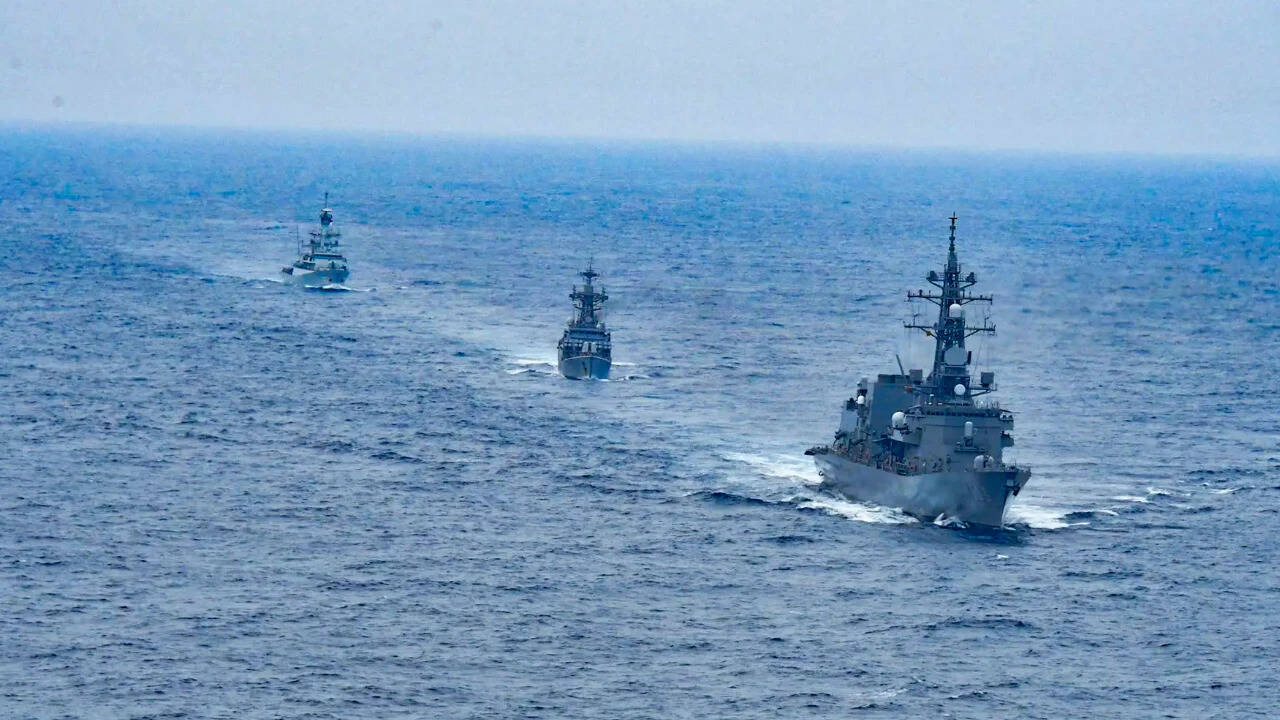
Beijing loves a predictable script. For years, the narrative from the Chinese Ministry of Foreign Affairs has remained entirely static: Washington is the chief instigator of regional instability, and any middle power cooperating with the United States is merely a compliance-driven proxy. When Tokyo expands its maritime security footprint in the South China Sea, mainstream media instantly swallows Beijing's bait, framing Japan’s actions either as an American-mandated provocation or a dangerous resurgence of mid-twentieth-century regional ambition.
Both interpretations are fundamentally lazy. They misunderstand the cold, transactional nature of modern Indo-Pacific geopolitics.
Japan is not operating as a subordinate muscle for the U.S. Seventh Fleet, nor is it seeking to out-escalate Washington. Tokyo is executing a calculated, highly independent strategy born out of deep anxiety regarding American long-term reliability. By focusing entirely on bilateral diplomatic shouting matches, analysts miss the real shift: Japan is quietly building an autonomous network of secondary security partnerships designed to function regardless of who occupies the White House or how distracted the United States becomes by other global conflicts.
The Proxy Myth and the Fallacy of the Compliant Ally
The mainstream foreign policy consensus views the Indo-Pacific through a rigid, bipolar lens. In this view, every naval transit, joint exercise, or defense transfer involves a direct command from Washington or a direct reaction from Beijing. When China labels Japan's naval role in the South China Sea as "more destructive than the US," it is a deliberate rhetorical tactic designed to isolate Tokyo from its Southeast Asian neighbors.
The Western press routinely mirrors this framing by treating Japan’s revised national security strategies as a triumph for American diplomacy. This is a severe misreading of Tokyo’s internal political drivers.
I have spent years analyzing regional security frameworks and talking to defense planners who see the stark reality behind the official communiqués. They know that relying exclusively on a single superpower is a structural vulnerability. Japan’s defense modernization—including its acquisition of counterstrike capabilities and its maritime deployments southward—is driven not by a desire to please Washington, but by the terrifying realization that American commitment is finite.
Consider the structural vulnerabilities of the U.S.-Japan alliance. The traditional bargain relied on Japan providing bases while the U.S. provided the regional shield. Today, that shield is stretched across Eastern Europe, the Middle East, and domestic political polarization. Tokyo looks at Washington and does not see an infallible hegemon; it sees an unpredictable partner prone to sudden shifts in strategic focus.
The South China Sea Is Japan’s Economic Choke Point
To understand why Japan is forcing its way into the South China Sea, look at a map of global trade, not a military playbook.
[Persian Gulf / Africa] ---> [Malacca Strait] ---> [South China Sea] ---> [To Tokyo / Yokohama]
                                                         |
                                             (90% of Japan's Energy Supplies)
Japan imports roughly 90% of its energy resources. The vast majority of these crude oil and liquefied natural gas (LNG) shipments pass directly through the South China Sea. If that maritime space becomes a closed domestic lake controlled by a single non-aligned power, Japan’s economic sovereignty evaporates overnight.
While the United States views the South China Sea primarily as a theater for global power projection and the defense of abstract international norms like "freedom of navigation," Japan views it as a literal windpipe. If the U.S. Navy pulls back or becomes compromised elsewhere, Japan cannot simply retreat to its home waters. It must have established, functional security relationships along that entire trade corridor to ensure its own survival.
Constructing the Middle-Power Coalition
Tokyo’s real genius over the past decade has been its pivot toward minilateralism—small, flexible groupings of states that bypass the sluggish architecture of traditional treaties. While Washington tries to build grand, sweeping coalitions that demand explicit alignment against Beijing, Japan takes a highly pragmatic, material approach.
Instead of demanding that Southeast Asian nations choose between major powers, Tokyo offers tangible capacity building. This is not about signing grand ideological declarations; it is about transferring hardware and institutional knowledge.
- The Philippines: Japan has supplied the Philippine Coast Guard with multi-mission response vessels, maritime radar systems, and is finalizing Reciprocal Access Agreements (RAA) to allow forces to train on each other's soil.
- Vietnam: Tokyo has consistently provided patrol boats and maritime security training to Hanoi, reinforcing Vietnam's capacity to police its own Exclusive Economic Zone (EEZ) without needing an explicit U.S. military footprint.
- Australia: The landmark Japan-Australia RAA effectively creates a secondary security axis in the Western Pacific that can operate independently of American command structures if circumstances dictate.
Imagine a scenario where a future U.S. administration decides to pursue an isolationist foreign policy, drawing down its naval presence in Yokohama and Sasebo to focus entirely on domestic economic protectionism. In that environment, a traditional ally relying solely on bilateral promises faces immediate crisis. Japan's current strategy ensures that even if the American pillar weakens, a resilient, interconnected web of middle powers remains active in the maritime domain.
The Risks of Strategic Autonomy
This contrarian approach is not without severe strategic downsides. By stepping out from behind the American shadow and establishing its own security footprint in the South China Sea, Japan deliberately exposes itself to direct diplomatic, economic, and military retaliation from Beijing.
+----------------------------------------+----------------------------------------+
| Advantages of Japan's Strategy         | Strategic Downsides & Risks            |
+----------------------------------------+----------------------------------------+
| Reduces absolute dependence on the U.S.| Escalates direct gray-zone friction    |
| Creates a resilient middle-power web   | Exposes corporate Japan to boycotts    |
| Secures critical energy supply lines   | Strains domestic pacifist consensus     |
+----------------------------------------+----------------------------------------+
Chinese gray-zone tactics around the Senkaku Islands consistently intensify whenever Tokyo takes a firm stand in the South China Sea. Furthermore, corporate Japan remains deeply entangled with the Chinese market, meaning every bold geopolitical move by the Prime Minister's office invites quiet, devastating regulatory retaliation against Japanese firms operating inside China. Tokyo knows this cost intimately, yet it chooses to pay it because the alternative—complete strategic blindness if Washington falters—is entirely unacceptable.
Dismantling Flawed Premises
When tracking public discourse on Indo-Pacific security, the questions being asked by conventional analysts are fundamentally broken.
Why doesn't Japan let the U.S. handle the South China Sea?
This question assumes the U.S. has infinite capacity and an unchanging political will. It ignores the reality of American war weariness and the shifting balance of naval power in the Western Pacific. Japan cannot afford to outsource 100% of its existential security to a country undergoing deep internal political redefinition every four years.
Is Japan trying to return to its pre-1945 military posture?
This is a lazy historical shortcut used by regional propagandists to evoke emotional reactions. Modern Japan faces an aging population, a constrained defense budget relative to its GDP, and a deeply ingrained domestic norm of defensive restraint. Tokyo's current naval strategy is not an expansionist crusade; it is a desperate insurance policy against regional isolation.
Stop Reading the Script
The conventional analysis will continue to produce endless variations of the same tired story: Washington pulls the strings, Tokyo complies, and Beijing reacts with righteous indignation. This framing is comforting because it requires no intellectual heavy lifting and fits neatly into old Cold War mental models.
The reality is far more complex and far more precarious. Japan is playing a high-stakes, independent diplomatic and military game. It is quietly preparing for a multi-polar Indo-Pacific where the American security guarantee is no longer absolute, leveraging practical partnerships to secure its vital trade arteries before the window of opportunity slams shut.